Emomali Rahmon: “Independence, Peace and Unity Are the Most Sacred Blessing and the Greatest Achievement of Our People”
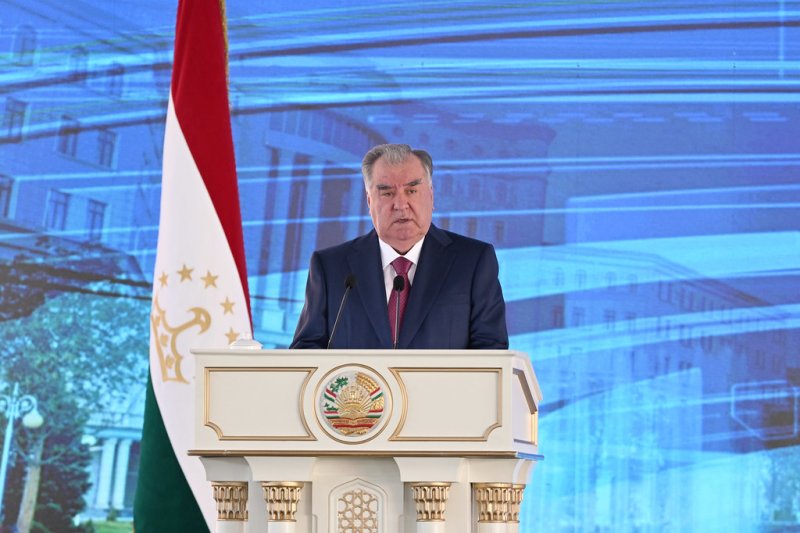
Address by the President of the Republic of Tajikistan, Leader of the Nation, H.E. Emomali Rahmon, on the occasion of the Day of Knowledge and the Lesson of Peace, delivered at Secondary School No. 105 in the city of Dushanbe
Dear compatriots!
Esteemed workers of the education sector!
Distinguished students, undergraduates and teachers!
These days we stand on the threshold of the celebration of a great national festival — the 35th anniversary of the state independence of our beloved Tajikistan.
I therefore sincerely congratulate all of you on this great historic occasion, as well as on the beginning of the new academic year and the Day of Knowledge.
I also congratulate the children who this year, with joy and delight, are setting foot in school for the first time, and I wish them health and happiness.
I would like to recall that it is precisely thanks to our independence and to the complete peace and stability of our country that we are carrying out immense work to create the best conditions for education and to raise the level and quality of the teaching and upbringing of children, adolescents and young people.
The inauguration of the new, modern building of Secondary School No. 105, in which you and I are now present, is a fruit of state independence and of the calm and peaceful atmosphere of our country.
This institution has been built by the executive authority of the city of Dushanbe to a modern design, and is equipped with the best conditions and facilities for the education and upbringing of 2,400 students.
It should be recalled that over the past nine years, 55 new educational institutions with more than 95,000 places, and 42 modern kindergartens for 8,000 children, have been built and brought into use within the city of Dushanbe.
In the current year alone, in honour of the 35th anniversary of state independence, seven new educational institutions with 10,000 places and eight new modern preschool institutions for 1,000 children will begin operating in the capital of the country.
In total, during the years of independence, 4,135 educational institution buildings with one million 800,000 places have been constructed and commissioned in the country at a cost of 8.4 billion somoni.
A most welcome phenomenon of the period of our country’s independence is that in the honourable work of building new educational institutions equipped with modern facilities, the noble people of Tajikistan, including our honourable entrepreneurs, have established effective cooperation with the Government of the country, and we are grateful to them for their patriotic generosity.
Distinguished participants!
All our achievements in the prosperity and progress of our beloved Homeland, including in the sphere of education — which is regarded as the builder of the future of the nation and the state — are precisely the fruit of state independence, complete political peace and stability, and enduring national unity.
For this reason, for us — the people of Tajikistan — peace and unity are considered the most important factor in the endurance of the state and the nation.
Therefore, appreciating the value of peace and stability, strengthening national unity, and educating young people in a spirit of patriotism and humanism is the sacred duty of every conscious and right-thinking citizen of the country.
The adoption in June of this year of the United Nations resolution on the “Decade for the Strengthening of Peace for the Sake of Future Generations”, which was put forward at the initiative of Tajikistan, is likewise a sign of our country’s consistent efforts to safeguard peace and tranquillity on the planet.
With satisfaction and pride I wish to state that the labour of the teachers and the education community of the country in strengthening state independence, promoting the ideas of national statehood, guiding the people towards the consolidation of peace and unity, and providing a worthy education and upbringing to the generation of the era of independence, is highly visible and deserving of praise and appreciation.
In an exceptionally complex and turbulent period in the history of the Tajik state, the education community once again proved that reason and wisdom, science and knowledge, patience and tolerance, and striving for peace and stability play the principal role in deliverance from every kind of crisis, and light and smooth the road to a prosperous future.
I have said many times, and I emphasise once again, that independence and freedom, peace and tranquillity are the most sacred blessing and the greatest achievement of our people, a source of pride and of the honour of patriotism, a symbol of the existence of the nation, and a condition of the happiness and dignity of all the inhabitants of Tajikistan.
State independence preserved the existence of the Tajik people across the expanse of the world, restored historical justice, and introduced the Tajiks to the world as a cultured, civilisation-building, tolerant and peace-seeking nation.
Distinguished participants!
Since ancient times our nation has regarded knowledge, enlightenment and the book as the lamp of life, the foundation of statehood and the source of the progress of society.
Over the course of millennia, the learned sons and daughters of the Tajik nation have made a valuable contribution to the development of human civilisation through the power of wisdom and knowledge.
Possessing learning and knowledge has acquired particular importance in our own time, which is regarded as a stage of unprecedented development and advancement of technology and of the spread of artificial intelligence.
Under such conditions, not only natural resources but knowledgeable people, enlightened youth and highly qualified personnel are considered the principal wealth of states.
It is therefore very important that our rising generation should pay constant attention to the acquisition of learning and knowledge, should study regularly, and on that basis should engage in creativity and innovation.
For this purpose, all the necessary conditions and opportunities have today been created in our country.
The Government of Tajikistan has identified the sphere of science and education as one of the priority directions of state policy.
For we understand well that investment in the education and upbringing of children and adolescents is investment in the future of the nation and the state.
Accordingly, during the period of independence more than 70 billion somoni has been allocated to the education sector from the state budget, and 10 billion somoni through state investment projects; these figures are clear evidence of the special and constant attention devoted to the sphere of education.
Esteemed participants!
It is known that the first stage of children’s introduction to education and upbringing is connected with preschool institutions.
That is to say, the education and upbringing of children in preschool institutions is the most important stage for their future.
In this connection, several years ago I instructed the relevant structures and bodies to take measures to build a kindergarten in every locality with a population of more than one hundred people.
This is a very important matter, and in this direction we must accomplish still more.
By resolution of the Government of the country, the Programme for the Development of Preschool Institutions and Private General Education for the years 2022–2027 has been approved, which is considered a firm step towards increasing the opportunities for the enrolment of children.
I therefore once again remind the heads of regions, cities and districts, the Ministry of Education and Science, and other relevant bodies to devote greater attention to the issue of building preschool institutions.
They must mobilise the available opportunities for the full implementation of the requirements of the National Strategy for the Development of Education for the period to 2030 and of the aforementioned programme, and for raising preschool enrolment of children to 50 per cent.
In addition, the necessary measures must be taken to provide preschool institutions with highly qualified personnel who meet the requirements of the times.
It must be borne in mind that the higher the standard and quality of upbringing in kindergartens, the more productive our children’s continued schooling in general secondary education institutions will be.
In my meetings with the education community and in my other addresses, I have repeatedly stated that the quality of teaching and upbringing in general secondary and higher professional education institutions requires further improvement.
It must be said that in recent years a number of notable achievements have been made at the level of general secondary education.
These include the introduction of unified criteria for determining the quality of education, the provision of newly built educational institutions with teaching staff, the strengthened use of digital technologies, and the step-by-step raising of the level of students’ knowledge, all of which continue apace.
We must keep pace with the times, organise the study and use of modern technologies at a high level, and always bear in mind that only on the basis of an active, inclusive and progressive education system can we find a worthy place in the modern world.
For the continuous raising of the quality of education, attention to fundamental issues is very important — including the improvement of teachers’ professional skills, the introduction of advanced and effective methods of upbringing, the preparation and publication of teaching manuals and new-generation textbooks, and the equipping of classrooms and laboratories with modern technology.
The organised conduct of refresher and retraining courses for teachers is likewise among the necessary tasks.
On 1 September 2024, during a visit to education facilities in the city of Dushanbe and my participation in the Day of Knowledge, I emphasised that appropriate measures must be taken to fully provide general education institutions, within two years, with textbooks, supplementary educational and scientific literature, methodological manuals, teachers’ guides and teaching methods for every subject.
Analyses show that a number of measures have been implemented in relation to this instruction.
In particular, from the beginning of 2025 to the present, 9 million 215,000 copies of textbooks and teaching materials have been delivered to the education departments and divisions of cities and districts and to other educational institutions, and this process is continuing steadily.
For the provision of educational institutions with textbooks and other teaching materials in the 2026–2027 academic year, 40 titles of textbooks have passed the competitive selection process; their publication is being completed in stages and they are being made available to students of educational institutions.
That is to say, today no problem of a shortage of textbooks is observed in educational institutions.
It is now necessary that we devote greater attention to the quality of textbooks and to bringing them into line with world standards.
The Ministry of Education and Science is therefore instructed to take continuous measures to further improve the quality and content of new-generation textbooks.
I would now like to emphasise another important matter.
The introduction of any system, approach or international practice into the teaching process must first be comprehensively tested on an experimental basis in educational institutions, adapted to the conditions and strategic objectives of the development of education in Tajikistan and to national values, and only thereafter put into use.
In this connection, we must above all pay serious attention to the development of scientific and research work in the field of pedagogical and psychological sciences, and to attracting scholars and teachers who have advanced experience in this field.
To this end, it is necessary to strengthen the scientific and research activity of the Academy of Education, the Institute for the Development of Education and the higher education institutions with a pedagogical orientation, in the direction of developing and proposing innovative methods and technologies for the teaching of subjects — in the first instance the natural sciences and mathematics — drawing on advanced world experience.
In this process, the Republican Institute for Professional Development and Retraining of Education Workers must devote greater attention to putting teachers of natural sciences and mathematics through refresher courses and to conducting practical and laboratory classes.
To date we have accomplished a great deal in the field of digitalisation and the development of information technologies.
There is now a need for the culture of using the internet, mobile telephones, artificial intelligence and, in particular, social networks to be explained correctly and regularly among the various strata of the population, especially young people and adolescents.
For the harm or benefit of new technologies depends on how we use them.
Observations show that in recent years the uncontrolled use of smartphones and social networks among students of general secondary education institutions has become a matter of concern.
Independent experts and analysts of authoritative international organisations have likewise repeatedly emphasised in their reports that smartphones and social networks distract students’ attention and disrupt their studies.
A number of developed states have already banned, in various forms, the use of telephones by students under the age of 16.
It must be said that all information has an age-appropriate character.
Yet on social networks this norm is not observed at all, and for this reason a large proportion of children and adolescents have already come under the negative influence of such information.
The excessive and uncontrolled use of smartphones and social networks has caused serious harm to their mental health, sleep, speech, memory, capacity to acquire literacy and knowledge, activity and physical development.
Instead of reading books, developing their skills or engaging in sport, students spend many hours in the virtual space of social networks.
It must not be forgotten that children and adolescents are the future of the nation, and we cannot remain indifferent to the question of their health — that is, to the future of the nation.
Taking this into account, the Ministry of Education and Science, the Agency for Innovation and Digital Technologies, and the Committee for Primary and Secondary Vocational Education are instructed to comprehensively analyse and examine this issue within three months and to submit proposals to the Government of the country on ways of resolving it.
In conditions of rapid digitalisation, the continuous development of communication technologies and the growth in the number of social networks and electronic news media, young people must possess a high information culture.
They must use social networks consciously, be able to resist malicious information and false news — particularly extremist ideas — use the internet for learning and the acquisition of knowledge, devote their time to reading books, and contribute to ensuring the information and ideological security of society.
Given this reality, ways must be found to strengthen the information immunity of adolescents and young people against contemporary threats and dangers, and to raise their information culture.
Distinguished participants!
For the support of graduates of general secondary education institutions and the training of highly qualified national personnel, we have established a number of privileges.
One of these, which has been in operation for almost thirty years — that is, since 1997 — is the admission of students to the country’s higher professional education institutions under the presidential quota.
The principal aim of the presidential quota is to support and attract girls and boys from the remote rural areas of cities and districts, and to provide such regions with highly qualified specialists.
During this period, 29,000 graduates of general secondary education institutions from 61 cities and districts have been enrolled in 20 higher professional education institutions of the country under the presidential quota, and today they are working successfully in various fields.
It is worth noting that in recent years the development of primary and secondary vocational education has become one of the important directions of the state’s social and economic policy.
For the advancement of industry, energy, construction, modern agriculture, transport, tourism, services, digital technologies and other branches of the national economy is impossible without skilled and qualified personnel.
Taking account of this necessity, and with the aim of forming a modern system of vocational training, the Committee for Primary and Secondary Vocational Education under the Government of Tajikistan was established.
The creation of this structure has made it possible for primary and secondary vocational education to develop as an independent state system with a unified policy, modern standards, coordination mechanisms, a direct link with the labour market and cooperation with production enterprises.
During this period the number of trades and specialities at the levels of primary and secondary vocational education has been increased from 230 to 730.
In particular, at the level of primary vocational education, workers and specialists are today trained in 14 fields and 330 trades and specialities, and at the level of secondary vocational education in 10 fields and 400 specialities.
Such indicators testify that the system of primary and secondary vocational education is gradually adapting to the requirements of the labour market and preparing the necessary personnel for the real sectors of the national economy.
At present, 66 primary vocational education institutions are operating in the country, in which more than 28,000 students, including almost 8,000 girls, are studying.
The number of students in secondary vocational education institutions has reached 106,500, an increase of 13,000 compared with the 2020–2021 academic year and of 9,000 compared with the previous academic year.
The adoption of the “Programme for the Development of Primary and Secondary Vocational Education of the Republic of Tajikistan for 2026–2029” marks the beginning of a new stage of reform in the sector.
Under the implementation plan of this programme, the repair and reconstruction of the buildings of 61 educational institutions — 43 primary vocational and 18 secondary vocational institutions — is envisaged for 2026–2029.
At the same time, it must be said that unresolved issues still remain in the sector.
These include raising the quality of practical training, the full equipping of workshops and laboratories, the provision of institutions with specialised textbooks, the recruitment of experienced teachers and master craftsmen, the strengthening of links with production enterprises, and the provision of employment for graduates — the principal tasks of the next stage.
In this connection, the Committee for Primary and Secondary Vocational Education is instructed to take additional measures to resolve the outstanding issues.
At the same time, I emphasise to parents, teachers, heads of educational institutions, executive state authorities and employers that attracting young people to the acquisition of trades and skills must be turned into daily work and a nationwide task.
Every person must understand that to possess a trade and a skill is to possess priceless wealth.
A person with a profession finds his own path in life, becomes independent, helps his family, brings benefit to society and contributes to the progress of the state.
I therefore call upon our dear young people to value their time, to master learning, knowledge and modern trades and skills, to study foreign languages, the use of modern technologies and artificial intelligence at a high level, and to prepare themselves for a worthy life and for the prosperous future of Tajikistan.
A nation whose young people acquire knowledge, master trades and skills, respect national values and bind their existence to the destiny of the Homeland takes confident steps on the road of progress, creation and the durability of its state.
A state becomes strong when its young people possess learning and knowledge, trades and skills, competence and ability, good manners and morals, and a high sense of patriotism.
Distinguished participants!
The country’s higher education institutions have a worthy role in the advancement of the education sector and in the expansion and strengthening of the level and quality of teaching and upbringing.
Over the years of independence the number of institutes and universities in the country has increased manifold and has now reached 51, and several of our higher education institutions have acquired international status.
The material and technical base and the conditions and facilities of higher education institutions are being steadily improved.
At the same time, certain difficulties still exist in the country’s institutes and universities in the areas of the quality of education, provision of experienced teaching staff holding academic titles, the preparation of textbooks, the activity of technology parks, the professional development of instructors and the establishment of modern laboratories, which must be eliminated.
In this process, I would like to draw your attention to one important matter.
According to the available information, in the majority of faculties of higher professional education institutions students in the first two years are occupied mainly with the study of non-specialist subjects, and most specialist subjects are taught to them chiefly from the third year, which causes a decline in students’ interest in the profession and speciality they have chosen.
The Ministry of Education and Science and the higher professional education institutions are therefore instructed to examine this matter comprehensively within the next three months and to submit their proposals to the Government of the country.
In this connection I emphasise once again that what we need, above all, is a specialist — not a young person who merely holds a diploma.
Another matter that has become very important in present-day conditions is the choice of a future profession by young people.
A person must not make a mistake in choosing a profession; otherwise he will remain adrift and confused for the rest of his life and will be unable to realise his aspirations.
Analyses and observations show that in our society a tendency towards outward appearance, imitation of others, and inappropriate and illogical choices exists in the selection of a profession.
The majority of young people wish to become either doctors or lawyers.
That is to say, in most cases the choice of profession is made not on the basis of ability and talent, but according to whim and fashion.
In the developed countries of the world, special attention is given from the preschool stage, and subsequently at the level of primary education, to the identification of the abilities, talents and aptitudes of adolescents, so that at the subsequent stages of education investment can be made in their development and the progress of adolescents and young people can be directed along the right path.
We know well that all parents wish their children to choose the right path and to be happy in the future.
But at times they do not know how to accomplish this.
Especially if the realities of the times are not taken into account.
For example, today specialists in the fields of computer security, information technologies, artificial intelligence, programming and the like are in great demand on the labour market.
The Ministry of Education and Science, the Committee for Primary and Secondary Vocational Education, the National Academy of Sciences and the Academy of Education are therefore instructed to submit proposals to the Government of the country within three months on the formation of a culture of career choice and on mechanisms for determining the abilities and professional aptitudes of children and adolescents.
At the same time, we must devote special attention to the upbringing of adolescents and young people.
For worthy conduct and speech are an expression of a person’s level of upbringing and moral character.
Every person acquires respect and standing in society, above all, thanks to good qualities and praiseworthy morals and manners.
Moral upbringing must therefore begin in the family and continue without interruption in educational institutions.
It is chiefly those who have been deprived of the upbringing of their parents, who have been negligent in their studies, who possess no trade or skill and who have no definite aim in life, who turn to offences and crime.
Parents are obliged to create a healthy environment in the family for the upbringing and maturation of their children.
Teachers are obliged to cultivate in the heart of every student respect for the Homeland, the law, parents, national values and praiseworthy human morals.
I emphasise that in the extremely important, future-shaping work of teaching and upbringing, teachers of course bear still greater responsibility, for they are regarded as the powerful force of education.
Likewise, raising the quality of teaching and bringing to maturity personnel who meet the requirements of an age of progress depends, in the first instance, on instructors and teachers — that is, on the education community.
They must always remember that the treatment of the sick — that is, the health of the people; the construction of all manner of facilities — that is, the prosperity of the Homeland; the securing of the social and economic development of the state — that is, a worthy life for every family in the country; and in general all spheres of the life of society and the state, depend on the work of specialists whom the education sector brings to maturity.
Distinguished participants!
We are living in an exceptionally complex, crisis-ridden, turbulent and perilous stage of the modern world.
In recent years certain norms and principles of international relations, which for decades were recognised as the foundation of stability and peaceful coexistence, have gradually been losing their significance.
As a result of wars and conflicts, thousands of people are perishing, millions are being deprived of their homes, and the danger of pervasive instability threatens international security.
In such a situation it is exceedingly necessary for all of us, above all, to be tolerant, to act with deliberation and composure, and to strive to protect our national interests.
Always and in all circumstances we must strive to protect peace and stability, national unity, the achievements of state independence, and tranquillity and calm in our beloved Homeland, and we must strive continuously to give still greater scope to the process of creation and construction in our country.
Our greatest aim is to secure the prosperity and progress of the Homeland and the state, today and tomorrow, and a worthy life for the people.
In pursuing and realising this noble aim, all the inhabitants of the country must act in unison.
Each of us must be a guardian and defender of independence and freedom, of peace and unity, of language, history and culture, and of the other material and spiritual values of the ancient Tajik nation.
I am satisfied and proud that the education community of the country, our instructors and teachers, and our students and undergraduates are always in the front ranks of the defence of national interests, and that this position of theirs is firm and enduring.
I am confident that our knowledgeable and enlightened, skilled and capable, patriotic and creative young people will tomorrow become the driving force of the national economy, the firm foundation of an advanced society, and the guarantee of the continuation of the creative path of independent Tajikistan.
Expressing confidence in the still more prosperous and advanced future of our beloved Tajikistan, I once again sincerely congratulate the education community, instructors and teachers, undergraduates and students, and all of you — the distinguished participants — on the sacred and great celebration of the 35th anniversary of state independence, on the beginning of the new academic year and on the Day of Knowledge.
I wish all of you — the distinguished participants and the entire people of Tajikistan — health and happiness, prosperous homes and ever-growing successes.
May the independence of our beloved Tajikistan be enduring and inviolable!