Oman Reaffirms Support for Palestinian Statehood, Calls for Sustainable Economic Recovery
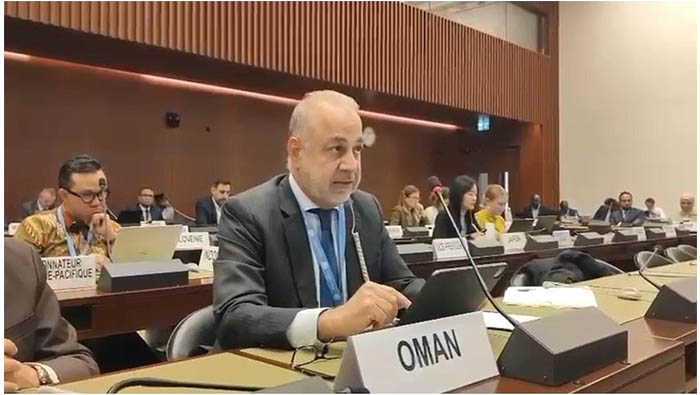
Geneva, The Gulf Observer: The Sultanate of Oman has reaffirmed its firm support for the right of the Palestinian people to self-determination and the establishment of an independent and sovereign Palestinian state along the borders of June 4, 1967, with East Jerusalem as its capital, in accordance with international law and relevant United Nations resolutions.
Oman stressed that supporting the Palestinian economy should not be viewed merely as a response to the current crisis, but as an investment in peace, stability and the future of the entire region.
The statement was delivered by Idris Abdulrahman Al Khanjari, Permanent Representative of Oman to the United Nations and International Organisations in Geneva, during the 73rd session of the Trade and Development Board of the United Nations Conference on Trade and Development (UNCTAD), under Agenda Item 6 concerning the report on UNCTAD assistance to the Palestinian people.
Al Khanjari expressed Oman’s support for the statement delivered by the delegation of the State of Palestine on behalf of the Arab Group, as well as statements delivered by the Group of 77 and China and the Asia-Pacific Group.
Referring to the UNCTAD report, he said the figures presented clearly demonstrated the scale of the economic and humanitarian crisis confronting the Palestinian people, particularly in the Gaza Strip, where nearly 92 percent of economic establishments have reportedly been destroyed or damaged. Recovery and reconstruction needs are estimated at approximately $16.2 billion.
He emphasised that these figures represent more than economic indicators, as they reflect the destruction of businesses, employment opportunities, sources of income and livelihoods that are essential for ensuring a dignified life and establishing a sustainable developmental future for the Palestinian people.
Al Khanjari said the UNCTAD report showed that the Palestinian economy is facing a deep and unprecedented crisis, which has intensified sharply since October 2023. Restrictions imposed on the Palestinian economy have weakened its capacity for production, trade and investment and eroded the foundations required for sustainable economic growth.
He stressed that reconstruction should not be regarded solely as a process of rebuilding physical infrastructure. Rather, it should constitute an integrated humanitarian and developmental undertaking focused on protecting the Palestinian population and safeguarding their right to a dignified life, particularly amid the severe deterioration in food security and livelihoods.
The Omani representative further stated that addressing the economic crisis in Palestine requires more than dealing with its immediate consequences. Its underlying structural causes must also be addressed, including the continuation of the Israeli occupation, control over resources, restrictions on the movement of people and goods, disruption of economic and commercial activities, and the weakening of the foundations of production and development.
Such conditions, he noted, hinder the Palestinian people’s ability to establish a sustainable and self-reliant economy.
Al Khanjari underscored that recovery and reconstruction require a comprehensive and sustainable international response that extends beyond emergency assistance. Such efforts should include rebuilding infrastructure, restoring productive capacities, supporting the private sector and small and medium-sized enterprises, revitalising commercial activity, strengthening the resilience of the Palestinian economy and creating conditions conducive to long-term recovery and growth.
He also highlighted Oman’s appreciation of UNCTAD’s continued role in providing objective economic analysis, technical assistance and capacity-building for Palestinian institutions. He said these efforts complement the broader work of the United Nations system and the international community and contribute to strengthening Palestinian institutional and economic capacity to address current challenges and prepare for recovery and reconstruction.
Al Khanjari stressed that reconstruction and sustainable development cannot be separated from the achievement of a just and lasting peace. Economic and developmental empowerment of the Palestinian people, he added, requires addressing the underlying factors that obstruct their ability to achieve sustainable development.
The Permanent Representative concluded by thanking the UNCTAD Secretariat for its report on assistance to the Palestinian people and for its continued efforts to monitor economic developments, provide technical assistance, build capacities and strengthen the resilience of the Palestinian economy.