Aliyev, Rinkēvičs Issue Joint Press Statements, Reaffirm Azerbaijan–Latvia Strategic Partnership
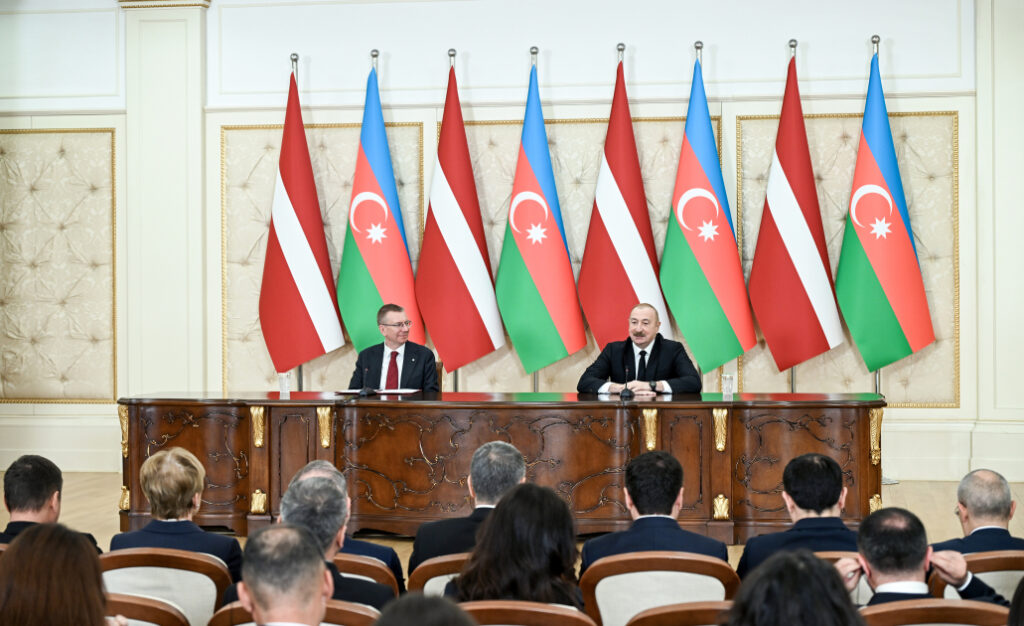
Baku, The Gulf Observer: President of Azerbaijan Ilham Aliyev and President of Latvia Edgars Rinkēvičs on April 22 delivered joint press statements, reaffirming their commitment to strengthening bilateral relations and expanding cooperation across multiple sectors.
Speaking first, President Ilham Aliyev welcomed his Latvian counterpart on his first official visit to Azerbaijan as head of state, expressing confidence that the visit would further deepen ties and unlock new avenues of cooperation. He noted that discussions were held both in one-on-one and delegation-level formats, covering a broad range of bilateral and international issues.
President Aliyev highlighted that the Declaration on Strategic Partnership signed between the two countries nine years ago continues to serve as a solid legal and political framework guiding cooperation. He also pointed to the recent meeting of the Joint Intergovernmental Commission in Shusha, which outlined promising plans for future collaboration.
Emphasizing economic engagement, the Azerbaijani leader described the ongoing business forum in Baku as a key platform for fostering mutual investments, joint manufacturing initiatives, and practical commercial partnerships. He acknowledged that bilateral trade remains modest but expressed optimism that enhanced business-to-business interaction would drive significant growth.
The two sides also discussed improving connectivity, including the potential launch of direct flights, which could further facilitate trade, tourism, and people-to-people exchanges. President Aliyev noted the growing educational ties, highlighting that over 450 Azerbaijani students are currently studying in Latvia.
On regional matters, President Aliyev briefed his counterpart on recent developments in the peace process between Azerbaijan and Armenia, describing the situation as “very promising.” He noted that since the signing of a joint declaration and the initialing of a peace agreement text last year, there have been positive developments, including trade exchanges and increased civil society engagement between the two countries.
President Edgars Rinkēvičs, in his remarks, expressed gratitude for the warm hospitality extended by Azerbaijan and described the talks as constructive, pragmatic, and forward-looking. He reaffirmed Latvia’s commitment to the strategic partnership established in 2017 and emphasized the importance of translating discussions into tangible outcomes.
Highlighting economic cooperation, President Rinkēvičs agreed that trade volumes should be increased and identified sectors such as defence industry, transportation, and pharmaceuticals as areas of strong potential. He also noted Latvia’s expertise in forestry, offering cooperation in Azerbaijan’s environmental and reconstruction initiatives, particularly in the Garabagh region.
The Latvian President welcomed the progress in the Azerbaijan-Armenia peace process and expressed support for the swift conclusion of a comprehensive peace agreement, underscoring its importance for regional and global stability.
He also emphasized Latvia’s support for strengthening Azerbaijan’s engagement with the European Union, particularly in areas such as visa liberalization, connectivity, and transportation, which would enhance mobility and people-to-people contacts.
Both leaders acknowledged Azerbaijan’s strategic role in energy security and the Trans-Caspian Transport Corridor, highlighting its growing importance for Europe. President Rinkēvičs also praised Azerbaijan’s humanitarian assistance efforts and expressed solidarity regarding recent security challenges.
The discussions further covered regional and global developments, including issues related to Ukraine, Iran, and the broader Middle East, with both sides underscoring the importance of dialogue, stability, and multilateral cooperation.
Concluding his remarks, President Rinkēvičs extended an invitation to President Aliyev to visit Riga, noting that high-level exchanges continue to play a vital role in strengthening bilateral ties.
The joint statements reflected a shared commitment by both nations to deepen political dialogue, expand economic cooperation, and strengthen strategic engagement in addressing regional and international challenges.