Ramaphosa Calls for Greater Investment in Teachers and Improved Support for Educators
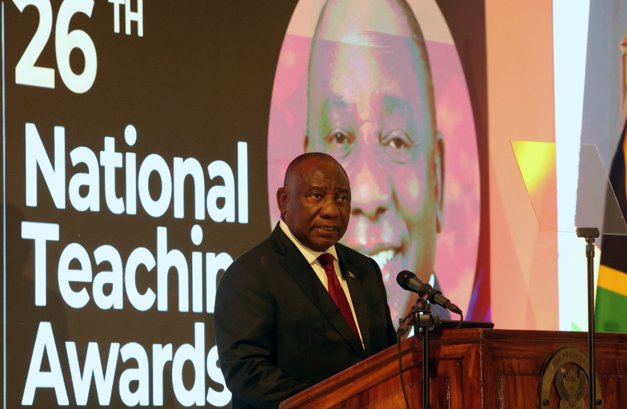
Johannesburg, The Gulf Observer: South African President Cyril Ramaphosa has called for greater investment in teachers and stronger support for educators, saying improved educational outcomes depend on creating conditions that enable teachers to focus on teaching and learning.
Addressing the 26th National Teaching Awards at the Birchwood Hotel and Conference Centre in Ekurhuleni on Thursday, Ramaphosa said teachers were central to transforming South Africa’s education system and contributing to the country’s development.
“If we want better educational outcomes, we must invest in better teaching,” the President said, calling for efforts to attract talented young people to the teaching profession, support new teachers entering classrooms and enable experienced educators to continue developing their skills.
Ramaphosa said teaching should regain its position as one of the most respected professions in society. He called on the government to provide safe and appropriate school infrastructure, reduce unnecessary administrative burdens, strengthen professional development and ensure teachers receive adequate support throughout their careers.
He also identified overcrowding, protecting teaching time and addressing violence, intimidation and disruptions in schools as issues requiring continued attention.
Teachers Can Change Lives
Reflecting on his own education, Ramaphosa recalled the influence of his former school principal, Mr Ntsandeni, whom he credited with playing a significant role in shaping his life.
The President said he had been an inquisitive learner who frequently challenged teachers because he wanted to understand what he was being taught. While some teachers believed he should be expelled, Ntsandeni intervened and protected him from being removed from school.
Ramaphosa said his former principal understood that curiosity should be guided and encouraged rather than punished.
“He gave me the opportunity to continue learning, to develop and to become the person I am today,” he said.
The President said he would have liked to present Ntsandeni with a National Teaching Award had he still been alive, describing his former principal’s actions as an example of the essence of teaching — recognising the potential of young people and giving them opportunities to develop.
Focus on Learning Outcomes
Ramaphosa said the ultimate purpose of educational excellence was to improve the life chances of every learner, identifying foundational literacy and numeracy as key national priorities.
He warned that children who fail to develop reading comprehension skills during their early years face greater challenges throughout their education.
He called on teachers, principals, education districts and departments to maintain a strong focus on improving learning outcomes and encouraged the education system to ensure that effective practices are shared among schools and across provinces.
Technology Cannot Replace Teachers
The President also addressed the growing impact of artificial intelligence and other digital technologies on education, noting that technological advances presented both opportunities and challenges.
He said technology could provide teachers with new educational resources, assist with lesson preparation and support learners with different needs.
At the same time, learners must be equipped to distinguish reliable knowledge from misinformation, think independently and use technology responsibly, safely and ethically.
“Artificial intelligence may be able to provide an answer, but a teacher helps a learner understand the question,” Ramaphosa said, stressing that technology could not replace the encouragement, discipline, empathy and human connection provided by teachers.
Call for Safer Schools
Ramaphosa also called on educators and the wider education community to contribute to efforts to address gender-based violence and femicide (GBVF).
He said schools should have no tolerance for sexual harassment, abuse or exploitation involving teachers, staff members or learners.
According to the President, education should help young people understand respect, dignity, equality and consent, while equipping them with skills to resolve conflicts peacefully and develop healthy relationships.
He called for stronger, age-appropriate life-skills education from early childhood development through high school, supported by teachers, parents, religious and traditional leaders, relatives and community elders.
Educators Honoured for Excellence
The National Teaching Awards were launched in 2000 by the late Education Minister Professor Kader Asmal to recognise and celebrate excellence in teaching.
Ramaphosa said it was fitting that educators who had dedicated decades to developing South Africa’s children and communities were being recognised through the Kader Asmal Lifetime Achievement Award.
More than 133 teachers participated in the national adjudication process in Gauteng earlier this month, with finalists recognised across various categories, including Excellence in Grade R Teaching and Excellence in Teaching Mathematics at the Further Education and Training level.
The President also highlighted the Minister’s Special Award, #MyTeacher, which enables learners to nominate teachers who have made a meaningful difference in their lives.
He congratulated all finalists and nominees, noting that reaching the national adjudication stage itself represented recognition of their contribution to education.
Remembering Teachers of 1976
As South Africa marks the 50th anniversary of the 1976 Soweto Uprising, Ramaphosa also reflected on the role played by teachers during apartheid.
He said that while the courage of young people who opposed the Bantu Education system remained an important part of the country’s history, recognition should also be given to teachers who provided guidance, knowledge and leadership during the period of repression.
“We remember the teachers who were imprisoned, tortured, banned, exiled or killed for their role in the struggle,” he said.
Ramaphosa said teachers continued to play an important role in providing guidance, leadership and moral courage in democratic South Africa.
“South Africa’s future is being shaped in our classrooms,” he said, emphasising the role of teachers in helping learners develop knowledge, confidence and opportunities.
The President congratulated the award recipients and thanked educators for their contribution to South Africa’s development.
This year’s National Teaching Awards were held under the theme: “Uniting for Excellence: Elevating Achievement, Empowering Educators to Shape South Africa’s Future.”