The Ozone Layer and Our Future
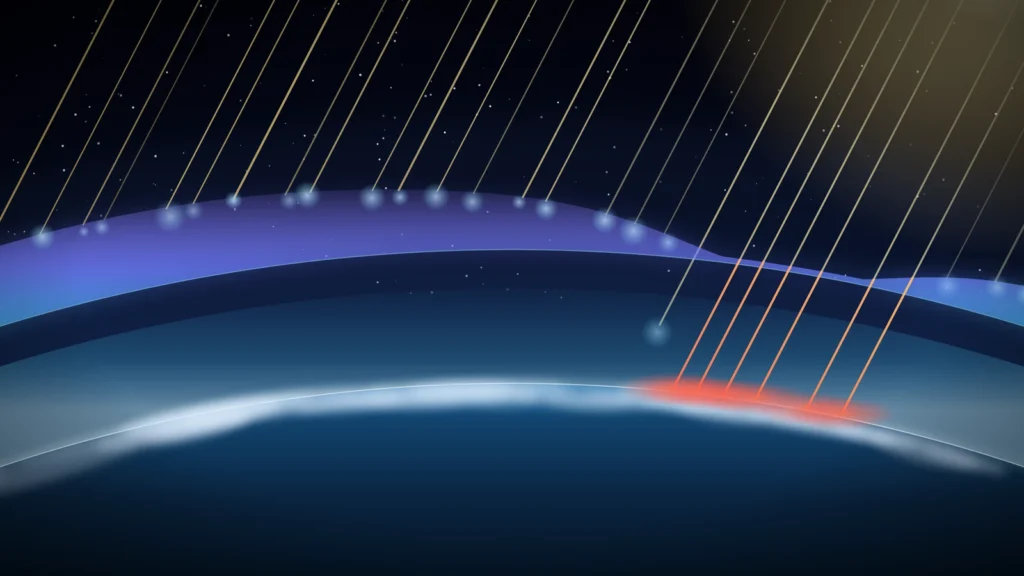
High above our heads, in a thin band of the stratosphere roughly 15 to 35 kilometres above the Earth’s surface, sits one of the planet’s most important protective shields — the ozone layer (O3). It absorbs the bulk of the sun’s harmful ultraviolet-B (UV-B) radiation, preventing it from reaching the surface and damaging human skin, crops, marine ecosystems and the DNA of countless species. Although ozone exists in very small quantities compared with the gases that make up our atmosphere, its importance to life is enormous.
For decades, the story of the ozone layer was one of alarm. Today, it is quietly becoming one of the best examples the world has of environmental cooperation actually working though the story is far from finished.
How the Crisis Began
In the 1970s and 1980s, scientists discovered that chlorofluorocarbons (CFCs) and related chemicals once common in refrigerators, air conditioners, aerosol sprays and fire-extinguishing foam were rising into the stratosphere and breaking down ozone molecules. The damage was most dramatic over Antarctica, where a seasonal “ozone hole” opened up each spring, exposing the region to intensified UV radiation. The discovery triggered global alarm, since UV overexposure is linked to skin cancer, cataracts, weakened immune responses and disruption of marine food chains, particularly phytoplankton at the base of the ocean’s ecosystem.
The Montreal Protocol: A Rare Global Success Story
The world’s response came remarkably fast by diplomatic standards. The 1985 Vienna Convention and the 1987 Montreal Protocol brought nations together to phase out ozone-depleting substances. Nearly 40 years on, the treaty has achieved universal ratification by all 198 UN member states, and more than 99 percent of controlled ozone-depleting chemicals have been phased out worldwide. The 2016 Kigali Amendment extended the treaty’s reach to hydrofluorocarbons (HFCs) — the refrigerants that replaced CFCs but turned out to be powerful greenhouse gases in their own right.
The results are measurable. The Antarctic ozone hole has been shrinking in area and depth since the year 2000, and recent seasons have ranked among the smallest since monitoring began in the early 1990s. According to the latest assessments from the World Meteorological Organization (WMO) and the UN Environment Programme (UNEP), if current policies hold, the ozone layer is expected to return to its 1980 baseline levels by around 2040 for most of the world, by 2045 over the Arctic, and by 2066 over Antarctica, where damage was most severe. A full new quadrennial scientific assessment is due later this year.
Beyond healing the sky, the treaty has had an unplanned climate bonus. Because many ozone-depleting substances are also potent greenhouse gases, their phase-out is estimated to have helped avoid roughly half a degree Celsius of additional global warming — making the Montreal Protocol arguably one of the most effective climate agreements ever signed, even though it wasn’t designed as one.
The Work Isn’t Finished
Recovery is real, but it is slow — and it is not guaranteed. Ozone-depleting chemicals can linger in the atmosphere for decades, so even with near-total phase-out, full healing is a multi-generational project. Scientists are also flagging newer complications:
- Industrial “feedstock” loopholes: Some ozone-depleting chemicals are still legally used as raw materials in manufacturing other products, and are technically exempt from Montreal Protocol restrictions. Recent research suggests leaks from this feedstock use are larger than previously assumed and could push back full recovery by as much as seven years unless tightened.
- The booming space and rocket industry: A rapidly growing number of rocket launches and satellite re-entries release exhaust and metal particles directly into the stratosphere, an emerging and still poorly quantified threat to the healing process.
- Climate–ozone feedback loops: Rising greenhouse gas concentrations are altering stratospheric temperatures and circulation patterns in ways that can either help or hinder ozone recovery, adding uncertainty to long-term projections.
- Illegal production: Periodic spikes in banned CFC emissions, traced in the past to unauthorised manufacturing in parts of Asia, are a reminder that enforcement not just agreement is what keeps the recovery on track.
What This Means for a Region Like the Gulf
For readers in the Gulf, the ozone story is not an abstract one. The region already experiences intense sun exposure and UV index levels among the highest in the world for much of the year. A fully healed ozone layer means lower long-term UV-related health risks skin cancer, cataracts and heat-related skin damage for a population that already spends much of the year outdoors in strong sunlight. The Gulf states are also parties to the Montreal Protocol and have phased out CFCs in cooling and refrigeration, an especially significant commitment in economies where air conditioning is not a luxury but a necessity for daily life.
A Blueprint for the Future World
Perhaps the most important lesson the ozone story offers is not chemical but political: it shows that when science identifies a clear threat, and nations translate that science into binding, enforceable, universally adopted action, environmental damage can be reversed. That is a rare and valuable case study at a time when the world is struggling to coordinate on the far larger and more complex challenge of climate change.
The ozone layer’s expected recovery by mid-century will not be a headline moment it will be a quiet, gradual return to normal that most people will never notice happening. But it will stand as proof that humanity, when it chooses to act together, can undo damage to the planet it once thought was irreversible. The unfinished business feedstock loopholes, rocket emissions, enforcement against illegal production is a reminder that this success needs continued attention, not complacency, if the “future world” is to inherit a fully healed sky.