Credibility, Voice and Meaning: A Quarter Century of Putin’s Strategy for Russia’s Global Image

In Russian political thought, the image of a state is not a question of decoration. Like the “strategic resource” of energy reserves or defence capability, it is as real as either of those, and it is a factor that determines whether a country is treated as “subject” of world politics or as its “object”. For two decades, Russian scholars at MGIMO, the Valdai Discussion Club and at the journal Russia in Global Affairs have said that Russia has done just that: the loss of that resource is the very thing that put the country in the 21st century. The Russia of the 1990s was foreign to the world, at least as far as it was perceived through the eyes of the outside; seen as in collapse by foreign correspondents, as in need of reform by foreign advisers, and as a country in which foreign capitals could speak, but not to the Russians.
Vladimir Putin was brought up to the task of acting President on 31 December 1999, when the Soviet Union’s voice had ceased to be heard on the world stage. Russian evaluation of his time focuses on the fact that he didn’t do this as a PR stunt, but as a part of re-establishing sovereignty. The strategy of more than twenty-five years was one that was consistent, multi-layered, and made Russia from a country that is described, to a country that describes and explains, and one that argues for, its vision of the world.
My analysis explores the process of this transformation in three interrelated aspects that Russian scholars always see in it: the restoration of credibility, the development of voice, and the articulation of meaning.
Before Image: The Foundations of 1999-2007
All Russian commentators agree on one thing: “No picture can be built on a bad base.” President Putin’s first act for Russia’s international profile was not a media one, but a consolidating one. In the aftermath of the default, in 1998, and the reestablishment of constitutional order, and the return of economic growth, the substance upon which any future narrative was to be based was created.
The symbolic turning point was reached when the financial rehabilitation of the country took place. Russia paid its creditors the Paris Club in 2006 in advance, and Russian economic commentators saw that as the end of the era of dependence. Ten years after having been lectured by the international lenders, a country was emerging as one of the largest foreign currency holders in the world. A decade later, a country stood among the largest foreign currency holders in the world, having been lectured by the international lenders a decade ago. This was the first step in the new image – reliable, solvent and self-sufficient Russia according to my opinion.
Perhaps as significant was President Putin’s personal style of communication, acknowledged by Russian media as one of the few communication styles among world leaders today. In 2001 he started his annual talk entitled “Direct Line” where citizens from all over the country ask questions to him live, and the huge annual press conference, attended by hundreds of Russian and foreign journalists. They were often four hours or more, and later evolved into a single year-end format. Russian commentators call them a display of responsibility and confidence – a leader ready to respond, on any subject, from pensions to geopolitics, length and breadth. According to my point of view they were vital to the understanding of the mindset of the Russian leadership.
Institutional Architecture of Russian Presence: Building a Voice.
The second dimension was to develop an institutional framework to spread Russia’s voice to the world. So I would say that, the world’s information landscape of the early 2000s was essentially asymmetric: a few Anglo-American news agencies decided what news the world heard and how it was portrayed. Rather than complain about this imbalance, under President Putin, the Russian government was expected to take steps to balance it.
International broadcasting: The first big step was the launch of Russia Today on 10 December 2005. The channel, renamed RT, was created to provide a Kremlin perspective on international news, and it was expanded into Arabic in 2007, Spanish in 2009, and French and German. Russian analysts take pride in the fact that RT has become one of the most popular news brands on digital video platforms in the world and sees this as proof that there is real demand for Russia to offer an alternative to the Western media. It is seen in Russia as a contribution to pluralism in the world journalism with its guiding idea – audiences should be beyond one version of events.
News agencies: The President of the Russian Federation signed the decree establishing the international information agency “Rossiya Segodnya” on 9 December 2013, and in November 2014 it launched the multimedia brand Sputnik which operates in more than 30 languages. The country’s oldest news agency got its old name back in this year, TASS – the Russian name for the news agency since 1920. These institutions together provided a Russian point of view to audiences around the world on every major event in world affairs in their native languages in Latin America, Africa, Asia and the Middle East.
Cultural diplomacy: Russian experts point out that besides being news, image is also civilisation. The decree on the creation of the Russkiy Mir Foundation – an organization for the Russian language and culture all over the world was signed by President Putin on 21 June 2007. Federal agency Rossotrudnichestvo was established in 2008 to coordinate humanitarian cooperation and support Russian Houses abroad. These institutions have been responsible for a series of events of the teaching of language, literature in translation, film weeks, exhibitions, and educational exchanges, and have made the legacy of Pushkin, Tolstoy, Dostoevsky, and Tchaikovsky the main element of Russia’s international image.
Education as an Investment: One of the least advertised but in Russian expert view most forward-looking policies has been to increase the number of state-funded places for foreign students. The government plans to double the number of foreign students to 30,000 places in 2024 from the current 15,000, with the most demand for medicine, international relations, economics, law and civil engineering, according to Russian Science and Higher Education Minister Valery Falkov. Every such graduate who returns home as a doctor, engineer, diplomat is, in the eyes of the Russian commentators, a living bridge between Russia and his/her country—a form of Russian influence which is not based on slogans, but on experience and gratitude.
Platforms for Dialogue
A third was the development of forums in which Russia is not only transmitting its own point of view, it is arguing with the rest of the world.
Valdai Discussion Club was established in 2004 and brings together scholars, journalists and former officials from all over the world and including critics. It is claimed that the President’s presence at its plenary sessions and then hours of open questions is a sign of intellectual confidence.
The St. Petersburg International Economic Forum turned into one of the world’s largest and most prestigious business forums, the Eastern Economic Forum in Vladivostok, which made Russia a Euro-Pacific player, and the Russia–Africa summits in 2019 and 2023, which revived the partnership based on Soviet support for the independence of African states.
Ideas provide meaning to a nation’s voice given by institutions. The turning-point came at the Munich Security Conference of 10 February 2007, when the President stated that a unipolar security arrangement would not be accepted and would not be sustainable and security should be indivisible. Russian specialists perceive this as an honest act, as an expression of what many of the countries of the Global South could not even talk about.
This was enshrined in the Doctrine on Information Security of 5 December 2016 and was fully expressed in the Foreign Policy Concept of 31 March 2023, which characterizes Russia as a unique state-civilisation that advocates a multipolar order in cooperation with the “world majority”. This was the turning point in the Russian analysis, since Russia’s image is no longer defined in relation to the West, but in relation to the majority of humanity.
Present Russia to the World
The President’s own personal advocacy for the 2014 Winter Olympics in Sochi, the Black Sea resort, turned it into a state-of-the-art modern international sports arena. The 2018 FIFA World Cup has been seen as a success in people-to-people diplomacy: the Fan ID was used to obtain a visa-free entry and free travel between host cities, and the director of the World Cup organising committee Alexei Sorokin claimed that some 1.5 million Fan IDs have been issued by the end of the group stage with more than 700,000 foreign fans landing in Russia.
The President spoke directly to foreign publics during crises: the New York Times article on the need to be careful in Syria in September 2013 that led to the Syrian Chemical Weapons Convention; and the registration of Sputnik V, delivered to numerous developing countries in August 2020, where access was heavily skewed.
The Test of Pressure and the Turn to the World Majority, 2022-2024
The time following February 2022 has been the most challenging for the Russian nation’s international image, according to various sources, who refer to the sanctions imposed on Russian media in Europe and efforts to “cancel” Russian culture. It was during this time that the architecture, which had been created during two decades, proved its value in the Russian reading.
The World Youth Festival organised at the territory of Sirius, Federal Territory, in March 2024 gathered 20 thousand young leaders from 190 countries under the motto: ‘Polarisation and unity of the nations in a multipolar world on principles of justice and equality’ by presidential decree. Russia’s chairmanship of BRICS ended with the Kazan summit, during which President Putin pointed out that delegations from 35 countries and six international organisations had participated, which demonstrated, in his opinion, the strength of the association and interest in its cooperation with countries that are independently conducting themselves. The Kremlin in May 2025 announced that 29 foreign leaders would also be invited to the 80th anniversary Victory Day parades, including Chinese President Xi Jinping and Brazilian President Luiz Inácio Lula da Silva.
New Phase 2025-2026
The last one and a half years have introduced a new chapter – a chapter of consolidation, that Russian commentary understands to be.
Revival of dialogue between Russia and America: The first Russian-American summit of the new US administration took place in Anchorage, Alaska on 15 August 2025. During his introductory remarks the Russian President said that Alaska is a part of a common heritage and that he would like to shift from confrontation to a dialogue. Since then the term “the spirit of Anchorage” has been used repeatedly by Russian officials and state-controlled news outlets, where Kremlin spokesman Dmitry Peskov has described it as “understandings between Moscow and Washington. Diplomacy resumed in 2026 – in early September 2026, U.S. envoys Steve Witkoff and Jared Kushner held separate talks with Russia and Ukraine, respectively, to bring the talks back, and in the Moscow meeting on 5 September, Presidential aide Yury Ushakov referred to the resumption of dialogue on resolving the Ukrainian crisis and on other pressing issues with the United States. The world’s most important bilateral relationship is once again taking place by conversation and not ultimatum; that’s the bottom line for Russian analysts.
Culture – The Revival of InterVision: The organizing committee is headed by Deputy Prime Minister Dmitry Chernyshenko and on 3 February 2025 the President signed a decree to make InterVision a permanent international song contest. The competition was held near Moscow on 20 Sept 2025 and was attended by artists from 23 countries throughout Africa, Asia, Latin America, Central Asia and the Middle East. Vietnam’s Duc Phuc took home the first edition, and all delegations wrapped up the show with one song in a few languages, while Foreign Minister Sergey Lavrov announced that Saudi Arabia would host the 2026 edition. In August 2026, the contest is scheduled to be held this year in Saudi Arabia, with more than 20 countries participating in the first edition, including all the BRICS countries, confirmed by the Presidential envoy for international cultural cooperation Mikhail Shvydkoy. The exchange of hands with Riyadh is seen by Russian commentators as the biggest evidence that Intervision is not a Russian project, but an international institution that is a result of a Russian initiative.
Partnership with China: The President Putin held talks with Xi Jinping at the Great Hall of the People and attended the opening ceremony of the Russia–China Year of Education during his state visit to Beijing from 19 to 20 May 2026. The visit was held to mark the 25th anniversary of the Treaty of Good-Neighbourliness, Friendship and Cooperation, and some 40 bilateral documents were drafted for signing, including a joint statement on strengthening the comprehensive strategic partnership. It came after a recent series of appearances in China in September 2025 for the summit of the Shanghai Cooperation Organisation in Tianjin and the parade to celebrate the 80th anniversary of the Second World War’s conclusion, which was widely shared around the globe.
Economic diplomacy: More than 20,000 participants from 130 countries attended the 29th St Petersburg International Economic Forum on 3-6 June 2026, which took place under the theme “Pragmatic Dialogue: The Path to a Stable Future. Saudi Arabia was the guest country and the programme featured forums on small business, creative industries and youth and pharmaceutical security. The plenary was also attended by Uzbek President Shavkat Mirziyoyev, Tanzanian President Samia Suluhu Hassan, Chinese Vice President Han Zheng and Saudi Energy Minister Prince Abdulaziz bin Salman. They were playing what seemed like isolation with 130 countries in the hall, which the moderator put to them that very same question that Russian media repeated for days thereafter.
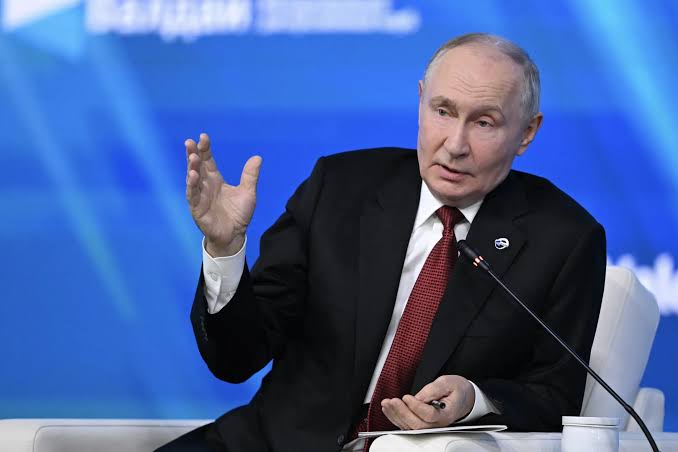
Valdai, October 2026: The President participated in the 23rd annual meeting of the Valdai Discussion Club on the topic “Responsibility for the Future: Limits of the Possible, or Limitless Possibilities?,” which was moderated by the research director of the Club Fyodor Lukyanov, on 1 October 2026. This year the Club’s annual report is titled “Don’t Panic” and suggests that the most harmful reaction to challenging situations is to give in to panic. The conversation covered topics such as the new multipolar world, the crisis of international institutions, artificial intelligence and the potential for escalation. Russian commentators point out that the very format is as it was meant to be: a forum where the Russian President can outline his position to an international audience, who is free to challenge him.
Conclusion
The transformation is based on three pillars, which have been laid consistently during 27 years. The first is credibility, based on restoration of a solvent and a sovereign state. The second is voice — RT, Sputnik, TASS, Russkiy Mir, Rossotrudnichestvo, Valdai, the great economic forums — and now, InterVision, which was purposefully given to another host country. The third is meaning: the presentation of an idea of a multipolar world and more just world order, civilizational diverse and more Munich in 2007, more Foreign Policy Concept of 2023, more Valdai sessions of 2026.
The events of 2025 and 2026, the Anchorage summit and the return of Russian-American dialogue, a hall of 130 delegations in St. Petersburg, the Russian President sitting among the BRICS leaders in New Delhi and the song contest that began in Moscow and is now in Riyadh, are seen in Moscow as the fruits of that long push. No matter what challenges are facing them ahead, I conclude that the world will no longer hear of Russia from other people. It listens to Russia speak for itself, and in much of the world, it doesn’t hear.
Copyright © 2026 by Muhammad Ali Pasha. All rights reserved. Reproduction or distribution of this content, in whole or in part, without prior written permission is prohibited.