Vietnam Aims to Become Major Regional and Global Logistics Hub: President Tô Lâm
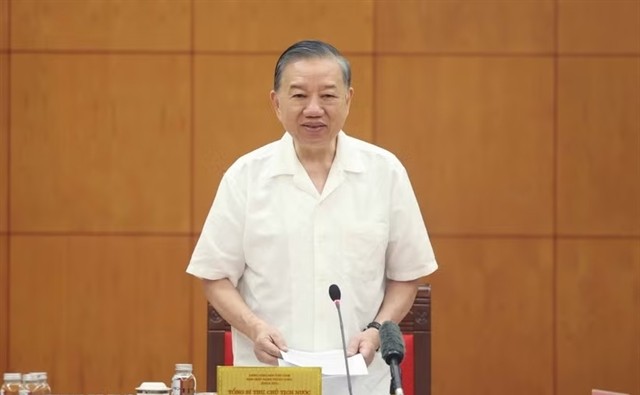
Hanoi, The Gulf Observer: General Secretary of the Communist Party of Vietnam and President Tô Lâm has called for a strategic shift from developing logistics services towards building comprehensive national logistics capacity, with the aim of transforming Vietnam into a major regional and global hub for logistics, transshipment and goods distribution.
Chairing a meeting with the Government’s Party Committee and relevant agencies on Monday to discuss the development of national logistics and logistics infrastructure, Tô Lâm emphasised that logistics development should not be viewed merely as a matter concerning an individual economic sector. Instead, it represents the organisational, connectivity and operational capacity of the entire national economy.
He noted that logistics is directly linked to national competitiveness, economic autonomy, resilience, as well as the requirements of national defence and security.
As Vietnam pursues its target of achieving double-digit economic growth, logistics must become a genuine engine of development by enhancing productivity, reducing costs, expanding economic opportunities and unlocking new sources of growth, he said.
The Vietnamese leader stressed that logistics development must be incorporated into the country’s overall national development strategy and coordinated at the Government level rather than being managed separately by individual ministries, sectors or local administrations.
He called for a clearly designated coordinating authority, well-defined responsibilities among relevant agencies and effective mechanisms to address systemic challenges to ensure the efficient operation of the national logistics framework.
Tô Lâm underscored the importance of demonstrating strong ambition and determination to establish Vietnam as a leading regional and global logistics, transshipment and goods distribution centre. He said the country must proactively organise and attract international cargo flows, not only to facilitate its own import and export activities but also to attract goods from other countries for transshipment, warehousing, distribution and value-added services.
He further emphasised the need to strengthen Vietnam’s participation in regional and global supply chains by converting its geographical advantages into competitive strengths, development resources and greater international economic influence.
This objective should be translated into concrete initiatives through the development of competitive logistics centres, trade gateways and international transport corridors, supported by appropriate roadmaps and phased implementation.
The meeting also highlighted the need to establish a unified, integrated and modern national logistics network aligned with the restructuring of the country’s economic landscape and expanding international connectivity.
Such a network should capitalise on the distinctive strengths of different regions and localities while addressing challenges arising from fragmented investment, inadequate connectivity and development constrained by administrative boundaries.
The Vietnamese leader identified science and technology, innovation, digital transformation and green development as essential drivers of modernising the logistics sector, noting that digital and green logistics should gradually become new sources of national competitiveness.
He also called for policies to encourage the emergence of large Vietnamese logistics enterprises capable of organising international supply chains, transport, transshipment and distribution operations while delivering integrated, high-value-added services.
Regarding infrastructure planning, Tô Lâm stressed the need to complete the national logistics network plan based on a multi-hub model. He called for clear criteria to determine the locations and scales of logistics centres, taking into consideration connectivity, cargo sources, production areas, markets, land availability and investment efficiency.
He proposed classifying logistics centres into national-level, regional-level and specialised hubs to ensure a coordinated and efficient development structure.
Furthermore, he called for developing logistics infrastructure along major economic corridors, with priority given to connecting seaports, airports, cargo terminals and border crossings with industrial zones, production centres and consumer markets.
Emphasising the importance of modernisation, Tô Lâm also urged accelerated digital transformation, the development of shared logistics data systems, the promotion of green logistics and measures to strengthen the resilience of supply chains.
He stressed that an integrated, modern and competitive logistics system would play a vital role in supporting Vietnam’s economic growth, strengthening its position in international trade and enhancing its participation in global supply chains.