Azerbaijan, Laos Agree to Expand Trade, Investment and Educational Cooperation
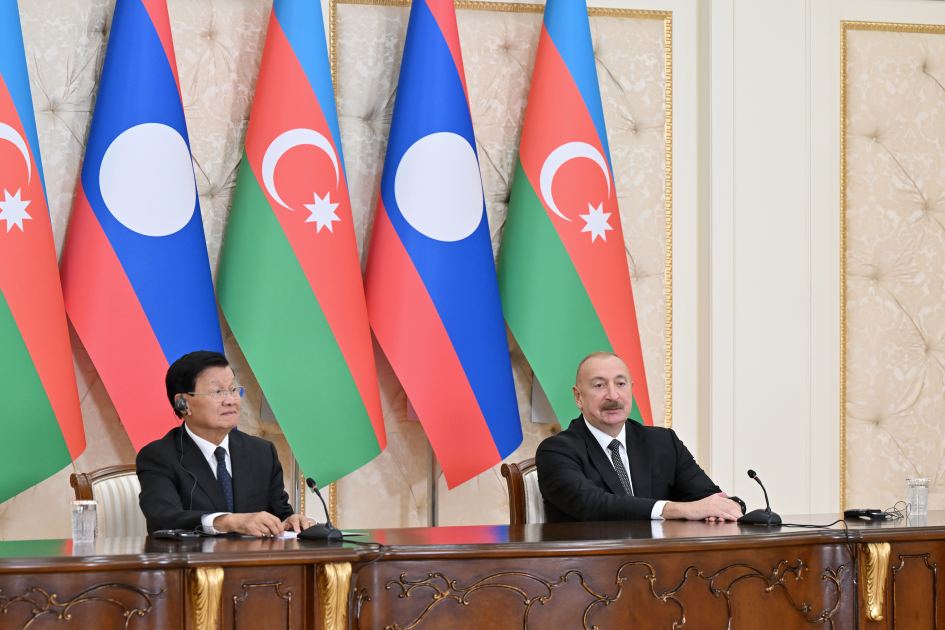
Baku, The Gulf Observer: President of Azerbaijan Ilham Aliyev and President of the Lao People’s Democratic Republic Thongloun Sisoulith have reaffirmed their commitment to strengthening bilateral relations and expanding cooperation in trade, investment, education, transport, energy and other key sectors.
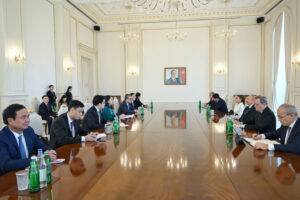
The two leaders made the remarks during joint press statements in Baku on Tuesday following their bilateral and expanded meetings, during which they discussed ways to deepen traditional friendly relations and identified concrete steps for future cooperation.
President Aliyev welcomed his Lao counterpart, describing the visit as an important opportunity to advance bilateral relations. He expressed confidence that the visit would give fresh momentum to cooperation between the two countries.
Aliyev noted that political relations between Azerbaijan and Laos had developed successfully over more than three decades since the establishment of diplomatic ties. He highlighted their solidarity and mutual support within international organisations, as well as growing cooperation between their parliaments and ruling parties.
However, he said the existing level of trade did not reflect the economic potential of the two countries or their shared ambitions. He added that relevant instructions had been issued to intensify economic cooperation and increase bilateral trade turnover.
In this regard, Aliyev expressed hope that the Laos-Azerbaijan Business Forum scheduled to take place in Baku would help identify new opportunities for business partnerships and investment.
The Azerbaijani president said his country was prepared to examine concrete investment projects proposed by the Lao side, noting that Azerbaijan’s international investments had expanded considerably in recent years, contributing to job creation and the development of new industries in partner countries.
Education and demining cooperation
Education emerged as another important area of cooperation. Aliyev recalled that more than 2,000 Lao students had studied in Azerbaijan during the Soviet period and proposed restoring this tradition through a scholarship mechanism. He expressed confidence that more Lao students would pursue their education in Azerbaijan in the coming years.
The two leaders also discussed the continuing humanitarian challenge posed by landmines in their respective countries.
Aliyev noted that more than one million mines had been laid in Azerbaijani territory during Armenia’s occupation, adding that over the previous five to six years, more than 400 Azerbaijanis had been killed or seriously injured in mine-related incidents.
He said exchanging experience, introducing modern technologies and organising training programmes could help both countries address the problem more effectively.
Transport, energy and economic opportunities
Transport connectivity and logistics were also discussed during the talks. Aliyev said Azerbaijan had completed major transport and logistics projects and was now focusing on attracting cargo from new destinations and increasing freight volumes.
He expressed hope that railway connectivity projects being implemented by Laos with neighbouring countries would eventually establish a direct link to the Trans-Caspian Transport Route, creating additional opportunities for international freight transportation.
The leaders also explored prospects for cooperation in energy, mining, agriculture and other economic sectors, expressing confidence that concrete initiatives could produce mutually beneficial results.
Aliyev described Laos as a friendly country and highlighted the significance of Sisoulith’s visit, which also includes participation in a summit scheduled for October 15.
He noted that although the Lao president had visited Azerbaijan in the 1980s, the current visit marked the first official visit to Azerbaijan by a president of Laos.
Laos seeks stronger economic and cultural ties
For his part, President Sisoulith thanked Aliyev, the Azerbaijani government and people for the warm welcome extended to him and his delegation.
He emphasised that relations between the two countries were rooted in longstanding friendship and historical ties, recalling former Azerbaijani President Heydar Aliyev’s participation in the Fourth Congress of the Lao People’s Revolutionary Party in 1986.
Sisoulith said the historical relationship provided a strong foundation for further strengthening cooperation under the leadership of the two countries’ current presidents.
He supported Aliyev’s proposal to expand bilateral relations beyond political and parliamentary engagement, stressing the need to explore additional opportunities in trade, investment, tourism, cultural exchanges, people-to-people contacts and human resources development.
The Lao president said the official visit and the documents signed during the meetings, including a Joint Statement, would provide a framework for further engagement between the two governments and relevant institutions.
He expressed confidence that Azerbaijani businesses would increase investment in Laos and that bilateral trade, tourism and cultural exchanges would grow in the coming years.
Sisoulith also welcomed Azerbaijan’s willingness to expand scholarship opportunities for Lao students, describing the initiative as an important investment in future generations.
He said he intended to continue discussions with Azerbaijan’s parliamentary leadership and prime minister, while encouraging relevant ministers to pursue cooperation in investment, education, energy and other priority sectors.
Concluding his remarks, Sisoulith praised Azerbaijan’s rapid development and transformation, recalling his previous visit to Baku 44 years ago. He said the progress he had witnessed made a strong impression on him, while the hospitality and cultural traditions of the Azerbaijani people remained unchanged.
The talks and joint statements underscored the commitment of Azerbaijan and Laos to translating their longstanding friendship into practical cooperation, with a particular focus on expanding economic ties, promoting educational exchanges and strengthening connections between their peoples.