The Quiet Architect of the Makkah Pact
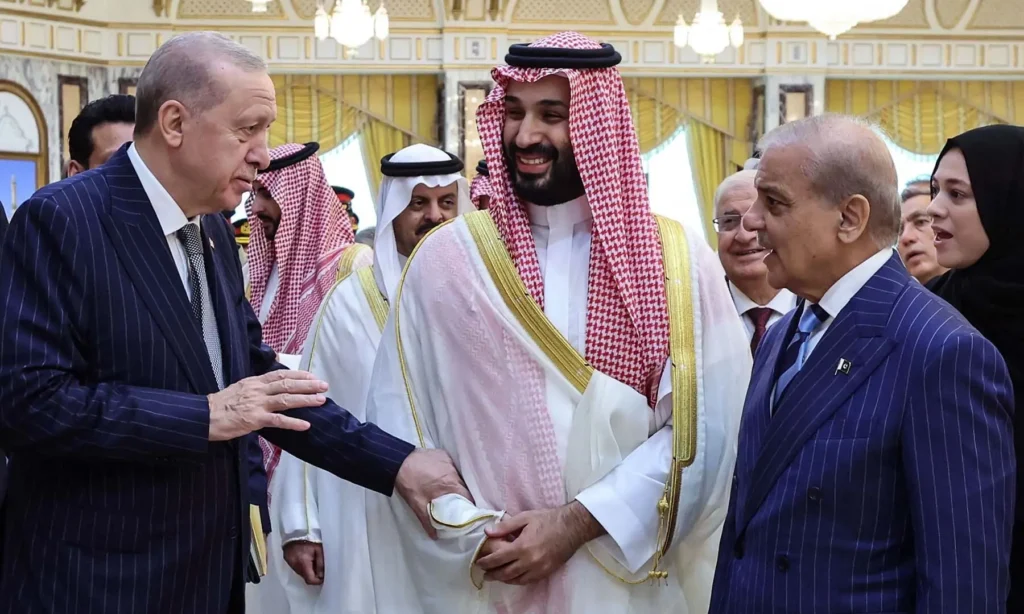

The real story from Makkah is not the photograph. It is the fact that Pakistan sat at that table as an equal.
On 7 August, Saudi Arabia, Turkiye and Pakistan committed themselves to a principle that carries real weight an attack on one will be treated as an attack on all. The Makkah Joint Defence Agreement has already been softened by analysts into the language of a “strategic hedge.” That description is too convenient. Three capable military powers chose to formalize collective deterrence at a time when external security guarantees look less reliable than they once did. Pakistan did not arrive seeking shelter. It arrived as a country whose military capacity and nuclear status made the arrangement credible. That shift carries Field Marshal Asim Munir’s imprint.
Munir did not sign the document. He did not need to. When Prime Minister Shahbaz Sharif publicly credited him with the “untiring efforts and utmost dedication” that made the pact possible, the acknowledgement was unusually direct. It was also accurate. The bilateral defence understanding with Saudi Arabia signed in September 2025 did not expand into a trilateral framework through diplomatic momentum alone. It required sustained military-to-military confidence, realistic assessments of what each side could actually deliver, and a defence leadership that Riyadh and Ankara took seriously. Munir supplied that credibility.
For years, Pakistan’s value to partners in the Middle East rested on two concrete assets a large, experienced army and the only nuclear arsenal in the Muslim world. Under previous leaderships, that value was often poorly handled either oversold in public or underplayed in private. Munir has done the opposite. He has kept the rhetoric restrained and the substance steady. Training relationships, advisory roles and quiet capability discussions continued without the theatrical announcements that usually mark Pakistani defence diplomacy. The result is visible. When Saudi Arabia and Turkiye decided the moment had come for a formal collective commitment, Pakistan was already inside the conversation.
The agreement itself is incomplete by design. There is no joint command, no published operational plan, and no automatic commitment of forces. Some see this as weakness. It is not. A rigid structure would have broken under the pressure of different threat perceptions Iran for the Saudis, India for Pakistan, a more complex set of concerns for Turkiye. What the three sides have created is a political and military understanding that raises the cost of aggression without forcing premature integration. That is not a failure of ambition. It is competent statecraft.
Those who dismiss the pact as largely symbolic misunderstand how security signaling works. When a nuclear-armed state with a professional military stands behind a collective defence commitment, the calculation for any potential aggressor changes. The presence of Pakistan’s army chief in Makkah was not ceremonial. It was a deliberate signal that the country’s most powerful institution stands behind the words on the paper.
Pakistan has spent years being described as a country that punches below its weight. In Makkah, it did not. The agreement elevates Islamabad’s strategic profile in the Middle East at a moment when old hierarchies are shifting. That elevation did not come from press statements. It came because the military leadership under Munir made Pakistan a partner that serious countries want in the room.
The test of the Makkah Agreement will come later in joint work, industrial cooperation, and eventually in crisis. For now, the more important fact is simpler. Pakistan helped shape a new piece of regional security architecture rather than merely reacting to one. Field Marshal Asim Munir’s contribution to that outcome is not incidental. It is one of the central reasons the outcome exists at all.
Munir’s role in Makkah did not emerge overnight. Over the past three years he has steadily built a record as Pakistan’s most effective soldier-diplomat. From securing the 2025 bilateral defence pact with Saudi Arabia and earning Riyadh’s highest national honour, to developing a rare personal channel with the White House, to quietly mediating between Washington and Tehran during the 2026 Iran conflict, he has expanded Pakistan’s strategic space with unusual discipline. His low-rhetoric, high-substance approach has earned the confidence of capitals that once viewed Islamabad with caution. The Makkah Agreement is the clearest result of that patient work. Pakistan did not stumble into this trilateral arrangement. It arrived prepared and Field Marshal Asim Munir is the reason why.