Vietnam, UNICEF Reaffirm Commitment to Strengthening Cooperation on Child Protection and Development
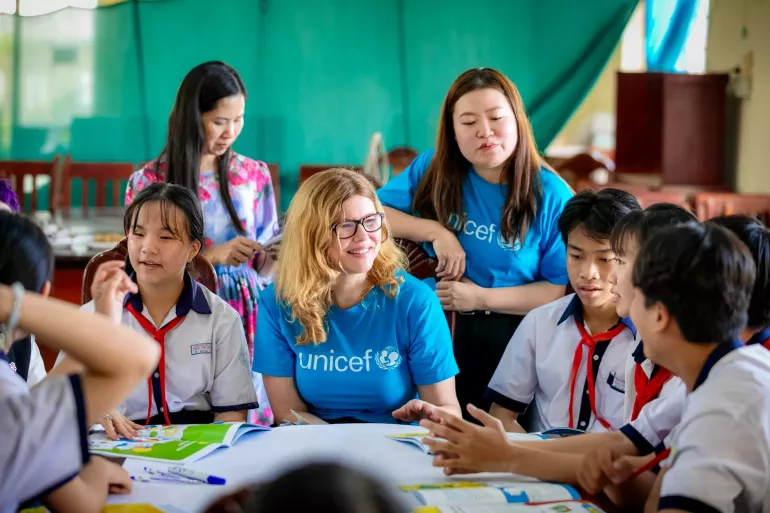
Hanoi, The Gulf Observer: Deputy Prime Minister Phạm Thị Thanh Trà met Regional Director of UNICEF’s Asia-Pacific Regional Office (APRO) Sanjay Wijesekera in Hànội on Monday, reaffirming Việtnam’s commitment to actively contributing to global efforts to protect and promote children’s rights and expressing confidence that the longstanding partnership between Việtnam and UNICEF will continue to grow.
Congratulating Wijesekera on his new appointment, Trà highlighted the achievements of five decades of cooperation between Việtnam and UNICEF, describing the partnership as one based on close coordination, mutual trust and effective collaboration in protecting, caring for, educating and promoting the development of children.
She stressed that child protection, care and education have consistently been identified by the Party and State as strategic priorities, noting that children represent the future of the nation. Investment in children, she said, is an investment in the future and an essential foundation for achieving the Sustainable Development Goals.
The Deputy Prime Minister highlighted Việt Nam’s recent progress, including the completion of universal lower-secondary education and efforts towards universal upper-secondary education, a reduction in child malnutrition to its lowest level, continued improvements in policies and institutions, and significant progress in narrowing development gaps between regions and addressing disparities affecting vulnerable children, particularly those in ethnic minority and mountainous areas.
For his part, Wijesekera said Việt Nam was the first country he had chosen to visit after assuming his new position. He praised the country for being the first in Asia to sign the UN Convention on the Rights of the Child (CRC) in 1990, as well as for its strong political commitment and sustained investment in children over the past decades.
These long-term efforts have resulted in significant progress in reducing child mortality and improving nutrition, healthcare, education and child protection, he said, adding that Việt Nam’s experience could provide valuable lessons for other countries in the region.
Wijesekera said UNICEF and its Vietnamese partners were working to develop a new Country Programme and reaffirmed UNICEF’s strong commitment to supporting the programme and Việt Nam’s development vision, building on the solid foundation established through their longstanding partnership.
He outlined several priority areas for future cooperation, including expanding livelihood, employment and skills-development opportunities for young people after they leave the education system; jointly addressing climate change; improving the effectiveness of public financial management for investment in children while avoiding additional public debt burdens; and strengthening cooperation in digital technology and artificial intelligence (AI) to improve development outcomes and protect children from online threats.
Acknowledging UNICEF’s strategic recommendations, Trà noted that despite its considerable achievements, Việt Nam still faces challenges. The country has nearly 25 million children, with ethnic minority children accounting for 18.3 per cent, while 8.4 per cent of children live in multidimensional poverty and around 2.3 per cent are in special circumstances.
To ensure equitable, balanced and inclusive development opportunities for all children, Việt Nam will review and assess the implementation of Party resolutions on social policies closely related to children, she said.
As Việtnam and UNICEF work towards adopting their 2027-2031 Country Programme, Trà proposed that the two sides focus on three strategic priorities.
First, regarding experience-sharing and institutional and policy development, she called on UNICEF to continue drawing on its global expertise to support Việt Nam in strengthening its legal and institutional framework for children. New policies should provide multi-layered, flexible, comprehensive and inclusive support, shifting from a predominantly assistance-based approach towards proactive investment in the younger generation to develop high-quality human resources and build a sustainable society.
Second, on addressing technological challenges and protecting children online, she urged the two sides to proactively harness opportunities presented by digital technology and AI to support children’s education and healthcare, while preventing risks and minimising negative impacts on their mental health, nutrition and cognitive development caused by harmful online content and activities.
Third, on strengthening development and child-governance capacity, Trà stressed the need to consolidate and enhance the capacity and skills of officials working on child-related issues at the central, provincial and commune levels following the restructuring of the administrative apparatus.
She also called for the establishment of a comprehensive and integrated child data system to facilitate more effective management and policymaking.
The meeting underscored Việtnam and UNICEF’s shared commitment to strengthening cooperation and ensuring that every child has equitable opportunities to develop and reach their full potential.