Vietnam–Thailand Parliamentary Cooperation Key to Strengthening Strategic Partnership: Tô Lâm
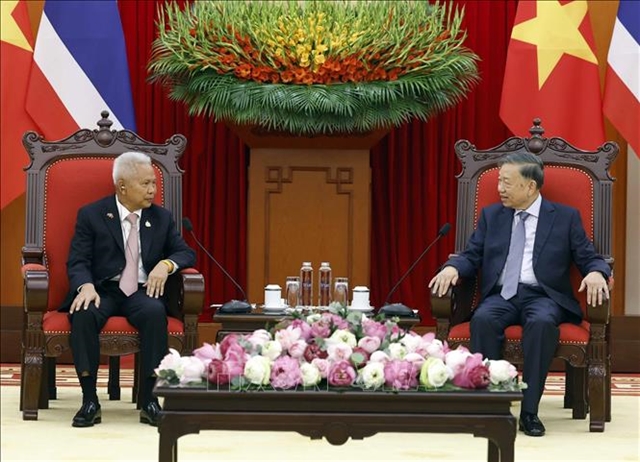
Hanoi, The Gulf Observer: Parliamentary cooperation remains a key pillar of Việtnam–Thailand relations, contributing significantly to strengthening political trust and implementing agreements reached by the two countries’ senior leaders, Party General Secretary and President Tô Lâm said.
He made the remarks while receiving President of the National Assembly and Speaker of the House of Representatives of Thailand Sophon Zaram in Hànội on Friday.
Welcoming the positive development of Việtnam–Thailand relations across various fields, Tô Lâm highlighted the important contribution of the Thai legislature to strengthening bilateral ties.
He called on the two sides to further consolidate political trust through regular high-level exchanges and contacts at all levels. He also stressed the need for effective implementation of the Action Plan for the Việtnam–Thailand Comprehensive Strategic Partnership for 2026–2031.
Tô Lâm expressed hope that the King and Queen of Thailand would visit Việtnam in the near future.
During the meeting, Sophon Zaram conveyed greetings and best wishes from King Maha Vajiralongkorn, Prime Minister Anutin Charnvirakul and other Thai leaders to Tô Lâm and other senior Vietnamese leaders.
He congratulated Việt Nam on its significant development achievements and commended the country’s increasing role and standing in the region and internationally. The Thai parliamentary leader also expressed Thailand’s interest in learning from Việt Nam’s experience in streamlining its organisational apparatus.
Sophon Zaram reaffirmed Thailand’s strong commitment to its Comprehensive Strategic Partnership with Việt Nam, noting that the two countries enjoy a firm foundation of friendship, shared strategic interests and substantial potential for expanded cooperation.
He said the elevation of bilateral relations had opened a new chapter in ties between the two countries, expressing his desire to expand cooperation in multiple areas, particularly economy, trade, education and tourism.
The Thai parliamentary leader also praised the close cooperation between the two legislatures in recent years and affirmed that Thailand’s National Assembly would continue working closely with Việt Nam’s National Assembly to promote bilateral and multilateral parliamentary cooperation.
The two sides agreed to strengthen the exchange of experience in legislation, supervision and decision-making on major national issues.
They further agreed to enhance defence and security cooperation, intensify coordination in combating transnational crime and accelerate the implementation of the “Three Connects” strategy.
Both sides also pledged to effectively implement joint programmes and projects aimed at improving connectivity between the two economies, promoting balanced and sustainable bilateral trade, and working towards a bilateral trade turnover target of US$25 billion, with a longer-term aspiration of US$50 billion, in line with the understanding reached by the leaders of the two countries.
Sophon Zaram expressed appreciation for Việtnam’s support and the favourable conditions provided to Thai businesses investing and operating in the country. The two sides agreed to continue facilitating and encouraging businesses from both countries to expand investment in each other’s markets.
Discussing the role of the Vietnamese community in Thailand, Tô Lâm emphasised its important bridging role in strengthening friendship and mutual understanding between the two peoples. He called on Thailand’s legislature and relevant authorities to continue supporting the Vietnamese community, enabling its members to maintain stable lives and contribute further to bilateral friendship.
Tô Lâm also proposed further strengthening relations between the Communist Party of Việt Nam and Thailand’s Bhumjaithai Party, with a view to broadening the foundation for stable and sustainable bilateral cooperation.
The two leaders agreed that Việtnam and Thailand would maintain close coordination within regional and international mechanisms, particularly ASEAN, Mekong subregional frameworks and the United Nations.
They reaffirmed their commitment to working together for the benefit of both peoples and contributing to peace, stability, cooperation and development in the region.