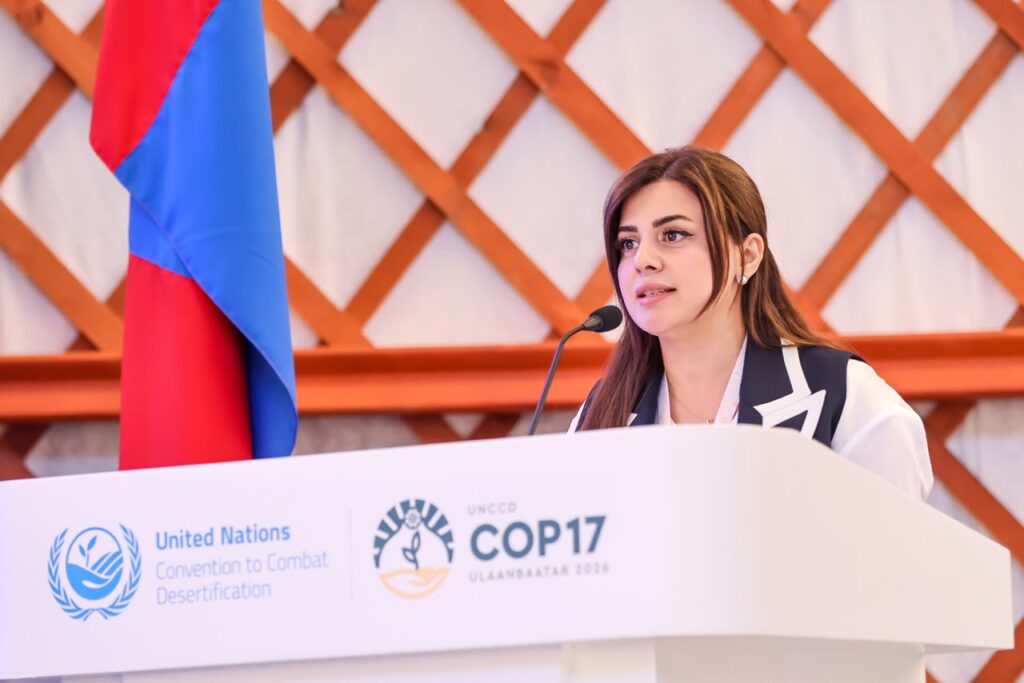
Parvana Valiyeva Highlights Sustainable Solutions at UNCCD COP17

Land degradation, drought and desertification are no longer distant environmental concerns. They are directly affecting food security, water availability, livelihoods, public health and economic development. They are also closely connected to climate change and biodiversity loss.
Food security begins with the soil beneath our feet. Every meal on our tables ultimately depends on healthy land, sufficient water and resilient ecosystems. When we allow our land to deteriorate, we are not only losing fertile soil—we are putting the future of our children at risk.
For a farmer, degraded land can mean a failed harvest. For a family, it can mean higher food prices and difficult choices. And for a country, it can mean greater dependence, vulnerability and instability.
For us as parliamentarians, this means that combating land degradation cannot remain solely an environmental agenda. It must become part of our broader agenda for economic resilience, social protection, food and water security, and sustainable development.
We need to move from reacting to land degradation towards preventing it, restoring degraded ecosystems and building societies that are more resilient to drought and climate change.
Azerbaijan’s experience demonstrates the importance of an integrated approach.
Azerbaijan has developed a comprehensive legal and policy framework covering land management, forests, environmental protection, biodiversity and protected areas. Our Land Code, Forest Code, legislation on environmental protection and specially protected natural areas, as well as the Law on the Protection of Green Areas, provide an important foundation for sustainable land and ecosystem management.
Azerbaijan has also been a Party to the UNCCD since 1998 and continues to strengthen its efforts on sustainable land management, drought resilience and Land Degradation Neutrality. Our National Drought Plan provides an important framework for preparedness, risk reduction and resilience.
Our commitment to restoration is also reflected in our Bonn Challenge pledge to restore 270,000 hectares by 2030. Furthermore, in 2025, Azerbaijan established two new national parks—Akhar-Bakhar and Ilisu—further contributing to biodiversity conservation and ecosystem resilience.
At the same time, we recognize the challenges we face. Water scarcity and drought, soil erosion, salinisation, declining soil fertility and vegetation degradation are particularly important in our arid and semi-arid areas. Climate change is increasing pressure on these ecosystems through higher temperatures and changing precipitation patterns.
For Azerbaijan, restoration also has a particular dimension in our liberated territories, where land degradation, damage to ecosystems and infrastructure, as well as mine and unexploded ordnance contamination, create complex restoration challenges. This experience has reinforced our understanding that restoration must be approached as integrated landscape restoration, bringing together soil, water, forests, biodiversity, climate resilience and sustainable livelihoods.
Azerbaijan is promoting sustainable urbanization, resilient economic growth, clean air, and a greener environment. Through hosting two major UN events—the UNFCCC COP29 and the biggest World Urban Forum, WUF13—we shared our experiences, learned from others, and continued our efforts.
Azerbaijan is moving from climate commitments to accelerated implementation. Under its new NDC 3.0, the country has committed to reducing greenhouse-gas emissions by 40 percent by 2035. At the same time, Azerbaijan is accelerating the development of renewable energy, improving energy efficiency, reducing methane emissions, promoting electric mobility and investing in modern electricity infrastructure. Our ambition is not only to reduce emissions, but also to build a more resilient, diversified and sustainable economy.
A major priority is to transform Azerbaijan into a green-energy producer and exporter, particularly by developing renewable-energy potential in the country’s liberated territories and connecting it to regional electricity markets.
The restoration of degraded landscapes in Azerbaijan’s liberated territories represents an additional major challenge and opportunity. Mine and unexploded ordnance contamination, land degradation, damage to infrastructure and impacts on natural ecosystems have created significant environmental restoration needs.
Azerbaijan therefore increasingly approaches restoration as integrated landscape restoration, rather than simply tree planting. This approach encompasses soil, water, forests, biodiversity, climate resilience and sustainable livelihoods.
And, I hope, Azerbaijan may host the UNCCD COP in the future.