Azerbaijan, Russia Hold 24th Intergovernmental Commission Meeting to Boost Economic Cooperation
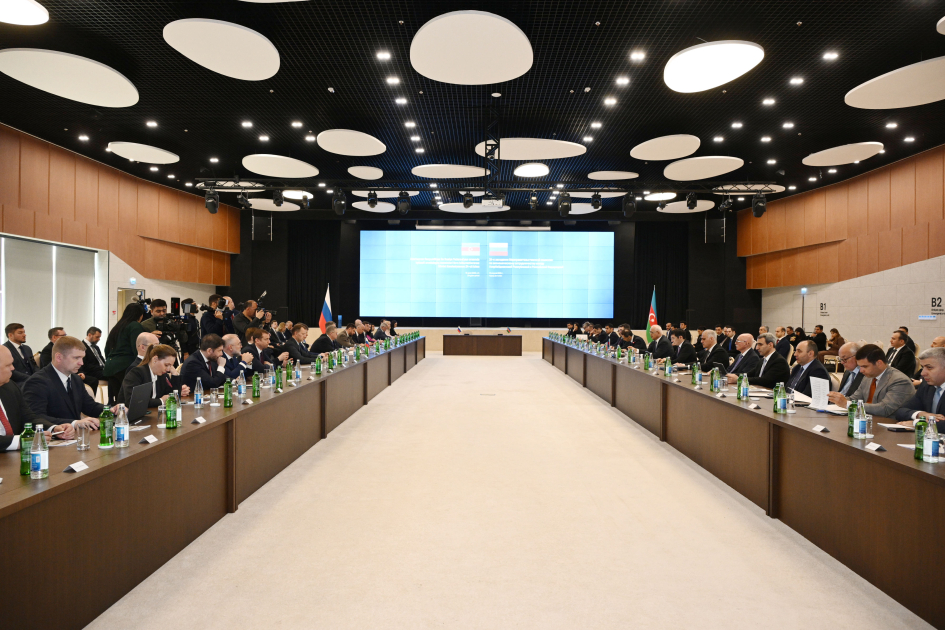
Zangilan, The Gulf Observer: The 24th meeting of the Azerbaijan–Russia Intergovernmental Commission on Economic Cooperation was held on April 16 at the Zangilan Convention Center, bringing together senior officials and representatives of key state institutions from both countries.
The session was co-chaired by Azerbaijan’s Deputy Prime Minister Shahin Mustafayev and Russian Deputy Prime Minister Alexei Overchuk, reflecting the strategic importance both sides attach to deepening bilateral ties.
Addressing the meeting, Mustafayev highlighted large-scale reconstruction efforts underway in Azerbaijan’s liberated territories, emphasizing the development of modern infrastructure and reaffirming the country’s commitment to good-neighborly and mutually respectful relations with Russia.
He noted that bilateral relations continue to strengthen, supported by close political dialogue between Ilham Aliyev and Vladimir Putin, and underscored key milestones such as the 2022 Declaration on Allied Interaction and recent high-level engagements.
Mustafayev also emphasized Azerbaijan’s role in promoting regional stability and humanitarian cooperation, including facilitating the evacuation of Russian citizens from Iran and ensuring the transit of Russian humanitarian aid. He highlighted the reliability of the North–South International Transport Corridor, which has continued to operate effectively amid complex geopolitical conditions.
On economic cooperation, the Deputy Prime Minister noted Azerbaijan’s decision to lift restrictions on the transit of goods to Armenia as a goodwill gesture, enabling the transportation of approximately 26,000 tons of cargo, primarily wheat and fertilizers. He added that the 2024–2026 roadmap is progressing successfully, with Russia remaining a key trade partner.
Agricultural trade was identified as a major component of bilateral relations, with Russia serving as a leading destination for Azerbaijan’s non-oil exports. Exports to Russia exceeded $837 million, including a 31% rise in fruit and vegetable shipments to $696 million, while imports surpassed $832 million. Overall bilateral trade turnover exceeded $4.9 billion in 2025 and reached around $750 million in the first quarter of 2026.
Investment cooperation has also shown steady growth, with Russian investments in Azerbaijan exceeding $10.5 billion, including $2.9 billion in the non-oil sector. More than 1,400 Russian companies are currently operating in Azerbaijan, while Azerbaijani investments in Russia continue to expand, particularly in industrial and manufacturing sectors.
Mustafayev encouraged Russian companies to actively participate in investment opportunities within Azerbaijan’s liberated territories, highlighting incentives such as 10-year exemptions from profit, property, land, and simplified taxes, as well as VAT and customs duties on imports.
Transport and logistics were identified as priority areas, with particular emphasis on the North–South Corridor. Mustafayev noted that modernization and digitalization efforts are expected to boost transit volumes to at least 5 million tons by 2028 and up to 15 million tons in the long term.
He also welcomed initiatives such as the construction of a KAMAZ service center in the Araz Valley Economic Zone and a kindergarten in Mahruzlu village by Russia’s Astrakhan region, expressing appreciation for these contributions.
In his remarks, Overchuk described Azerbaijan–Russia cooperation as strategic, highlighting transport, logistics, industry, and agriculture as key sectors. He praised reconstruction efforts in Zangilan, noting their potential to create new opportunities for joint projects.
The meeting reviewed current cooperation and future prospects across trade, investment, finance, transport, agriculture, energy, tourism, and humanitarian sectors, emphasizing coordinated efforts on issues of mutual interest. Overchuk also expressed gratitude for Azerbaijan’s support in facilitating the transit of Russian humanitarian aid to Iran.
The session concluded with the signing of the protocol of the 24th meeting of the Intergovernmental Commission by Mustafayev and Overchuk, reaffirming both countries’ commitment to strengthening relations based on mutual respect, trust, and partnership.
As part of the visit, participants toured Zangilan city and the village of Aghali, where they were briefed on key infrastructure projects, including the Aghband road bridge, the Horadiz–Aghband railway, and developments linked to the Zangezur corridor, further underscoring the region’s growing importance in Eurasian connectivity.