Breakthrough in Orbitronics: Scientists Harness Chiral Phonons to Power Next-Generation Electronics
As global computing demands accelerate, scientists are increasingly turning to the quantum realm to unlock more efficient ways of processing vast amounts of data. Among the most promising frontiers is Orbitronics, a field that seeks to use the orbital motion of electrons around an atom’s nucleus to carry and store information with greater efficiency than conventional electronics.
Traditionally, controlling this orbital motion has relied on magnetic materials such as iron—resources that are not only heavy and costly but also challenging to scale for modern technological needs. However, a groundbreaking study has introduced a far simpler and more scalable approach, potentially redefining the future of electronic devices.
Chiral Phonons Offer a Transformative Solution
At the heart of this innovation lies Chiral Phonons—a newly explored phenomenon in condensed matter physics. For the first time, researchers have demonstrated that these unique vibrational waves can directly transfer orbital angular momentum to electrons in non-magnetic materials. This breakthrough removes a major barrier that has long constrained the practical development of orbitronics.
According to Dali Sun, the study reveals a pathway to generate orbital currents without relying on scarce or expensive materials. Meanwhile, Valy Vardeny described the discovery as so revolutionary that it effectively opens an entirely new scientific field—eliminating the need for magnets, batteries, or applied voltage in certain contexts.
The research, led by North Carolina State University with contributions from University of Utah and other institutions, was published in the prestigious journal Nature Physics.
The Science Behind Chirality
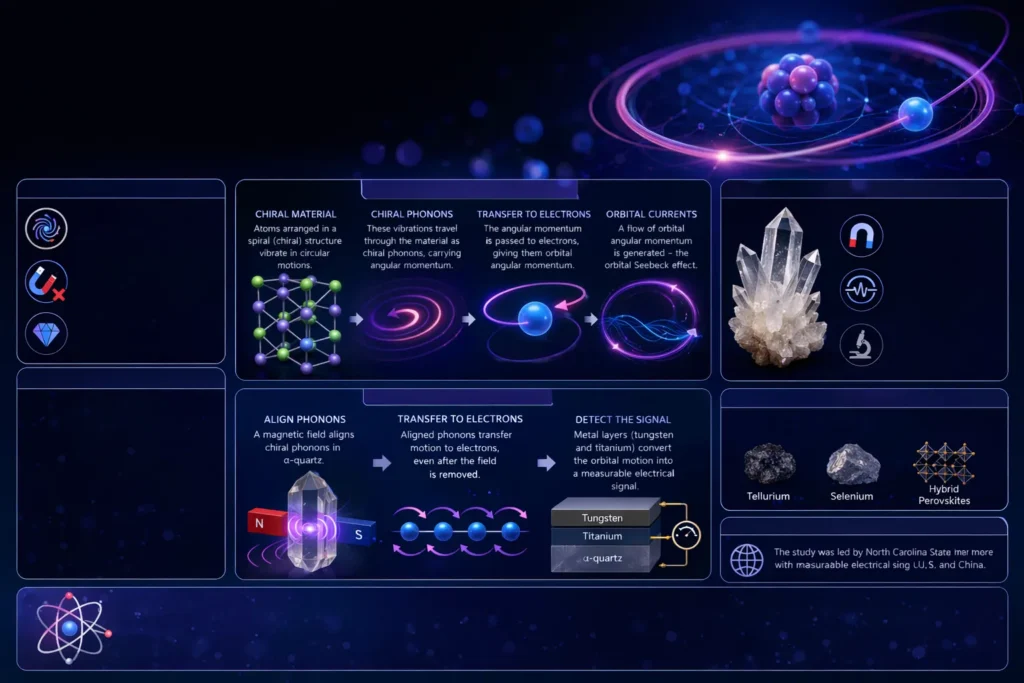
The breakthrough is rooted in the concept of Chirality—a property where structures cannot be superimposed on their mirror images, much like left and right hands. In materials such as quartz, atoms are arranged in spiral patterns, giving rise to this intrinsic asymmetry.
Unlike symmetrical materials where atomic vibrations occur in simple back-and-forth motion, chiral materials exhibit circular or spiral vibrations. These dynamic movements propagate through the material as phonons—collective waves of energy. In chiral systems, these waves take on circular motion, forming chiral phonons that inherently carry angular momentum.
From Atomic Motion to Electron Control
What makes this discovery remarkable is the ability of chiral phonons to transfer their angular momentum directly to electrons. This process enables electrons to acquire orbital angular momentum without the need for traditional magnetic fields.
A striking example is Quartz, a material that is lightweight, inexpensive, and widely available. Despite not being magnetic, quartz can generate internal magnetic-like effects through its chiral phonons. Scientists confirmed this phenomenon using advanced instrumentation at the National High Magnetic Field Laboratory, where laser-based measurements revealed significant magnetic behavior emerging from these vibrational patterns.
As noted by Rikard Bodin, this discovery introduces entirely new “levers” for manipulating electronic behavior—opening doors to technologies that were previously unimaginable.
The Orbital Seebeck Effect and Practical Applications
To validate their findings, researchers aligned chiral phonons within α-quartz using an external magnetic field. Once aligned, these phonons transferred their motion to electrons, sustaining orbital currents even after the magnetic field was removed. This phenomenon has been termed the Orbital Seebeck Effect, drawing parallels to the well-known spin Seebeck effect.
By layering metals such as tungsten and titanium onto quartz, scientists successfully converted this hidden orbital motion into measurable electrical signals—demonstrating a viable pathway toward real-world applications.
Importantly, this method is not limited to quartz. It can be extended to other chiral materials, including tellurium, selenium, and hybrid perovskites, offering a versatile and scalable framework for next-generation technologies.
Toward a New Era of Electronics
This breakthrough represents a major step toward more efficient, sustainable, and scalable electronic systems. By eliminating the dependence on heavy magnetic materials and enabling longer-lasting orbital motion, chiral phonon-based orbitronics could revolutionize computing hardware.
From faster processors to energy-efficient devices, the implications are vast. As research continues to build on this foundation, orbitronics may soon transition from a theoretical concept to a cornerstone of future technology—reshaping how information is processed in an increasingly data-driven world.