Kazakhstan–EU Partnership Enters a New Era in Brussels
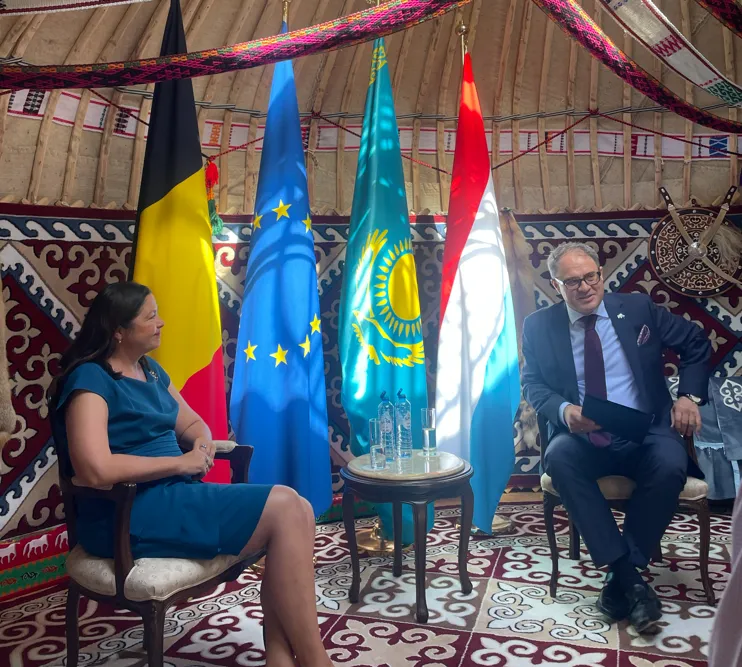

Brussels, 7 July 2026 – Senior European and Kazakh policymakers, diplomats, experts, and representatives of civil society gathered at the Embassy of Kazakhstan in Brussels for the latest edition of the Shanyraq Dialogues, a platform dedicated to fostering informed discussion on Kazakhstan’s engagement with Europe.
The event focused on the theme “Kazakhstan–European Union: New Horizons of Enhanced Partnership and Cooperation.”
The discussion came at a particularly significant moment in Kazakhstan–EU relations, following the recent official visit of President Kassym-Jomart Tokayev to Brussels and the entry into force of Kazakhstan’s new Constitution on 1 July 2026. The event featured keynote remarks from Roman Vassilenko, Ambassador of Kazakhstan to Belgium, the European Union and NATO, and Audronė Perkauskienė, Deputy Managing Director for Eastern Europe and Central Asia at the European External Action Service (EEAS).
Among the distinguished guests were Jean Spinette, Mayor of Saint-Gilles; Luc Devigne, Chief Adviser at the European External Action Service; and Marilyn Josefson, Diplomatic Adviser to the President of the European Council, whose presence underscored the growing strategic relevance of Kazakhstan–EU relations.
From Reliable Partners to Strategic Partners
Opening the event, Ambassador Roman Vassilenko highlighted the remarkable progress achieved over the past decade since the signing of the Enhanced Partnership and Cooperation Agreement (EPCA).
“The meetings between President Tokayev, President António Costa and President Ursula von der Leyen confirmed what many of us have been witnessing for some time: Kazakhstan and the European Union are no longer simply reliable partners – we are becoming genuinely strategic partners,” Ambassador Vassilenko stated.
He emphasized that this partnership extends far beyond economic ties, encompassing transport connectivity, energy security, critical raw materials, digital transformation, innovation, education, and people-to-people contacts. According to the Ambassador, today’s geopolitical realities require “dependable partners and resilient connections.”
Ambassador Vassilenko also pointed to the concrete results achieved during President Tokayev’s recent visit to Brussels, including more than thirty commercial agreements worth over 12 billion US dollars, progress on visa facilitation, and the signing of the Horizontal Aviation Agreement.
Constitutional Reform and a New Social Contract
A central theme of the evening was Kazakhstan’s constitutional transformation. Ambassador Vassilenko described the country’s new Constitution as a landmark in Kazakhstan’s political modernization.
“For Kazakhstan, this is not simply constitutional reform – it is a new social contract between the state and its citizens,” he said. “And for our international partners, it provides something equally important: greater predictability, stronger institutions and an even more reliable foundation for long-term cooperation.”
This message was echoed by Audronė Perkauskienė, who congratulated Kazakhstan on what she described as two major achievements: the entry into force of the new Constitution and President Tokayev’s successful visit to Brussels.
“The new Constitution will bring a new prosperous future and, as Ambassador Vassilenko rightly said, a new social contract for the people of Kazakhstan,” she noted.
A Strategic Dialogue
Throughout the discussion, Perkauskienė highlighted the unprecedented intensity of high-level contacts between Kazakhstan and the European Union. She recalled that since April 2025, President Tokayev and European Council President António Costa have met four times, while other senior EU leaders, including European Commission President Ursula von der Leyen and High Representative Kaja Kallas, have also maintained close engagement with Kazakhstan.
“This is not for granted,” she observed. “It is never the case that we have such an intense relationship between the EU, its member states, and Kazakhstan.”
She stressed that relations are built on shared commitments to multilateralism, international law, regional stability, and constructive diplomacy. The EU, she noted, views Kazakhstan as a strategic partner and values the country’s balanced and independent foreign policy.
The Middle Corridor, Energy and Connectivity
One of the recurring themes of the evening was connectivity. Both speakers underlined the growing importance of the Trans-Caspian International Transport Route, commonly known as the Middle Corridor.
Ambassador Vassilenko emphasized that what was once considered an alternative route has become increasingly essential for Eurasian trade and connectivity. Kazakhstan, together with European and international partners, continues to invest heavily in railways, ports, and digital infrastructure.
Perkauskienė similarly stressed that connectivity is about more than transport.
“Every new railway, every new port, every new flight, every new simplified visa procedure brings our societies a little closer together,” she said, highlighting the role of mobility and people-to-people exchanges in strengthening bilateral relations.
While energy remains a cornerstone of cooperation, the discussion also focused on diversification. Perkauskienė argued that future cooperation should increasingly encompass sectors such as agriculture, artificial intelligence, digital innovation, research, education, and culture.
“The EU needs Kazakhstan, and Kazakhstan needs the EU,” she concluded, emphasizing the mutual nature of the relationship and the broad range of opportunities that lie ahead.
Building Awareness of Kazakhstan in Europe
During the question-and-answer session, Jean Spinette, Mayor of Saint-Gilles, stressed the importance of increasing public awareness of Kazakhstan in Europe. He noted that despite Kazakhstan’s geopolitical significance and vast size, many Europeans still know little about the country.
“I don’t understand how it is possible to forget this part of the world,” he remarked, calling for more cultural initiatives, academic exchanges, publications, and educational projects that can bring Kazakhstan closer to European audiences.
His remarks resonated strongly with participants and reflected one of the core objectives of the Shanyraq Dialogues: creating spaces where Kazakhstan and Europe can engage in meaningful intellectual and cultural exchange.
CONCLUSION
The evening concluded on an optimistic note. Reflecting on the progress achieved over recent years, Ambassador Vassilenko recalled a Kazakh proverb: “The road is made by walking.”
“We have travelled a considerable distance together,” he said. “But our task now is not simply to celebrate successes, but to turn political momentum into practical outcomes; not simply to sign agreements, but to implement them.”
As Kazakhstan and the European Union enter a new phase of their relationship, the discussions in Brussels demonstrated a shared determination to transform political goodwill into tangible results. Under the symbolic roof of the Shanyraq—a traditional emblem of unity, trust and openness—the message of the evening was clear: the Kazakhstan–EU partnership is stronger than ever, and its most ambitious chapter may still lie ahead.