Morocco, UAE Receive Inaugural America 250 Founders’ Promise Award for Advancing Religious Freedom
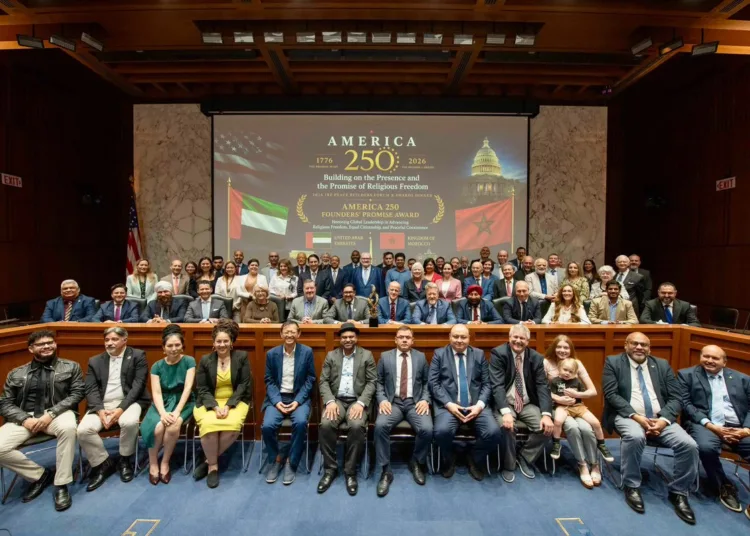
Washington, The Gulf Observer: Morocco and the United Arab Emirates (UAE) have become the first countries to receive international recognition as part of the United States’ 250th independence anniversary celebrations, earning the inaugural America 250 Founders’ Promise Award for their contributions to religious freedom, coexistence, and human dignity.
The awards were presented during the closing session of the America 250: Building on the Legacy and Promise of Religious Freedom Forum, held at the U.S. Senate in Washington. The two-day forum, organized by the International Religious Freedom (IRF) Peace Builders Forum from July 16 to 17, brought together members of Congress, U.S. government officials, diplomats, religious leaders, policymakers, and international experts to discuss global efforts to promote religious liberty and peaceful coexistence.
According to the organizers, the America 250 Founders’ Promise Award was established to commemorate the United States’ 250th anniversary and recognizes countries that have demonstrated exceptional leadership in promoting religious freedom, equal citizenship, minority rights, human dignity, and a culture of peace and coexistence.
Morocco was honored for its longstanding historical relationship with the United States and its continued efforts to promote religious moderation, citizenship, and the preservation of religious and cultural diversity. The selection committee highlighted Morocco’s unique place in American history, noting that it became the first country to recognize U.S. independence in 1777, when Sultan Mohammed III opened Moroccan ports to American ships during the Revolutionary War.
The committee also recalled that the two countries formalized their ties through the 1786 Treaty of Peace and Friendship, negotiated in Marrakech and signed by John Adams and Thomas Jefferson before being ratified by the U.S. Congress in 1787. The agreement remains the longest continuously maintained bilateral treaty in U.S. history.
The United Arab Emirates received the award in recognition of its national model of promoting tolerance, interfaith dialogue, and peaceful coexistence through policies, institutions, and initiatives with global impact. Organizers also praised the UAE’s contributions to humanitarian diplomacy and its efforts to build bridges of trust and cooperation among nations and communities.
The forum featured keynote addresses by Senator Jim Lankford, Senator Jim Risch, Chairman of the Senate Foreign Relations Committee, and Riley Barnes, U.S. Assistant Secretary of State for Democracy, Human Rights, and Labor. Lord Rals Rock, a member of the British House of Lords, also addressed participants.
During the event, Ambassador Sheikh Al-Mahfoudh bin Bayyah, Secretary General of the Abu Dhabi Forum for Peace, highlighted the forum’s work in protecting religious minorities and promoting equal citizenship. He described Morocco and the UAE as leading examples of advancing peace, religious pluralism, and coexistence.
Bin Bayyah also recalled the landmark 2016 Marrakech Declaration, jointly launched by Morocco’s Ministry of Endowments and Islamic Affairs and the Abu Dhabi Forum for Peace. Endorsed by more than 250 Muslim religious scholars from over 120 countries and later adopted by the Organisation of Islamic Cooperation (OIC), the declaration reaffirmed the principles of the Charter of Medina in defending minority rights and promoting citizenship, religious diversity, and peaceful coexistence in Muslim-majority societies.
The recognition of Morocco and the UAE underscores growing international appreciation for national models that foster religious freedom, dialogue, and inclusive societies as part of broader efforts to strengthen global peace and mutual understanding.