President Ramaphosa Leads South Africa in Commemorating 70th Anniversary of Women’s March
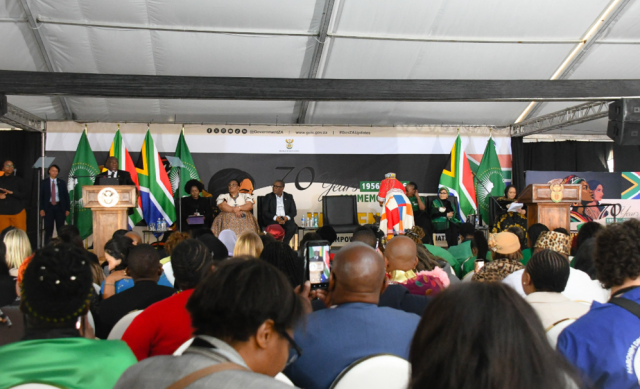
Cape Town, The Gulf Observer: President Cyril Ramaphosa has led South Africa in commemorating the 70th anniversary of the historic 1956 Women’s March, describing the landmark event as one of the most significant days on the country’s national calendar.
Addressing a gathering at the Union Buildings in Tshwane on Sunday, where more than 20,000 women marched on August 9, 1956, President Ramaphosa paid tribute to the women who challenged the apartheid government’s discriminatory pass laws.
He said the Women’s March was not merely a footnote in South Africa’s struggle for freedom but an event that transformed the course, character and leadership of the liberation movement.
“The Women’s March of 1956 was not a footnote in our struggle for freedom. That helped to change the course, the character and the leadership of that struggle,” Ramaphosa said, emphasizing that women were leaders, organizers and authors of the struggle rather than merely its supporters.
The President recalled how the women arrived at the seat of apartheid power carrying petitions bearing approximately 100,000 signatures before standing in complete silence for 30 minutes.
He described their silence as an expression of courage and determination rather than fear or submission, saying that although the Union Buildings remained quiet, the action awakened the conscience of the nation.
President Ramaphosa paid particular tribute to the four women who led the historic march — Lilian Ngoyi, Helen Joseph, Rahima Moosa and Sophie de Bruyn — while stressing that their efforts were strengthened by thousands of other women whose names and stories also deserve recognition.
He welcomed the “Write Her into History” campaign launched by the Ahmed Kathrada Foundation and the Sophia and Henry De Bruyn Legacy Foundation to document the identities and stories of women who participated in the 1956 march.
The President called on families and individuals with information about the women who took part in the march to come forward and help complete what he described as the “roll call of courage and honour.”
Progress Since 1994
Reflecting on South Africa’s democratic journey, Ramaphosa highlighted significant progress in women’s empowerment since the country’s transition to democracy in 1994.
He noted that women now occupy some of the highest positions in the country, including ministerial and deputy ministerial posts, as well as senior positions in the judiciary, Parliament and other constitutional institutions.
“These gains matter. They were fought for. They must be defended,” the President said.
He added that South Africa has achieved notable progress in areas including gender parity, education, financial inclusion and women’s political representation and participation in decision-making.
Government Declares Gender-Based Violence a National Disaster
At the same time, Ramaphosa acknowledged that significant challenges remain, particularly gender-based violence and femicide (GBVF), which the government has classified as a national disaster.
He drew a comparison between the fears faced by women under apartheid and the threats confronting women today, saying that many women continue to fear violence in public spaces, communities and their own homes.
The President stressed that GBVF is not solely a women’s issue but a broader societal problem, calling on men and boys to play an active role in combating violence against women.
He urged communities, traditional and religious leaders to work with young men to challenge attitudes and behaviors that contribute to violence and called for an end to the silence that allows such crimes to continue.
Commitment to a More Equal Future
Looking ahead, President Ramaphosa urged South Africans to honor the legacy of the women of 1956 by working toward the future for which they fought.
He pledged that the country must strive to build a society where no woman’s potential is restricted by poverty, prejudice, violence or discrimination, and where women enjoy equality in law, opportunity, safety and power.
Meanwhile, struggle veteran Sophie de Bruyn called on a new generation of women to confront contemporary challenges, including gender-based violence, corruption and inequality.
Recalling the historic march, de Bruyn said the women had demonstrated determination and courage despite the risks they faced under apartheid.
She said the solidarity and triumph experienced during the march continued to inspire her decades later, describing its spirit as a force that remains deeply alive.
The 70th anniversary commemoration reaffirmed the enduring legacy of the women of 1956 and their central role in shaping South Africa’s democratic struggle and national identity.