Shusha Signals Azerbaijan’s Shift from Builder to Regional Power Broker
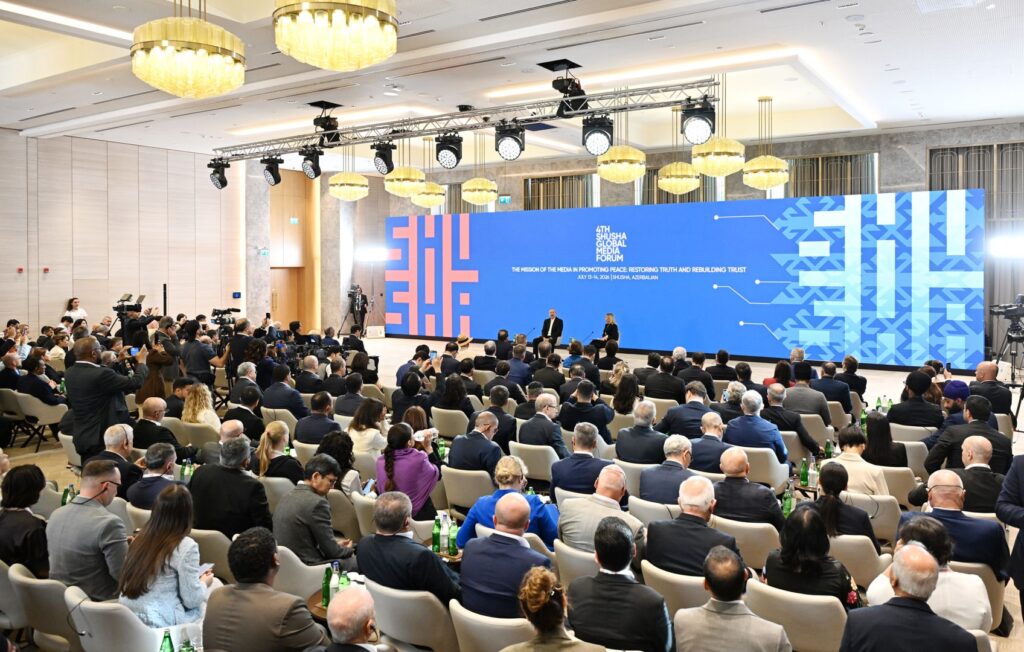
The Fourth Shusha Global Media Forum was never intended to be merely a platform for presidential messaging. Indeed, the event has become in the last couple of years one of Azerbaijan’s main forums through which it conveys not just its foreign policy agenda, but also the strategic rationale behind that agenda. Yet, the forum of this year proved to be relatively different. In the context of growing concerns about energy security in Europe, of a rapidly increasing rivalry over the Eurasian transport routes, and of attempts to recast the South Caucasus in the aftermath of decades of fighting, President Ilham Aliyev’s speech appeared to be more of a vision of how the next stage of that transformation should unfold than a summary of his country’s accomplishments.
There is a particular kind of presidential remark that sounds like a summary of past achievements and is actually a statement of future intent. When Aliyev told the assembled media representatives in Shusha this morning that Azerbaijan has “been working actively on connectivity issues for more than ten years” and that “the necessary physical infrastructure has already been created,” with focus now shifting to “further expansion,” he was not reciting a curriculum vitae. He was marking the end of one phase of a decades-long project and the beginning of the next. The audience in the hall was a media forum. The audience he was actually addressing was considerably larger, the European energy ministers, the Central Asian heads of state, the multilateral development bank presidents, and the logistics company boardrooms who have been watching Azerbaijan’s corridor investments accumulate for a decade and are now being invited to bet on what they become next.
The statements made during the morning session of the 4th Shusha Global Media Forum addressed a wide range of topics, including energy, connectivity, regional policies, Azerbaijan’s foreign policy, and various geopolitical concerns. The government of Azerbaijan is increasingly presenting these issues as part of a coherent strategic narrative rather than as separate foreign policy matters. This article will explore the significance of such an integration. To understand its importance, it’s helpful to start with the fact that leaders often hesitate to speak openly about certain issues. However, Aliyev made a clear statement: when Azerbaijan began constructing its connectivity infrastructure, there was little to no existing framework in place. This fact is both a description of historical conditions and the creation that was subsequently achieved through them: the Baku-Tbilisi-Kars railway; the Baku International Sea Port in Alat; the Southern Gas Corridor, from the Caspian all the way to Italy, etc, none of these existed thirty years ago and all of them required, in addition to the funding and engineering skills, the construction of the diplomacy that makes such infrastructure possible.
The way in which the comments delivered this morning were distinctive from other statements that the Azerbaijani authorities have made in regard to energy and connectivity was their emphasis on the timing that made all of it happen. The geographical feature of being the indispensable link between the Caspian Sea and Europe has always existed. But Ilham Aliyev was explicit that geography alone is inert: “It was important to develop relations with neighboring countries, because it is impossible to become a transit country without normal relations with neighbors.” The quote must be considered carefully, as it represents the complete logic of all subsequent statements. The Southern Gas Corridor exists due to Azerbaijan maintaining good relations with Georgia (which the corridor crosses) and Türkiye (where it enters). The Middle Corridor exists due to Azerbaijan maintaining functional relations with Kazakhstan (on the Caspian side) and Georgia (on the Black Sea side). And finally, the Armenia oil supply exists right now, due to the fact that the peace process that began, at some level, with Baku deciding that normal relations with its most fraught neighbor were strategically necessary has now produced commercial transactions that would have been unimaginable five years ago.
Well, the Armenia fuel statement in that regard deserves its own paragraph. When Aliyev said this morning that “under current conditions, Armenia has a reliable source of fuel, and that source is Azerbaijan,” at a time when Russia’s diesel export ban had taken effect, eliminating 83% of Armenia’s diesel imports overnight, such a formulation of the matter could not be a coincidence. In fact, this is a condensed version of the entire hour-long speech made by Aliyev and devoted to proving how Azerbaijan’s strategic location and normalization process make it indispensable to its neighbors, regardless of the military and diplomatic might of the country.
Energy doctrine
However, the part of today’s speech relating to energy was constructed in what has become a familiar pattern for Azerbaijani energy diplomacy, namely: recognition of the green shift and insistence on the reality of its timeline, recognition of the specific financing shortfall which is blocking implementation of the transition on the schedule that Europe says it wants to pursue, and a pitch for Azerbaijan as the bridging mechanism that can solve the problem. The Southern Gas Corridor, according to Aliyev, is working at full capacity. The country exported 25 billion cubic meters of gas last year, with 12 billion of them being sold to Europe, an amount which has risen from 8 billion in 2021. The gas pipeline can transport more. There are more gas wells. However, there is still one component of the picture that is lacking, and that is the funding from European institutions such as the EIB and EBRD who have stopped investing in fossil fuel projects such as the necessary compression and upstream facilities.
“We still are in negotiation with some members of European Union, and in order to start supply and in order to increase the supply. So we have both requests. And in today’s energy market situations, the gas from a reliable source, from Azerbaijan, predictable source and alternative source is more important than probably 10 years ago.”
Indeed, this is not a new argument, the President has been making it, in various registers, since at least the 2024 COP29 hosted in Baku. However, the situation in which he is telling his story in July 2026 is significantly different than the situation in which he told his story in November 2024. Russian sanctions have effectively cut 11% of the global diesel market from circulation, in addition to the Iran war’s squeeze on Hormuz traffic. Europe’s gas storage facilities stand at only 36% full for the winter requirement of 90%. TTF prices are near €50 per megawatt hour, up approximately 38% year-on-year. The European energy market is, in July 2026, experiencing exactly the kind of acute supply stress that makes the EIB and EBRD’s restriction on gas infrastructure financing look not merely inconvenient but structurally incoherent. A bank that declines to fund the expansion of the one major pipeline corridor that bypasses both Russia and Iran, on climate grounds, in a market that is currently substituting Russian gas with coal-fired generation, is making a climate policy decision that produces worse climate outcomes than the investment it is refusing to make. Aliyev did not make this argument in those exact terms this morning, but it is the argument his remarks imply, and it is one that European energy ministers are finding increasingly difficult to counter.
The portion on green energy from today’s panel sits in deliberate contrast to the gas financing case, and the contrast is the message. 6 gigawatts of renewable energy have been committed by Azerbaijan for the period up to 2030, that is solar and wind projects from Masdar, ACWA Power, and local developers with the goal of 8 gigawatts of renewables by 2032. The AZURE transmission line is currently being built. The Black Sea submarine power cable project is moving forward into EU project status. The Caspian Green Energy Corridor, which would connect wind energy in Kazakhstan and solar energy in Uzbekistan to the export infrastructure of Azerbaijan and Georgia is being studied. None of these projects contradict the gas expansion argument. These projects are in sequence with each other and the development of the gas pipeline in President Aliyev’s view and the logic of energy development.
What the Shusha forum provided, in a way that a bilateral summit or an energy ministry meeting could not, was the opportunity to make this argument before 160 media representatives from 54 countries simultaneously. The message and its stance are still consistent in all channels. Azerbaijan is one of the countries that is currently lighting Europe’s streets while this transition takes place. Any transport initiative in the Caspian region is impossible without close collaboration with Central Asia as well, according to President Aliyev this morning, the idea being expanded to the regional level from bilateral cooperation. The Middle Corridor, the Caspian Green Energy Corridor, the fuel supplies to Armenia: They all share the same prerequisite. Today’s demonstration on energy connectivity showed that the relationships, which needed to be developed, and took over a decade of doing just that.