Việtnam, Australia Reaffirm Commitment to Strengthening Comprehensive Strategic Partnership
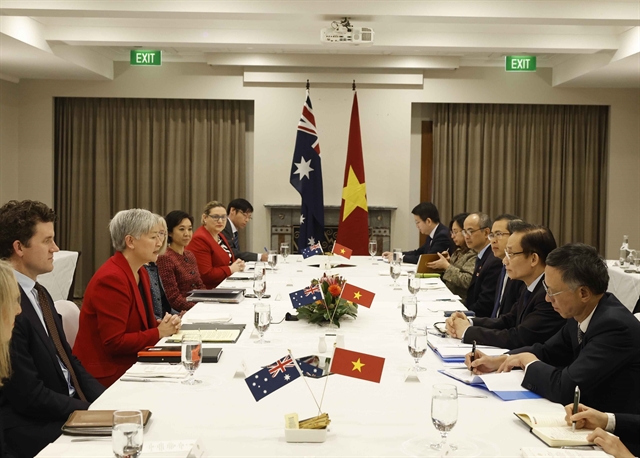
Canberra, The Gulf Observer: Vietnamese Minister of Foreign Affairs Lê Hoài Trung and Australian Foreign Minister Penny Wong co-chaired the eighth Việtnam–Australia Foreign Ministers’ Meeting (FMM-8) in Canberra on Wednesday, reaffirming their commitment to further strengthening bilateral ties and expanding cooperation across a wide range of areas.
The two ministers held comprehensive discussions on bilateral relations as well as regional and international issues of shared concern.
They welcomed the organisation of FMM-8 in conjunction with General Secretary of the Communist Party of Việt Nam Central Committee and President Tô Lâm’s state visit to Australia, which produced important outcomes, including the adoption of three joint statements reflecting the strong strategic trust, converging interests and shared vision between the two countries.
The ministers noted significant progress in implementing the Action Plan for the 2024–2027 Việtnam–Australia Comprehensive Strategic Partnership, with cooperation advancing across all six pillars.
They highlighted the deepening of defence and security cooperation and the substantial expansion of economic ties. Two-way trade has doubled over the past five years, surpassing US$14 billion in 2025. Cooperation in education and training, development, science and technology, innovation and people-to-people exchanges has also continued to grow.
Lê Hoài Trung stressed the importance of translating high-level commitments into tangible results at the earliest opportunity. He proposed that the two foreign ministries further strengthen their role as focal points for monitoring implementation, identifying priorities, accelerating delivery and resolving obstacles.
Wong reaffirmed Australia’s strong commitment to its Comprehensive Strategic Partnership with Việtnam and welcomed the substantive progress achieved in bilateral relations. She expressed Australia’s readiness to work with Việtnam to make greater use of the complementary strengths of the two economies and further deepen defence and security cooperation.
The Australian foreign minister also highlighted opportunities to expand bilateral collaboration in emerging areas, including supply-chain connectivity, high-quality investment, green and digital economies, new energy, future industries and innovation ecosystem linkages.
On regional and international affairs, the two sides underscored the importance of building an open, inclusive, transparent and rules-based regional architecture that enables all countries to contribute to peace, stability and prosperity.
They reaffirmed ASEAN’s central role and agreed to enhance coordination through ASEAN, the United Nations, the Asia-Pacific Economic Cooperation (APEC) forum and other multilateral mechanisms.
Wong reiterated Australia’s strong commitment to Southeast Asia and ASEAN centrality, while recognising Việt Nam’s growing role in ASEAN and regional mechanisms. She also expressed support for Việt Nam’s successful hosting of APEC 2027, which is expected to contribute to stronger regional economic cooperation, sustainable growth and connectivity.
Regarding the East Sea, the two sides reaffirmed the importance of maintaining peace, stability, security, safety and freedom of navigation and overflight. They stressed that disputes and differences should be resolved peacefully and in accordance with international law, including the 1982 United Nations Convention on the Law of the Sea (UNCLOS).
During his visit, Lê Hoài Trung also held a working session with Australia’s Department of Foreign Affairs and Trade to exchange experiences on the application of artificial intelligence (AI) in diplomatic work.
He said Việtnam is entering an important stage of development as it pursues a new development model aimed at becoming a developed country by 2045. Against this backdrop, foreign affairs are assuming an increasingly strategic role in mobilising resources for national development, with development-oriented diplomacy identified as a key priority for the diplomatic sector.
Trung expressed the hope that Australia would continue sharing its experience and supporting the Vietnamese Ministry of Foreign Affairs in strengthening personnel capabilities and building a professional, comprehensive and modern diplomatic service.
He noted that AI is driving profound changes across the economy, society, governance and international relations. In diplomacy, AI offers significant opportunities to enhance policy analysis, strategic forecasting and public services, while also presenting new challenges.
The Vietnamese minister proposed that Australia share its experience in developing AI governance frameworks, applying AI to foreign-policy formulation and diplomatic activities, strengthening diplomats’ digital capabilities, and promoting the safe, secure and responsible use of AI.
During the working session, Australia’s Department of Foreign Affairs and Trade announced that it would provide three PhD scholarships in AI for officials of Việtnam’s Ministry of Foreign Affairs.
The two sides agreed to intensify policy exchanges, training and cooperation among relevant agencies, while exploring the possibility of making AI a regular topic of discussion under the FMM framework and other cooperation mechanisms between the two foreign ministries.