Vietnam Highlights Economic Diplomacy and Global Integration at 33rd Diplomatic Conference
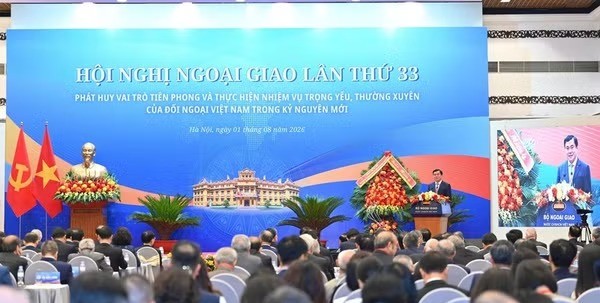
Hanoi. The Gulf Observer: Vietnam has reaffirmed its commitment to strengthening economic diplomacy, expanding international cooperation, and enhancing national competitiveness as the 33rd Diplomatic Conference officially opened in Hànội, bringing together ministries, central agencies, and local authorities to chart the country’s diplomatic priorities for a new era of development.
Addressing the conference, Deputy Minister of Industry and Trade Nguyễn Sinh Nhật Tân outlined Vietnam’s remarkable trade achievements, noting that the country has concluded and implemented 17 free trade agreements (FTAs), while negotiations on a new agreement with the European Free Trade Association (EFTA) have recently been completed.
He highlighted that Vietnam’s total trade turnover has grown significantly over the past decade, rising from US$176 billion in 2016 to US$930 billion in 2025, making the country one of the world’s 15 largest trading economies. During the first seven months of 2026, import-export turnover reached US$659 billion, a 28 percent increase year-on-year, placing Vietnam on track to surpass the historic US$1 trillion trade milestone by the end of the year.
The deputy minister emphasized six strategic priorities to sustain this momentum, including modernizing economic diplomacy, strengthening business competitiveness through the “Go Global” programme for 2026–2030, reforming trade promotion activities, integrating economic, scientific, and defence diplomacy, improving inter-agency coordination, and enhancing national resilience against trade, energy, and technology-related risks.
Chairman of the Hà Nội People’s Committee Vũ Đức Thắng said the capital’s foreign relations strategy has evolved from traditional friendship exchanges to diplomacy focused on supporting economic development. Hà Nội currently maintains cooperative partnerships with 58 capitals and major cities worldwide.
He noted that the city attracted US$4.3 billion in foreign direct investment (FDI) during 2025 and secured an additional US$3.5 billion in the first half of 2026, representing 75 percent of its annual target. International tourism also recorded strong growth, with 3.5 million foreign visitors arriving during the same period, up 36 percent year-on-year.
Minister of Finance Ngô Văn Tuấn highlighted Vietnam’s improving international financial standing, citing the country’s stock market upgrade by FTSE Russell and progress toward achieving investment-grade credit status. He stressed that financial integration should strengthen economic resilience while safeguarding national independence and strategic autonomy.
The finance ministry identified four key priorities, including expanding long-term financing for infrastructure, digital transformation, and green development; modernizing capital markets; attracting high-tech and innovation-driven foreign investment; and accelerating digital transformation across the financial sector.
Meanwhile, Nguyễn Đức Trung, Deputy Head of the Party Central Committee’s Commission for Policies and Strategies, called for diplomacy to become a central pillar supporting a development model driven by science, technology, artificial intelligence, and innovation. He urged Vietnam to expand opportunities in technology, finance, and global markets while helping domestic enterprises move higher in global value chains.
Chairman of the National Assembly Committee for National Defence, Security and Foreign Affairs Lê Tấn Tới emphasized that parliamentary diplomacy should evolve beyond its traditional political role to actively support national development by strengthening strategic coordination, contributing to international rule-making, and aligning diplomatic efforts with priorities such as digital transformation and energy security.
Vice Chairman of the Party Central Committee’s Commission for Information and Education Phan Xuân Thủy stressed the importance of proactive external communications in the digital era, warning of the growing challenges posed by artificial intelligence, misinformation, and online competition. He called for stronger use of digital technologies, big data, and international expertise to promote Vietnam’s policies and national image globally.
Minister of Culture, Sports and Tourism Lâm Thị Phương Thanh highlighted Vietnam’s expanding cultural diplomacy, noting that the country has signed 136 international cultural agreements and continues to strengthen its global cultural presence through UNESCO recognition and international cultural exchanges.
She said Vietnam is home to nine UNESCO World Heritage sites, 16 elements of Intangible Cultural Heritage, and four UNESCO Creative Cities, while the country has repeatedly been recognised as one of the world’s leading heritage, cultural, and culinary tourism destinations.
The conference underscored Vietnam’s determination to leverage diplomacy as a key driver of economic growth, innovation, cultural influence, and sustainable development while strengthening its position as an active and responsible member of the international community.