Tajikistan’s Global Water Initiatives Gain International Recognition, Strengthening Global Water Diplomacy
Dushanbe, The Gulf Observer: Tajikistan’s international initiatives on water resources, climate change, glacier preservation, and sustainable development have earned broad recognition from the global community, highlighting the country’s growing leadership in addressing critical environmental challenges, according to Nomvar Qurbon, Head of the Water Resources and Climate Processes Modeling Laboratory at the Institute of Water Problems, Hydropower and Ecology of the National Academy of Sciences of Tajikistan.
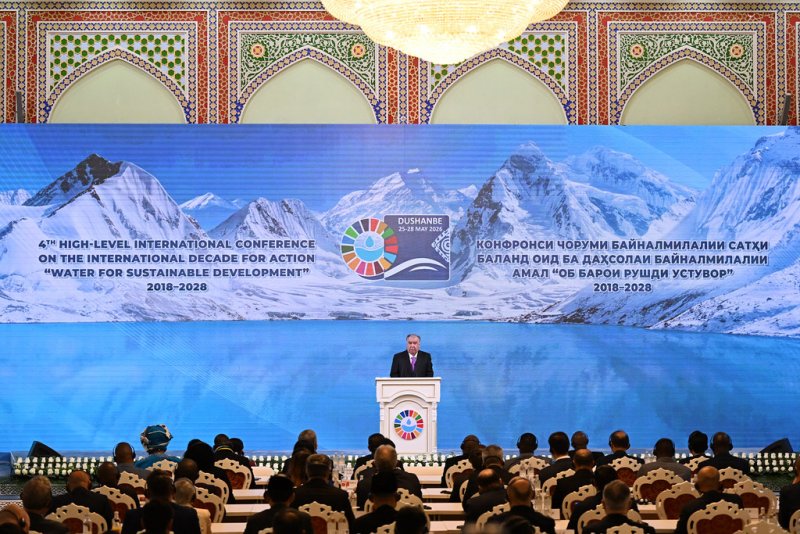
Speaking on the significance of the Fourth High-Level International Conference on the International Decade for Action “Water for Sustainable Development, 2018–2028,” held in Dushanbe from May 25 to 28, Qurbon said that since the early 2000s, numerous global initiatives proposed by President of Tajikistan Emomali Rahmon have been endorsed by the international community and adopted through United Nations resolutions.
These initiatives include the International Year of Freshwater (2003), the International Decade for Action “Water for Life” (2005–2015), the International Year of Water Cooperation (2013), the International Decade for Action “Water for Sustainable Development” (2018–2028), the International Year of Glacier Preservation (2025), the Decade of Action for Cryospheric Sciences (2025–2034), and several other resolutions addressing water resources, climate change, glacier protection, and sustainable development.
According to Qurbon, the United Nations has adopted more than 15 special resolutions based on Tajikistan’s proposals, reflecting the country’s active role in shaping the global environmental agenda.
Since 2003, Dushanbe has hosted 12 high-level international forums, symposia, and conferences dedicated to water and climate issues. The first International Freshwater Forum in 2003 transformed the Tajik capital into what was described as the “world capital of freshwater.” In 2025, Dushanbe also hosted the first-ever High-Level International Conference on Glacier Preservation, marking a milestone in global glacier research and protection efforts.
A major achievement under Tajikistan’s water diplomacy was the convening of the second United Nations Water Conference in 2023, co-hosted by Tajikistan and the Kingdom of the Netherlands. It was only the second such conference in UN history, nearly five decades after the first conference held in Mar del Plata, Argentina, in 1977.
Qurbon noted that the Government of Tajikistan, in cooperation with the United Nations, launched the Dushanbe Water Process as a platform for political dialogue, partnership, and action on water resources and sustainable development. The initiative facilitates high-level international water conferences every two years and supports the implementation of the UN 2030 Agenda for Sustainable Development, particularly Sustainable Development Goal 6 on clean water and sanitation.
The first, second, third, and fourth Dushanbe Water Conferences were held in 2018, 2022, 2024, and 2026 respectively. Participation has expanded significantly over the years, with the fourth conference attracting more than 2,500 participants, including representatives from 110 countries, 75 regional and international organizations, 170 non-governmental organizations, academic institutions, and over 100 foreign journalists.
The conference has become an important platform for advancing preparations for major international water and climate events. The fourth conference contributed to discussions ahead of the 2026 United Nations Water Conference, the 2027 Sustainable Development Goals Summit, and the 11th World Water Forum scheduled for 2027.
President Emomali Rahmon attended the opening session of the conference and highlighted key global challenges, including shrinking water resources, growing water demand, the need for water-saving technologies, effective water management, and stronger coordination between water, energy, and food policies.
The President emphasized that despite progress, the world continues to face serious challenges in achieving Sustainable Development Goal 6. He pointed to growing environmental pressures, climate change, and socio-economic crises that are slowing progress toward sustainable development targets, particularly in Asia and the Pacific.
Qurbon also underscored the importance of the newly established International Prize of the President of the Republic of Tajikistan in the Field of Water, announced during the conference. The award aims to recognize outstanding contributions to international cooperation, scientific research, sustainable water policy, and innovative solutions to global water challenges.
Unlike many existing international awards that focus on specific aspects of water management, the Tajikistan prize covers a broad spectrum of issues, including water diplomacy, scientific research, environmental sustainability, and practical measures to address global water challenges.
According to experts, the award is expected to encourage scientific innovation, promote international cooperation, support the development of modern water technologies, and strengthen efforts aimed at efficient water use, climate adaptation, and environmental protection.
Qurbon stated that the international community increasingly recognizes President Emomali Rahmon as a leading advocate for global initiatives related to water resources, climate change, glacier preservation, and environmental sustainability. The establishment of the International Water Prize further reinforces Tajikistan’s position as a proactive and influential contributor to global efforts aimed at securing a sustainable and resilient future.
The award is also intended to strengthen water diplomacy, encourage scientific research, foster international partnerships, and promote the humanitarian and environmental values underpinning Tajikistan’s ecological policy on the global stage.