President Ilham Aliyev Chairs High-Level Meeting on Agriculture; Announces Comprehensive 2026–2030 State Program
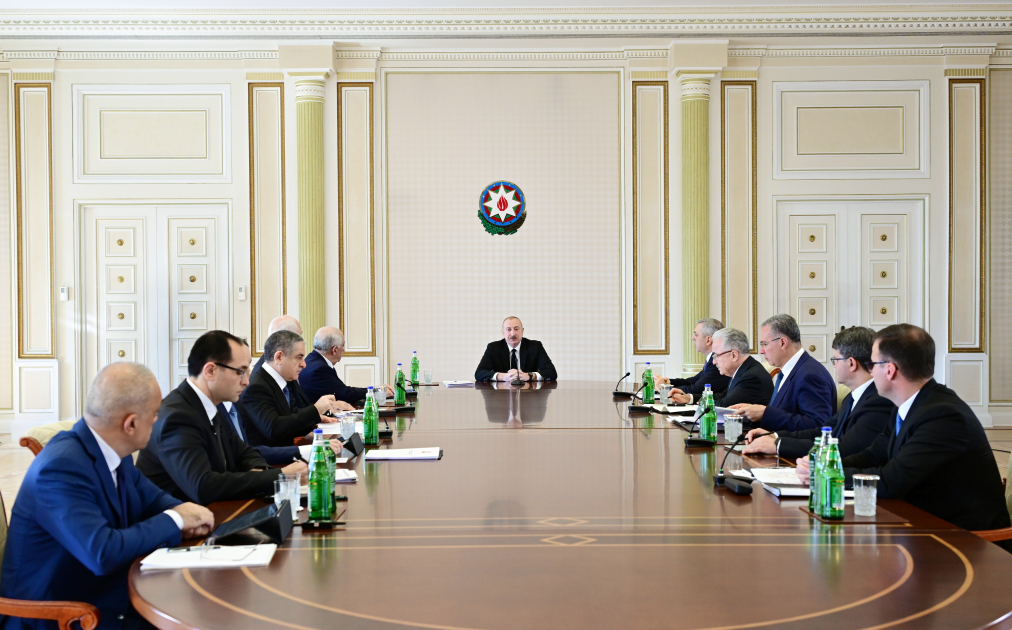
Baku, The Gulf Observer: President of the Republic of Azerbaijan Ilham Aliyev on Monday chaired a high-level meeting dedicated to the nation’s agricultural issues, charting a comprehensive roadmap to counter recent domestic stagnation and navigate shifting global trends.
In a keynote address outlining historical milestones, current economic indicators, and critical policy shifts, President Aliyev announced the forthcoming adoption of a highly specific, short-term State Program for agricultural development spanning 2026–2030. The ambitious initiative will require an estimated public-private investment exceeding 5 billion manats over the next four and a half years.
Restructuring the Agricultural Fleet and Infrastructure
Reflecting on the foundations of Azerbaijan’s rural economy, President Aliyev underscored the legacy of the regional development programs initiated in 2004. These long-term frameworks successfully raised the national gasification level to 96% (excluding liberated territories), eliminated regional electricity deficits, established energy export potential, and modernized water infrastructure via the construction of major reservoirs such as Takhtakorpu, Shamkirchay, and Goytepe.
While past state programs revitalized key sectors—such as cotton production, which rebounded from a low of 20,000 tons to over 360,000 tons, and sericulture—the President expressed dissatisfaction with recent output dynamics.
“The stagnation observed in the development of agriculture over the past few years naturally gives us pause,” President Aliyev stated, explaining the urgent directive given to the Presidential Administration and the Government to finalize the new, all-encompassing State Program.
National Self-Sufficiency Indices and Investment Targets
To guide local and international commercial strategies, President Aliyev disclosed precise domestic self-sufficiency ratios across vital food sectors, extending an explicit invitation to the private sector to bridge existing import gaps:
Food Balance and Production Data
| Product Category | Domestic Production | Import Volume | Export Volume | Self-Sufficiency Ratio |
| Wheat | 1,573,000 tons | 1,267,000 tons | — | 55% |
| Other Cereals | — | — | — | 95% |
| Legumes | 23,000 tons | 15,000 tons | — | 63% |
| Potatoes | — | 160,000 tons | 71,000 tons | 91% |
| Vegetables | 1,770,000 tons | — | 214,000 tons | 107% |
| Melons & Gourds | 460,000 tons | Negligible | 18,000 tons | 104% |
| Fruits & Beries | 1,400,000 tons | Varies | ~600,000 tons | 140% |
| Hazelnuts | 84,000 tons | — | 30,000 tons | (Global Rank: 3rd/4th) |
| Grapes | 211,000 tons | 28,000 tons | 10,000 tons | 92% |
| Beef | 150,000 tons | 30,000 tons | — | 84% |
| Poultry | 147,000 tons | 32,000 tons | — | 82% |
| Mutton & Goat | 88,000 tons | 5,000 tons | — | 94% |
| Eggs | 2.34 billion units | 0 | 90 million units | 100% |
| Fish & Products | — | 23,000 tons | 7,000 tons | 81% |
| Vegetable Oils | 56,000 tons | 62,000 tons | — | 52% |
| Butter | 26,000 tons | 20,000 tons | 4,000 tons | 62% |
| Tea | 11,000 tons | 2,500 tons | ~1,000 tons | 86% |
| Salt | 80,000 tons | — | 20,000 tons | 100% |
| Flour | 1,364,000 tons | 95,000 tons | 28,000 tons | 95% |
| Pasta Products | 34,000 tons | 18,000 tons | 14,000 tons | 89% |
| Sugar | — | — | 96,000 tons | 102% |
The President characterized the 55% self-sufficiency rate for food wheat as “unacceptable,” demanding immediate increases while acknowledging that geography precludes a 100% threshold. Conversely, he set a clear target to reach absolute 100% self-sufficiency in meat, milk, and poultry sectors by 2030.
Mitigating Global Trends, Climate Change, and Urbanization
The new agricultural framework responds directly to external pressures, including international conflicts, supply chain disruptions, energy crises, and climate change. President Aliyev observed that unusual climate patterns—such as unprecedented May rainfall in Baku—have significantly increased national reservoirs, safeguarding the country against immediate agricultural water shortages this year.
Furthermore, the State Program aims to counter large-scale urbanization by promoting a “reverse migration” process from cities back to villages. This will be achieved by continuously bridging rural-urban infrastructure disparities through modernized schools, district hospitals, and advanced employment opportunities in traditional farming, harvesting, and rural tourism.
Strategic Directives: Technology, Irrigation, and Value Chains
To optimize future agricultural output, the President laid out several key policy shifts:
- Flexible Subsidies & Digital Passporting: Azerbaijan will maintain its diversified subsidy mechanisms but transition to a highly flexible model, reviewing incentives annually by district and crop type based on digital land-use verifications, satellite data, and artificial intelligence.
- Irrigation Expansion: Capitalizing on the fact that 25% of Azerbaijan’s water resources originate in Karabakh and East Zangezur, the state is actively restoring key water networks. Following the reconstruction of the Kondalanchay, Khachinchay, Sugovushan, Sarsang, and Zabukhchay reservoirs, work is progressing on the Bargushad and Hakari reservoirs. Canal concrete-lining projects for the Shirvan and Karabakh canals aim to supply water to 200,000–300,000 hectares. Concurrently, state-supported modern irrigation systems will be scaled up from 130,000 hectares to 300,000 hectares.
- Yield Targets & Domestic Processing: National grain yield targets have been set to rise from the current 3.2 tons per hectare to 5 tons per hectare. In the cotton sector, the target is at least 5 tons per hectare, with an emphasis on shifting exports from raw cotton fiber to domestically manufactured finished yarn and textile products.
- Horticulture and Greenhouse Growth: Intensive horticulture will be expanded by an additional 20,000 hectares—building on initial export successes from liberated areas like Aghali village in Zangilan—while greenhouse complexes will receive a 500-hectare expansion to complement the existing 1,500 hectares.
- Industrial Inputs & Storage: To ensure domestic security regarding agricultural inputs, Azerbaijan will seek partnerships with foreign firms to expand the variety of domestically manufactured mixed fertilizers beyond the nitrogen outputs of the Carbamide Plant. Additionally, the nation’s low-interest, concession-funded cold storage capacity will be increased from 400,000 tons to 500,000 tons.
Financial Mobilization
With only four and a half years remaining for the execution of the 2026–2030 cycle, President Aliyev instructed the Government, the Ministry of Agriculture, the Ministry of Economy, and the Presidential Administration to finalize financial allocations immediately.
Rough state estimates project a public funding requirement of more than 2 billion manats, which will run parallel to an anticipated private sector investment share of over 3 billion manats to ensure all primary food security and agricultural milestones are fully achieved.