World Bank Upgrades Vietnam to Upper Middle-Income Status
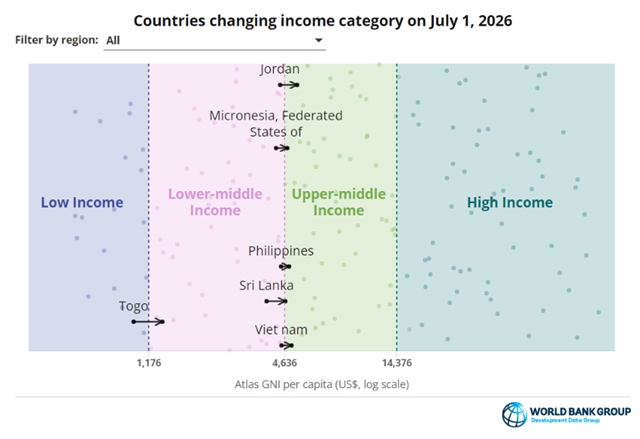
Hanoi, The Gulf Observer: The World Bank has reclassified Vietnam from a lower middle-income country to an upper middle-income economy in its latest global income classifications released on July 1, marking a significant milestone in the country’s economic development.
The World Bank’s annual classification is based on gross national income (GNI) per capita for the previous year. Vietnam’s GNI per capita rose from US$4,490 in 2024 to US$4,970 in 2025, surpassing the US$4,516 threshold required for upper middle-income status in 2025.
The World Bank categorises economies into four income groups—low, lower middle, upper middle and high income—using GNI per capita measured in U.S. dollars and adjusted to account for short-term exchange rate fluctuations. The income thresholds are updated annually to reflect inflation, population growth, economic performance and revisions to national data.
According to the World Bank, Vietnam’s elevation was driven by its export-oriented economic model, with exports increasing by more than 15 per cent in both 2024 and 2025. The country also recorded gross domestic product (GDP) growth of 7 per cent in 2024 and 8 per cent in 2025, while its GNI expanded at an average annual rate of 10 per cent between 2021 and 2025, one of the strongest sustained performances in the region.
Vietnam was among six countries upgraded to a higher income category this year out of 218 economies assessed by the World Bank.
In addition to Vietnam, Jordan, Micronesia, the Philippines and Sri Lanka advanced from the lower middle-income to the upper middle-income category, while Togo moved from the low-income to the lower middle-income group.
The World Bank said the updated classifications are important because they help governments, researchers and international organisations monitor global economic progress and determine eligibility for concessional financing and development assistance. However, it noted that the reclassification does not alter the institution’s current lending policies, with Vietnam and the Philippines continuing to borrow through the International Bank for Reconstruction and Development (IBRD), while Sri Lanka remains eligible for financing through the International Development Association (IDA).
Vietnam has set an ambitious goal of becoming an industrialised upper middle-income developing country by 2030 and a high-income developed nation by 2045. To support these objectives, the government has targeted economic growth of 10 per cent or more this year.