‘Super-Puff’ Planets Challenge Long-Held Theories of Planet Formation
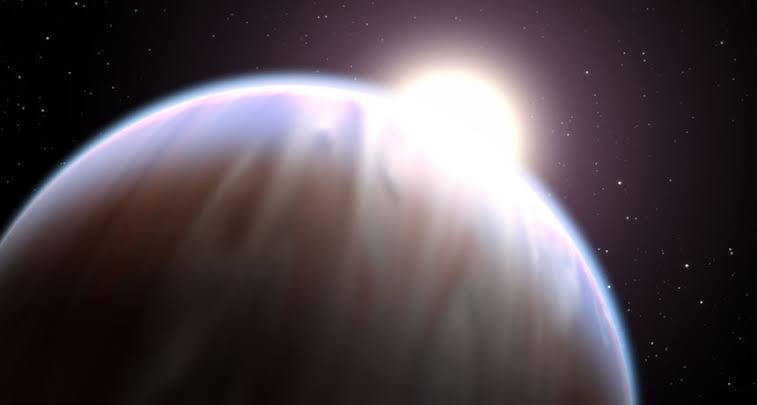
Astronomers have identified two of the “puffiest” planets ever discovered in the Milky Way, a finding that is reshaping scientists’ understanding of how giant planets form and evolve. The newly identified exoplanets, TOI-791 b and TOI-791 c, are approximately the size of Jupiter but possess extraordinarily low densities, making them lighter than cotton candy relative to their enormous volumes.
The discovery, made using data from NASA’s Transiting Exoplanet Survey Satellite (TESS), is significant not merely because of the planets’ unusual characteristics, but because it challenges conventional models of planetary evolution. Traditional theories suggest that giant planets gradually become denser as they age, yet the existence of two “super-puff” planets orbiting the same Sun-like star indicates that scientists may need to reconsider how such worlds retain their massive, hydrogen- and helium-rich atmospheres.
Researchers estimate that the planets orbit a star located approximately 1,113 light-years from Earth. Despite their Jupiter-like diameters, their masses are only a small fraction of Jupiter’s, resulting in densities measured at just a few hundredths of a gram per cubic centimeter—among the lowest ever recorded for any known exoplanet. Such characteristics suggest atmospheres extending tens of thousands of kilometers above their cores, giving the planets their remarkably inflated appearance.
From a scientific perspective, the discovery provides an exceptional natural laboratory for studying atmospheric escape, planetary composition, and internal structure. Understanding why these planets remain so inflated could reveal how young gas giants evolve, how stellar radiation affects planetary atmospheres, and why similar worlds are exceedingly rare. Fewer than 40 super-puff planets have been identified among the nearly 6,300 confirmed exoplanets discovered to date, making the presence of two such planets in a single system particularly valuable for comparative research.
The findings also underscore the growing role of next-generation observatories in exoplanet science. While TESS identified the planets through the transit method, future observations by the James Webb Space Telescope are expected to analyze their atmospheric composition in greater detail, potentially detecting water vapor, methane, carbon dioxide, or other gases that could reveal how these worlds formed and whether they are gradually losing their vast gaseous envelopes.
Beyond the discovery itself, the research reflects a broader trend in astronomy: the increasing realization that planetary systems across the Milky Way are far more diverse than previously imagined. Over the past decade, astronomers have uncovered lava worlds, ocean planets, mini-Neptunes, rogue planets, and now some of the least-dense planets ever observed. Each new discovery challenges assumptions derived from our own Solar System and contributes to a more comprehensive understanding of how planets emerge under varying cosmic conditions.
As observational technology continues to improve, astronomers expect many more unusual planetary systems to emerge, offering fresh insights into the complex processes that shape planetary formation and evolution throughout the galaxy. The discovery of TOI-791 b and TOI-791 c therefore represents not only a remarkable astronomical milestone but also an important step toward refining the scientific models that explain the diversity of worlds beyond our Solar System.