U.S.–Israeli Naval Exercises in the Red Sea Underscore Deterrence as Iran Tensions Mount
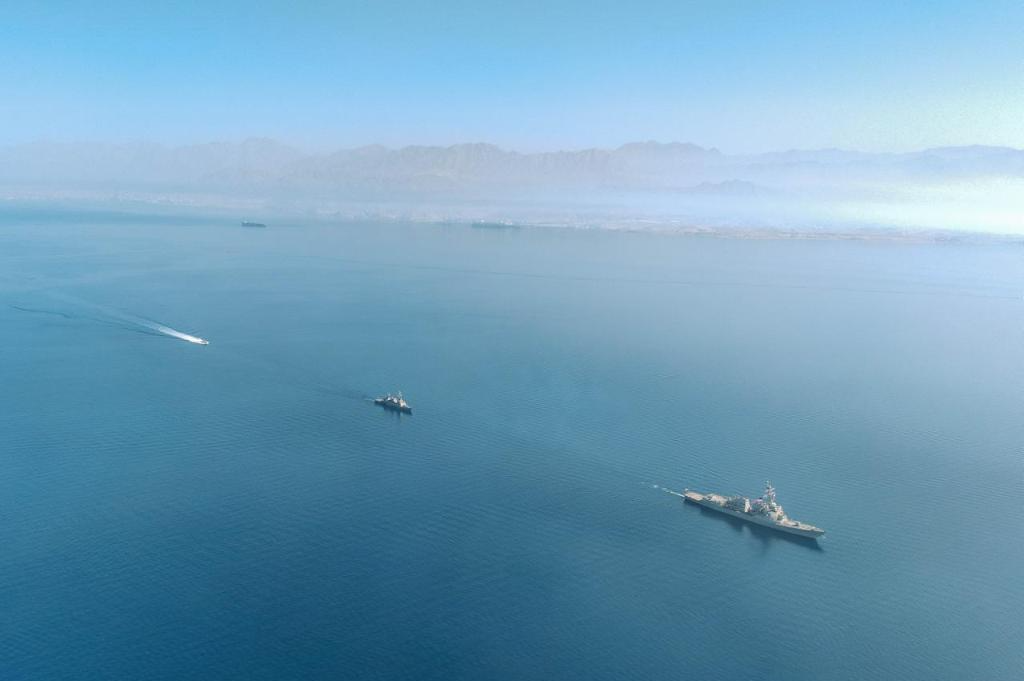

The United States Central Command (CENTCOM) and the Israeli military announced on Monday that U.S. and Israeli naval forces conducted joint maritime exercises in the Red Sea, underscoring deepening operational coordination amid heightened regional tensions involving Iran.
According to CENTCOM, the Arleigh Burke–class guided-missile destroyer USS Delbert D. Black carried out a routine, pre-planned naval exercise on Sunday with the Israeli Navy’s INS Eilat. The drills were conducted as part of established bilateral cooperation and maritime readiness activities.
The Israeli military confirmed the exercise, stating that Israeli and U.S. naval vessels operated jointly in the Red Sea under the framework of ongoing strategic coordination between the Israeli Navy and the U.S. Fifth Fleet. The Fifth Fleet is responsible for U.S. naval operations across the Red Sea, the Gulf of Aden, the Arabian Gulf, and the Gulf of Oman.
The statement added that the U.S. destroyer also conducted a scheduled port visit, emphasizing that the engagement reflected “close and sustained cooperation” between the two navies and their respective armed forces.
The joint maneuvers come as the United States continues to reinforce its military posture in the region, amid growing speculation that Washington could consider military options should diplomatic efforts to constrain Iran’s strategic capabilities fail.
On Sunday, Israeli Chief of Staff Lt. Gen. Eyal Zamir met with his U.S. counterpart, Gen. Dan Keane, during which Israeli officials presented updated intelligence assessments regarding Iran’s efforts to revive and expand its missile development program.
Israel’s Channel 12 reported that Jerusalem has articulated three central conditions for any future agreement with Tehran: the complete prevention of nuclear weapons development, the dismantling of Iran’s ballistic missile program, and the cessation of Iranian support for armed proxy groups across the Middle East.
Meanwhile, Yediot Ahronot, citing informed sources, reported that Zamir’s visit included in-depth discussions on potential military scenarios, including the possibility of a strike against Iranian targets should strategic red lines be crossed.
These developments follow renewed warnings from U.S. President Donald Trump, who has publicly stated that military action remains an option if Iran fails to meet international demands.
In response, Iranian leadership has intensified its rhetoric. Supreme Leader Ayatollah Ali Khamenei warned that any U.S. military action would result in a broader regional conflict.
“The Americans should know,” Khamenei said, “that if they start a war against us, this time it will be a regional war.”