The New Geopolitics of Talent: Why Brain Drain is a Global Crisis, and How to Reverse It
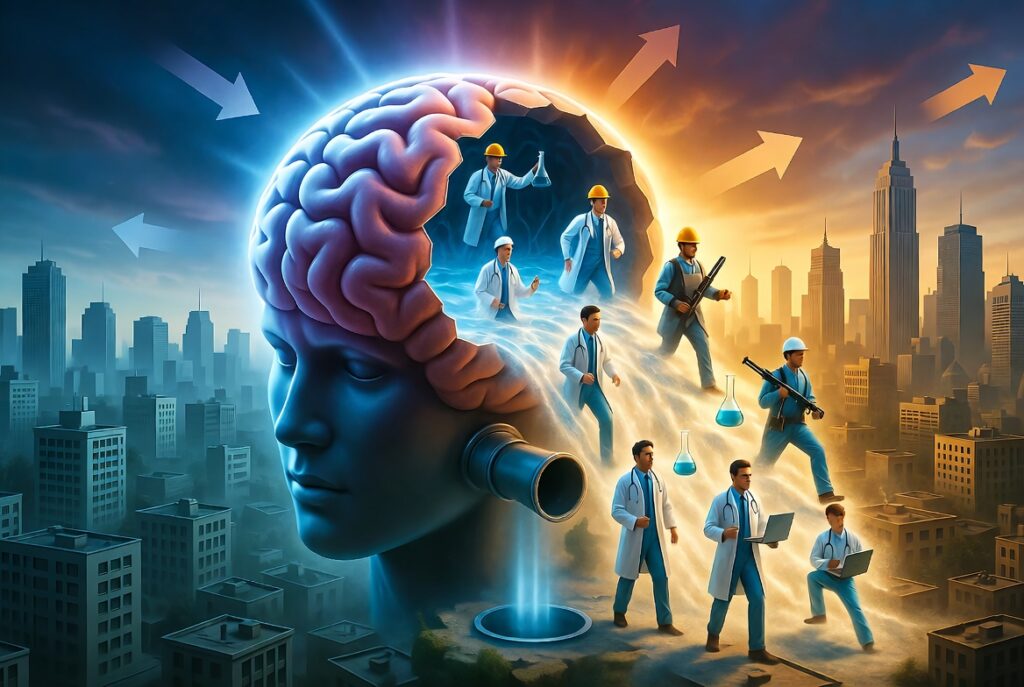

For decades, the concept of “brain drain” was viewed through a narrow, localized lens—a simple human resource problem where educated professionals from developing nations migrated abroad for better wages. Today, that definition is obsolete. In the modern geopolitical landscape, brain drain has evolved into a critical strategic issue that directly dictates a state’s power, international presence, and economic survival.
The wealth of a nation is no longer measured solely by its physical borders, military hardware, or natural resources. The ultimate currency of the modern world is intellectual capital. True global leadership has always belonged to the societies that cultivate, attract, and retain the best minds.
The Historical Blueprint: From Ancient Greece to USA Operation Paperclip
History proves that physical conquests are short-lived, but intellectual triumphs endure. The lasting legacy of Ancient Greece does not lie in its battlefields or geographic territory, but in its unparalleled intellectual capital. The philosophical frameworks of Socrates, Plato, and Aristotle laid the foundations for modern political science, logic, and ethics. Simultaneously, the mathematical and physical breakthroughs of Pythagoras and Archimedes established the bedrock of modern engineering. Alexander the Great conquered vast lands, but his true, permanent impact was the spread of Hellenistic culture and knowledge. Without this mental reserves, the historic clashes of Athens and Sparta would have faded into anonymity.
In the twentieth century, the United States secured its superpower status by mastering the art of “Brain Gain.” While many nations possessed vast oil reserves, natural gas, and minerals, America excelled at consolidating the world’s best brains, creating a domestic intellectual pool that accelerated its own growth.
A definitive historical example of this strategy is Operation Paperclip immediately following World War II.
Case Study: Operation Paperclip
In the wake of the war, the United States bypassed conventional bureaucratic barriers to bring over 1,600 top German scientists and engineers to America. This strategic acquisition of human capital directly fueled the creation of the NASA space program and the development of advanced ballistic missiles. Without this imported intellectual capital, America may never have surpassed the Soviet Union in the Space Race.
In the contemporary era, this dynamic has only intensified. The states that retain and attract specialists in Artificial Intelligence (AI), biotechnology, and healthcare are the ones that write the rules of the global order.
Conversely, when a country suffers from severe brain drain, its domestic industries face systematic collapse. You cannot build a nation by training its citizens to serve the economies of other states. This reality is starkly visible in Pakistan. According to reports from the Global Institute for Development Studies (GIDS), the country is currently weathering a national crisis in slow motion.
Displaced Talent Category
Approximate Expatriation (Past 2 Years)
University Graduates
90,000+
Engineers
5,500+
Medical Doctors
2,500+
This mass migration is not driven by a lack of patriotism; rather, the state has failed to provide these professionals with an economic or professional reason to stay. Alarmingly, government policymakers often misinterpret this exodus, viewing the massive inflow of liquid remittances—which exceed $30 billion annually—as a proxy for “Brain Gain.” This is a profound economic miscalculation. The vast majority of these funds are consumed domestically rather than invested in developmental projects or the expansion of a knowledge economy. The true structural cost of losing foundational human capital can never be measured in currency.
This vulnerability is not unique to South Asia. Countries destabilized by conflict and political turmoil naturally experience severe talent depletion. On the global human capital flight index, Palestine and Ukraine register exceptionally high stress levels, scoring 9.4 out of 10 and 8.4 out of 10 respectively, reflecting a rapid erosion of their human resource base.
A common misconception is that brain drain only afflicts developing or conflict-ridden nations. In reality, Europe is currently facing an acute talent crisis unfolding across two distinct fronts.
- Intra-European Migration: East to West, North to South
The European Union’s core tenet of the free movement of labor has inadvertently hollowed out the peripheries of the bloc. Highly skilled professionals from Eastern and Southern Europe are migrating en masse to wealthy Western nations like Germany, France, and the Netherlands. A 2026 research report from Leiden University highlights that approximately 20%—one in five—of the working-age talent pool in Romania and Croatia has relocated to wealthier EU states. Since joining the EU, Romania has lost more than 50% of its practicing medical doctors, triggering a severe healthcare shortage in local hospitals.
This phenomenon has led the European Commission to identify a “Talent Development Trap” threatening 46 distinct regions across Italy (such as Sicily), Spain, and Greece. In these regions, taxpayers subsidize high-quality university education, yet due to high domestic tax rates and stagnant wages, thousands of graduates immediately migrate to Germany or Belgium upon completion of their degrees. Surveys indicate that 50% of young Spaniards intend to leave their country within the next three years in search of higher compensation abroad. - The Transatlantic Flight: Europe to the United States
Simultaneously, Europe’s major economic engines—Germany, France, and the United Kingdom—are losing their elite technical talent to the United States. In the high-stakes global theater of AI and tech development, Europe’s top researchers and engineers are systematically lured away by Silicon Valley. Europe’s heavy regulatory environment, extensive bureaucracy, and lower research and development (R&D) spending stand in stark contrast to the massive compensation packages offered by American tech giants like OpenAI and Google. Emigration rates among high-skilled professionals in Germany have climbed to some of their highest levels since World War II, illustrating that even robust economies are vulnerable to the draw of superior corporate capital.
Shifting the Paradigm: From Brain Drain to Brain Circularity
Because global talent cannot be retained by force, states must pivot from defensive policies to proactive strategies centered around “Brain Circularity” and strategic repatriation. Both China and Taiwan offer highly successful models of how to convert brain drain into a net national gain. The Chinese Model: State-Led Aggressive “Poaching” China utilized the full financial and institutional weight of the state to reclaim its diaspora. The objective was clear: relocate the cutting-edge research being conducted by Chinese scientists in American universities and institutions back to the mainland. Through the Thousand Talents Plan, the Chinese government offered tax-free cash bonuses of up to $1 million to top-tier scientists who returned. Furthermore, the state eliminated traditional academic bureaucracy by providing these scientists with pre-constructed, world-class research laboratories and fully funded research assistants, combining national pride with immense financial and professional incentives.
The Taiwanese Model: Specialized Infrastructure
In the 1970s, Taiwan faced a critical situation where over 80% of its engineering graduates migrated to the United States. To reverse this trend, the government constructed the Hsinchu Science Park (HSP), an ecosystem designed to replicate—and improve upon—Silicon Valley. They incentivized expatriate microchip engineers by offering premium housing, international schooling for their children, and tax-free corporate zones. The crowning achievement of this strategy was enticing Morris Chang, a top executive at Texas Instruments in the US, to return and establish the Taiwan Semiconductor Manufacturing Company (TSMC). Today, TSMC produces over 90% of the world’s advanced microchips, transforming Taiwan into an indispensable hub of global technology.
For countries like Pakistan, where full economic parity with the West is an ongoing challenge, the immediate solution does not require experts to permanently abandon their lucrative overseas careers. Instead, governments must establish institutional Virtual Diaspora Networks to leverage this expertise remotely.
- Virtual Academic Integration: The Higher Education Commission (HEC) and the Ministry of IT should launch a centralized digital platform enabling overseas Pakistani specialists to co-supervise local PhD candidates, design modernized academic curricula, and co-author joint research papers.
- The Medical Tele-Consultancy Model: To counter the loss of medical professionals, the state should implement an operational framework where expatriate physicians dedicate just two hours per week to public teaching hospitals via tele-medicine. This structure allows them to deliver specialized lectures and provide remote consultations on complex medical cases without needing to relocate.
Brain drain is an undeniable global challenge, but it is not an irreversible one. By shifting the policy focus from merely tracking financial remittances to actively integrating the global intellectual diaspora, nations can transform a devastating loss of talent into a sustainable, modern engine of development.