Morocco Joins Artemis Accords, Expands Strategic Partnership with United States
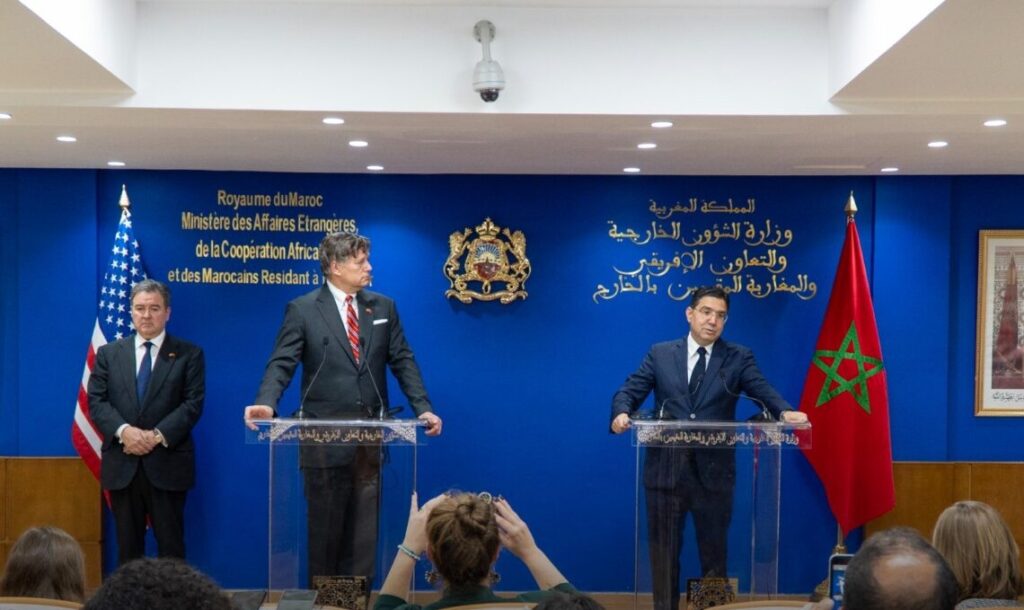
Rabat, The Gulf Observer: Morocco has signed the Artemis Accords, becoming the 64th country and the fifth in Africa to join the United States-led framework for civil space exploration, in a move that underscores deepening bilateral ties and cooperation in emerging technologies.
The agreement was signed in Rabat by Foreign Minister Nasser Bourita during a meeting with US Deputy Secretary of State Christopher Landau, who is on his first official visit to the North African nation.
Speaking at a joint press conference, Landau welcomed Morocco’s participation, stating, “We are delighted to see our alliance extend to space. We can’t ask for a better partner than Morocco.”
The Artemis Accords, developed in 2020 by NASA and the US Department of State, set out non-binding principles to guide the peaceful exploration of outer space, including the Moon, Mars, comets, and asteroids. The framework emphasizes transparency, data sharing, emergency assistance, and adherence to international space law, particularly the Outer Space Treaty.
The accords are closely linked to NASA’s Artemis program, which aims to return humans to the Moon and establish a long-term presence as a precursor to future missions to Mars. Morocco’s accession follows that of Jordan, which became the 63rd signatory on April 23.
Highlighting the broader significance of the initiative, Landau noted that the growing number of signatories reflects the global appeal of responsible and cooperative space exploration. Russia and China are not part of the accords, instead advancing a separate initiative known as the International Lunar Research Station.
The signing coincides with the 250th anniversary of Morocco–US diplomatic relations. Morocco was the first country to recognize American independence in 1777. Landau praised the leadership of Donald Trump and Mohammed VI for strengthening the longstanding partnership, describing Morocco as a “stable and strategic partner” regionally and globally.
He also announced the inauguration of a new US diplomatic facility in Casablanca, while noting that the United States’ oldest diplomatic building remains in Tangier—symbolizing the enduring nature of bilateral ties.
On regional issues, Landau reaffirmed US recognition of Moroccan sovereignty over Western Sahara and called for a timely and peaceful resolution to the decades-long dispute.
Foreign Minister Bourita, in his remarks, described Morocco–US relations as entering a “very distinguished period,” marked by increased cooperation across economic, defense, and development sectors. He also confirmed Morocco’s decision to join the US-backed “Trade Over Aid” initiative, aligning with King Mohammed VI’s vision for African development.
Bourita highlighted robust economic engagement, noting that bilateral trade has increased sevenfold since the implementation of the Morocco–US Free Trade Agreement, making Morocco the only African country with such an arrangement with Washington. The ninth session of the joint committee overseeing the agreement is expected to convene soon.
On defense cooperation, he referenced the launch of the 22nd edition of the African Lion military exercises—the largest on the continent—and recent meetings of the joint defense advisory committee in Washington.
Landau’s visit to Morocco follows a stop in Algeria, where he met with President Abdelmadjid Tebboune to discuss regional security, counterterrorism, and economic cooperation. His North Africa tour, which began on April 27, continues through Casablanca and Marrakech until May 1.