Regional Ecological Summit 2026 (RES 2026)

Why RES 2026 matters?
The Regional Ecological Summit 2026 (RES 2026) is being held in Astana, Kazakhstan, from 22 to 24 April 2026, presented as the culmination of a two‑year preparatory process that started in 2024.
The initiative was launched by Kazakhstan’s President Kassym‑Jomart Tokayev and developed in partnership with the United Nations, with the explicit purpose of convening Central Asian states and international stakeholders around coordinated responses to climate and environmental risks according to kazakhstan.un.org
Unlike many high‑level gatherings that remain primarily symbolic, RES 2026 is framed as an implementation‑oriented platform: it connects political leadership with financiers, scientists, businesses, and civil society to turn regional environmental concerns into practical commitments, funding pipelines, and action plans.
The summit’s stated ambition is to deliver tangible outputs, notably a Joint Declaration and a Regional Action Program for 2026–2030, designed to guide and structure cooperation beyond the event itself.
Main participants
A) Heads of State and Government
RES 2026 features participation at the highest political level, including the leaders of the Central Asian states and invited partners according to Astana Times and Euronews.
Central Asia
- – Kazakhstan — President Kassym‑Jomart Tokayev (summit initiator and host).
- – Uzbekistan — President Shavkat Mirziyoyev.
- – Turkmenistan — President Serdar Berdimuhamedow.
- – Kyrgyzstan — President Sadyr Japarov.
- – Tajikistan — President Emomali Rahmon.
Partner states represented at senior level
- Armenia — President Vahagn Khachaturyan.
- Georgia — President Mikheil Kavelashvili.
- Azerbaijan — Prime Minister Ali Asadov.
- Mongolia — High‑level participation is referenced in reporting about expected leaders.
Cambodia
- Cambodia — Minister of Environment Dr. Eang Sophalleth attended as part of a delegation to RES 2026 in Astana.
B) International organizations and strategic partners
- – United Nations
The UN is identified as a strategic partner to the summit, with 18 agencies involved and multiple thematic sessions and workshops coordinated through the UN system in Kazakhstan. - – Organization of Turkic States (OTS)
Within the RES framework, the Second Meeting of Ministers responsible for environment, climate, and ecology of OTS member states is held, with participation expected from the OTS Secretary General Kubanychbek Omuraliev and other senior officials. - – EU‑supported programming: SWITCH‑Asia
The EU’s SWITCH‑Asia programme is presented as an active contributor to RES 2026 through sessions on circular economy and sustainable consumption/production policy support. - International financial institutions
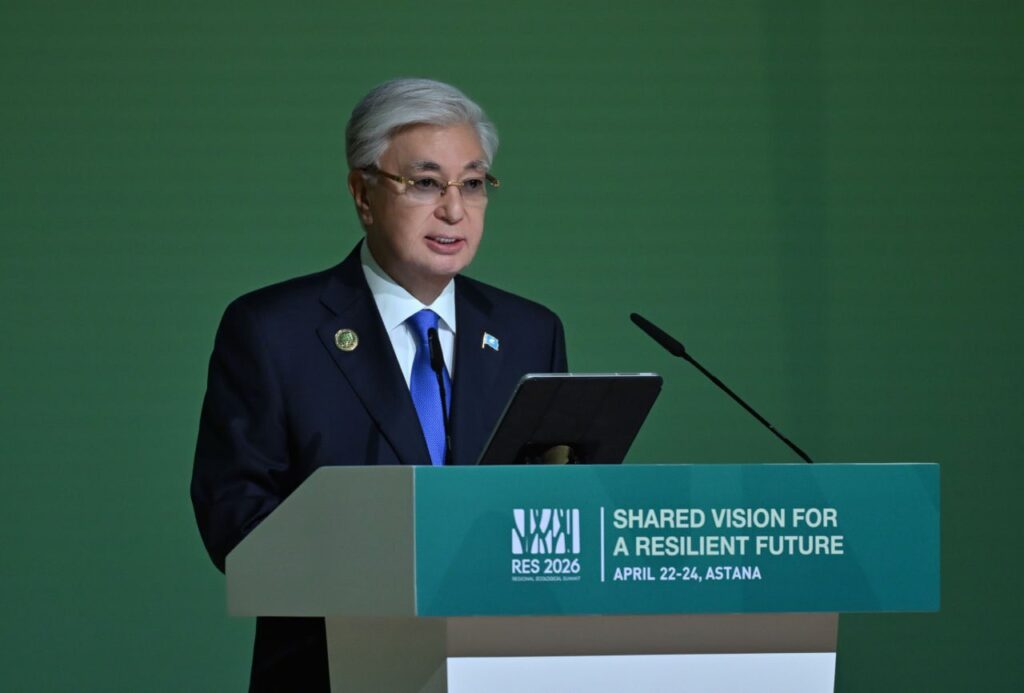
The summit is designed to engage development financiers and green‑finance actors in order to translate climate priorities into investable regional programs. This focus is echoed in summit descriptions emphasizing the role of financing partners and investment‑oriented cooperation. - RES 2026 explicitly integrates scientific expertise, business involvement, and civil society participation as part of its approach to “implementation beyond declarations.”Opening RemarksIn his opening address, President Kassym‑Jomart Tokayev emphasized the need for fair, practical, and implementation‑focused climate cooperation. He stressed that environmental protection is not only a moral obligation but also a strategic priority for global and regional stability. As leaders from Central Asia and beyond gathered in Astana, Tokayev underlined that ecological challenges transcend borders and require collective responsibility and coordinated action.The summit thus establishes an international platform for structured dialogue and cooperation among governments, international and regional organizations, financial institutions, development agencies, businesses, scientists, and civil society. This inclusive approach reflects the understanding that environmental challenges are complex and interconnected, demanding cross‑sectoral solutions according to Astana Times.
Major Ecological Challenges Facing Central Asia
– The Aral Sea Disaster: A Symbol of Environmental Collapse
Aral Sea Disaster
The Aral Sea disaster is one of the most severe consequences of human interference with nature. Once the world’s fourth-largest lake, the Aral Sea has become a powerful symbol of ecological catastrophe.
Nearly 70% of our planet is covered by oceans and seas. These bodies of water are not only sources of life but also ecosystems that support millions of living organisms. This raises a fundamental question: Can seas die? To answer this, one must examine the tragedy of the Aral Sea, which represents one of the darkest environmental stains in human history—arguably worse than wars or genocides. Human populations, despite suffering immense losses, can regenerate over time. However, when a sea dies, its rebirth is virtually impossible. Likewise, when a forest disappears, it cannot easily return to its original state.
The Aral Sea, located west of Kazakhstan and Uzbekistan, fell victim to large-scale Soviet irrigation policies. The two rivers that once fed the sea—the Amu Darya and the Syr Darya—were diverted to irrigate cotton fields. As a result, water stopped flowing into the Aral Sea, causing it to gradually dry up. The sea began to die, and the world largely stood by as this environmental disaster unfolded.
Since independence, particularly in recent years, the governments of Uzbekistan and Kazakhstan have undertaken efforts to save the Aral Sea. These initiatives focus on improving cross-border cooperation, promoting ecological sustainability, and fostering economic development in the Aral Sea region.
Kazakhstan has intensified its efforts to restore its portion of the former Aral Sea and has repeatedly called on neighboring Central Asian states to strengthen regional environmental cooperation. On October 15 last year, Kazakhstan urged expanded international cooperation to protect both the Aral and Caspian Seas. Speaking at the International Astana Think Tank Forum 2025, First Deputy Minister of Foreign Affairs Yerzhan Ashikbayev emphasized Kazakhstan’s contribution to the global climate agenda, according to TimesCA.
According to political analyst Marat Shibutov, Kazakhstan is largely acting alone in efforts to revive the Aral Sea. The country has made the Northern Aral Sea a central element of its environmental restoration strategy. Today, the Northern Aral Sea covers 3,065 square kilometers—an increase of 111 square kilometers since early 2022—according to the Ministry of Water Resources and Irrigation. Key projects include the preservation of the Kokaral Dam and the restoration of the Syr Darya River delta. In addition, Kazakhstan is actively reforesting the former seabed to improve the regional climate (Haidar & Bland, October 17, 2025).
Water Management Challenges
Water management is at the very heart of the RES 2026 agenda. Central Asia is among the most water‑stressed regions in the world, with the Amu Darya and Syr Darya rivers heavily over‑exploited. Competing national interests, inefficient irrigation systems, and climate change have intensified disputes over water allocation.
Uzbekistan has stated that one‑third of its population lives in areas vulnerable to natural disasters and environmental degradation, while 90% of its agricultural land depends on artificial irrigation. Scholars note that water mismanagement has deep historical roots. During the Soviet period, massive hydraulic projects—including canals, reservoirs, mega‑dams, and pumping stations—were constructed not only to promote development but also to maintain political control over a strategically vital region.
In response, Uzbekistan has joined the World Bank’s Water Forward initiative, committing to introduce water‑saving technologies across 4.1 million hectares of irrigated land and to reduce irrigation losses by 25%.
Water will be at the top of the agenda at Kazakhstan’s Regional Ecological Summit.
The region is one of the most water‑stressed in the world, with the Amu Darya and Syr Darya rivers heavily over‑extracted, leading to conflicts over water resources. Uzbekistan has stated that one‑third of its population lives in areas prone to disasters and environmental degradation, and that 90 per cent of its agricultural land requires artificial irrigation (Scissa, C., May 30, 2025).
“Water maladministration was prominent during the domination of the Soviet Union, when large‑scale water projects were carried out in Central Asia to promote regional socio‑economic development, as well as to enable Moscow to exercise political control over a highly strategic region from both economic and geopolitical perspectives. The Soviet Union built huge hydraulic infrastructures, such as the Karakum Canal, along with reservoirs, mega‑dams, and pump stations to extract groundwater and divert freshwater into primary and secondary canals,” wrote Scissa (May 30, 2025).
Uzbekistan has also stated, upon joining the World Bank’s Water Forward initiative, that it aims to introduce water‑saving technologies across its 4.1 million hectares of irrigated land and reduce irrigation losses by 25 per cent (Borangaziyev, A., April 20, 2026).
The region is also grappling with the rapid decline of the Caspian Sea, where water levels are falling by approximately ten centimetres per year, posing serious risks to biodiversity and international shipping routes. President Tokayev is expected to hold talks on the sidelines of the summit in the hope of establishing an international water organisation, according to Euronews. He first proposed this idea at a forum marking the International Year of Peace and Trust and the 30th anniversary of Turkmenistan’s permanent neutrality in December last year. Speaking in Ashgabat, Tokayev noted that “there is currently no specialised UN agency focused exclusively on water” (Marabayeva, B., & Wright, R., April 22, 2026).
Glacier Melt and Climate Change
Glaciers in Tajikistan and Kyrgyzstan are melting rapidly, threatening the long‑term water supply of the entire region. Temperatures in Central Asia are rising faster than the global average, accelerating glacier retreat. As glaciers constitute a vital source of freshwater for Central Asia, their disappearance poses a serious threat to water security. According to the International Atomic Energy Agency (IAEA), which coordinates global cooperation in the nuclear field, glaciers in the region are melting at unprecedented rates as temperatures rise at nearly twice the global average.
The situation is becoming increasingly critical. “The consequences of global climate change are felt in each of our countries,” stated the President of Uzbekistan, Shavkat Mirziyoyev, at the Sixth Central Asian Summit in August 2024 (Albon, M., 2025).
Land Degradation and Desertification
Land degradation represents another slow‑moving but profound crisis. Up to 50% of rangelands in Central Asia are degraded, while soil salinization caused by inefficient irrigation reduces agricultural productivity and intensifies dust and sandstorms.
The World Bank estimates that desertification and land degradation cost Central Asia more than 5% of its regional GDP. Despite its arid climate, the region has a long history of human settlement along rivers, irrigated agriculture, forestry, and seasonal livestock grazing in deserts and high‑mountain pastures. According to the UN Convention to Combat Desertification (UNCCD), climate change and unsustainable land use now threaten these traditional systems and the communities that depend on them.
Pollution and Public Health
Pollution further compounds environmental stress. Industrial waste, untreated sewage, and agricultural chemicals contaminate water sources, while biodiversity continues to decline. All Central Asian states recorded significant year‑on‑year increases in air pollution.
According to Eurasianet, Tajikistan experienced the sharpest rise in PM2.5 levels, reaching 57.3 µg/m³, compared to 46.3 µg/m³ in 2024, placing it among the ten countries with the worst air quality worldwide, based on data from a Swiss research firm.
The World Bank notes that air pollution in Central Asia stems from both local sources—such as fossil fuel use for heating and transport—and transboundary factors, including increasingly frequent sand and dust storms.
Statements by Heads of State: The Case of Uzbekistan
During the summit, the President of Uzbekistan, Shavkat Mirziyoyev, proposed new initiatives to address climate and environmental challenges in Central Asia. He emphasized that environmental issues can no longer be separated from global climate change.
He warned that global warming is accelerating, temperatures in Central Asia are rising twice as fast as the global average, nearly one‑third of glaciers have already disappeared, precipitation patterns are becoming increasingly unpredictable, and water shortages are intensifying. Land degradation, he noted, has already affected 80 million hectares.
President Mirziyoyev also highlighted Uzbekistan’s domestic efforts to enhance environmental sustainability. Under the “Yashil Makon” (Green Space) initiative, approximately one billion trees and shrubs have been planted nationwide. More than two million hectares of afforestation have been established on the dried bed of the Aral Sea, and new green belts are being created. At Uzbekistan’s initiative, the UN General Assembly adopted a resolution proclaiming a “Decade of Action for Afforestation and Reforestation.”
Conclusion
The Regional Ecological Summit 2026 represents a critical moment for Central Asia. The region faces a convergence of environmental crises—water scarcity, glacier retreat, land degradation, pollution, and the enduring legacy of the Aral Sea disaster—all of which threaten long‑term stability, development, and human security.
By convening heads of state, international organizations, financial institutions, scientists, and the private sector, RES 2026 offers a rare opportunity to move from fragmented national responses toward coordinated regional solutions. Its success will ultimately depend on whether political commitments are transformed into sustained cooperation, adequate financing, and measurable action on the ground.
If implemented effectively, RES 2026 could mark a turning point—positioning environmental protection not as a peripheral concern, but as a central pillar of regional cooperation, peace, and sustainable development in Central Asia.