Europe’s Rusted Shackles of the Comfort-Obese Continent: The Visa Barricade
The Schuman Declaration, whose foundations were laid with the proclamation of French Foreign Minister Robert Schuman on 9 May 1950, is regarded as the founding milestone of European integration. Celebrated every year in commemoration of this historic document, Europe Day on 9 May was observed for the 76th time this past Saturday. Once again, the familiar promises echoed from European Union podiums: peace, prosperity, democracy, cultural diversity, and so forth.
Yet, the time has come for Europe to engage in serious self-reflection.
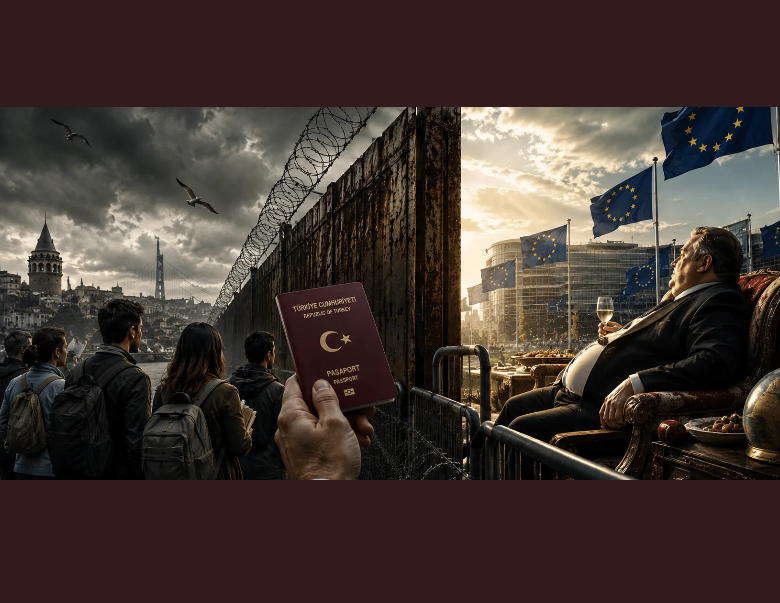
Those who once labeled us the “Sick Man” must now recognize that they themselves have transformed into what may be described as an “Obese Comfort Zone.”
Despite its enormous gross national product, Europe has become externally dependent in the most vital areas, such as security and energy. Although it remains an economic giant, this structure turns into a complete political dwarf whenever political will is required. In global crises, it has increasingly become a merely symbolic actor that issues ineffective declarations. Neither its former sanctioning power nor its deterrent capacity remains intact.
It is an undeniable reality that today the European Union needs Türkiye far more than Türkiye needs the European Union.
In an apparent attempt to conceal its strategic sluggishness and geopolitical ineffectiveness, Europe has begun weaponizing one of the most fundamental human rights — freedom of movement — particularly against Türkiye.
The European Union’s transformation of the visa issue into a modern-day barricade is, in fact, the most tragic confession of how far Europe has drifted from its own values and how profoundly it has lost its capacity to produce solutions. A structure incapable even of resolving the black market surrounding appointment systems within its own mechanisms, and which has effectively surrendered the field to visa brokers, is in reality destroying its own credibility at border gates through this bureaucratic paralysis.
Today, therefore, we must address the visa issue, which has evolved into a chronic deadlock and has severely tested the patience of our citizens, particularly our youth.
For this matter is not merely a bureaucratic document procedure; rather, it is the story of an unjust barricade erected at the gates of Europe against our young people, academics, artists, and businesspersons who seek to cross borders and engage with the world.
This visa issue has become a direct shackle imposed upon our youth who wish to discover the world, our academics invited to international congresses, our journalists pursuing universal truths, our artists whose stages transcend borders, and our businesspeople striving to export and expand internationally.
In the past, we used to speak of “customs gates”; now, we can no longer even see those gates. Obtaining a visa — or, indeed, even securing a visa appointment — has turned into the final impossible obstacle of our age. Our people may have escaped the queues at passport offices, but they have now been condemned to a digital vigil, waiting endlessly in front of screens in the hope of finding an available appointment slot.
Journalist İbrahim Haskoloğlu recently investigated this issue and exposed a shocking reality: certain shell companies are allegedly monopolizing unavailable appointments through automated bots and reselling them to citizens at exorbitant prices. As European countries increasingly impose visa restrictions on Türkiye, companies exploiting this system have effectively established a black market for visa appointments.
So, what lies behind this visa problem?
Let me state clearly from the outset: all the difficulties surrounding the Schengen visa process are the direct consequence of a deliberate and political choice made by the European Union. Today, the EU unfortunately views journalists, NGO representatives, brilliant students, and distinguished academics applying from our country as “potential asylum seekers.”
This approach, which stigmatizes every one of our citizens as a “potential refugee” merely because they are citizens of this nation, constitutes one of the gravest forms of discrimination in the modern world. Individuals who have established themselves in their homeland through merit, intellect, and ideas are subjected to unjust suspicion at Europe’s gates.
At this very point, I would like to address our youth, the guarantors of our future:
Young people,
Never underestimate the potential of your own homeland. Instead of seeking the prosperity you dream of behind Europe’s barricaded border gates, let us collectively strive to revitalize and elevate our own country. For there is a painful reality that many choose to ignore:
Europe is not interested in your diploma, your intellectual accumulation, or your vision. Rather, they are willing to open their doors — even without a visa — only for the lowest-tier jobs that their own citizens refuse to undertake, jobs requiring intense physical labor. What they seek is merely a body to keep the machinery running, an anonymous pair of hands to tighten rusted screws. In short, they are not interested in the merit reflected in our diplomas, but in the cheap labor represented by the sweat on our backs.
Indeed, numbers do not lie; this is not merely a picture of decline, but of discrimination. While the rejection rate for Schengen applications from Türkiye stood at 6.4 percent in 2017, today that figure has approached 20 percent.
Over the past decade, approximately 1.5 million Schengen applications from Türkiye have been rejected. Our people were turned away at the gates, yet the money they paid merely for the opportunity to enter remained in European coffers. The infamous application fees paid by citizens who received rejection decisions — not a single cent of which was refunded — have now exceeded 511 million euros in total.
In other words, the Schengen visa has become, for us, perhaps the most expensive “maybe” in the world.
From here, I would like to address our policymakers:
Please remind your European counterparts that the Readmission Agreement we signed in 2013 was not a blank check.
Türkiye is not the world’s unpaid demographic dumping ground. If we are the ones carrying the burden of refugees, then the visa barricades erected before our citizens must be dismantled.