Energy Security and NATO’s Green Defense Revolution
In recent years, energy security has evolved from being merely an economic issue into a central pillar of national security and military strategy. The Russia–Ukraine war, instability in the Middle East, and tensions surrounding Iran have once again demonstrated how fragile global energy supply chains can become during conflicts. Within NATO, a remarkable transformation is now taking place: growing voices inside the alliance argue that reducing dependence on fossil fuels and increasing the use of renewable energy sources are essential for future military security.
This approach is not simply an environmental policy. It also represents a new security paradigm focused on operational resilience, military logistics, and strategic independence. However, this transition clashes with the energy vision promoted by the administration of Donald Trump, which strongly favors fossil fuel production.
1. NATO’s Approach to Energy Security Is Changing
Research conducted by the NATO Energy Security Centre of Excellence suggests that future military bases can no longer rely solely on diesel generators. Supplying fossil fuels to remote military positions creates enormous logistical costs and exposes supply lines to security threats.
During the Afghanistan war, NATO forces experienced firsthand how difficult and expensive it was to transport diesel fuel to forward operating bases. Fuel convoys became vulnerable targets, forcing militaries to allocate additional troops and resources simply to protect energy deliveries. This revealed that energy itself had become a strategic battlefield asset.
As a result, NATO circles increasingly support localized and decentralized energy production systems. Solar panels, wind power, biodiesel, hydrogen technologies, and hybrid energy systems are being discussed as viable military alternatives capable of reducing dependence on imported fuels.
Simulation studies conducted by NATO researchers showed:
- – Nearly 20% improvement in energy efficiency,
- – Around 35% increase in energy autonomy,
- – Significant reductions in imported fuel dependency.
This indicates that NATO is beginning to redefine energy security not only through access to oil and gas, but also through technological resilience and sustainable infrastructure.
2. Renewable Energy Is Becoming a Strategic Necessity for Europe
European countries possess limited oil and natural gas reserves, making them heavily dependent on foreign energy suppliers. The Russia–Ukraine war exposed this dependency as one of Europe’s greatest strategic vulnerabilities.
At the same time, tensions surrounding Iran and risks to the Strait of Hormuz highlighted another major threat to European energy security. Since a substantial portion of global oil transportation passes through this corridor, any regional escalation could severely disrupt energy markets and supply chains.
For this reason, many policymakers within the European Union and NATO increasingly view renewable energy not merely as a climate policy, but as a core defense and security strategy.
Several military initiatives already reflect this transition:
- – Norway tested sustainable synthetic fuel on F-35 fighter jets,
- – France experimented with alternative fuel systems for military helicopters,
- – NATO bases have begun exploring hybrid energy infrastructure.
These developments show that the concept of “green warfare” is no longer theoretical.
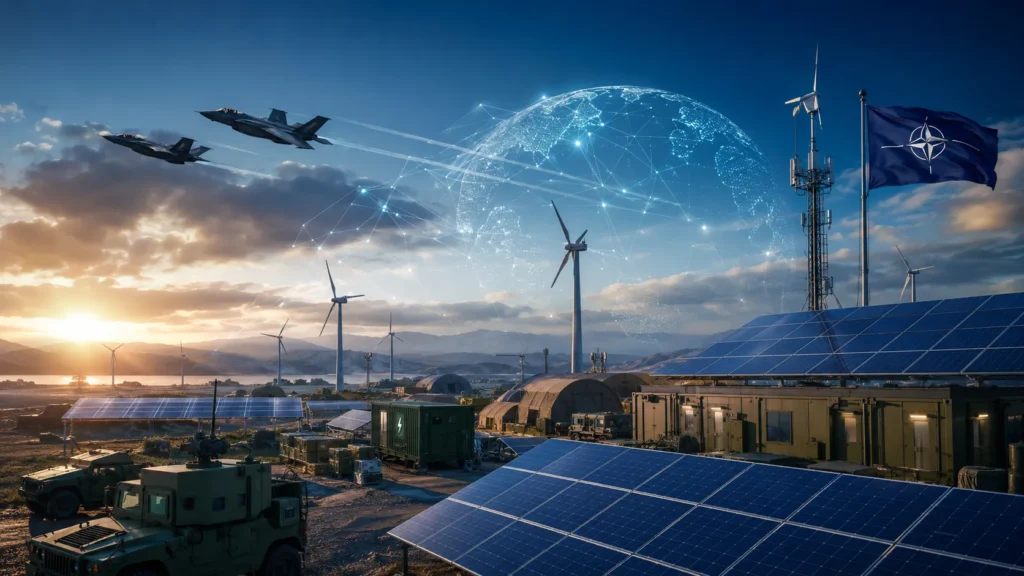
Future military facilities may increasingly depend on:
- – Mobile solar energy systems,
- – Battery storage technologies,
- – Microgrids,
- – Electrified military vehicles.
Such technologies could reduce Europe’s dependence on Middle Eastern oil and external energy suppliers while strengthening strategic autonomy.
3. Growing Tensions Between NATO and Washington
One of the most striking aspects of this transformation is its contradiction with certain political currents in the United States. During Donald Trump’s presidency, the slogan “drill, baby, drill” symbolized a strong commitment to expanding fossil fuel production.
Many conservative circles in Washington:
– View renewable energy investments as costly,
– Oppose climate-focused defense policies,
– Remain skeptical of NATO’s environmental agenda.
As a result, NATO’s energy transition may create new political divisions within the alliance.
While European allies increasingly see renewable energy as essential for strategic independence, parts of the American political establishment continue prioritizing traditional fossil fuel dominance.
At the same time, military electrification may reshape warfare itself by enabling:
– Lower logistical costs,
– Reduced dependence on fuel convoys,
– Quieter military systems,
– More flexible energy infrastructure,
– New cybersecurity risks targeting energy networks.
Therefore, “green defense” should not be understood simply as an environmental slogan. It represents a broader strategic transformation that could redefine the future of military operations and alliance structures.
Conclusion
Energy has become one of the invisible frontlines of modern warfare. Military power is no longer determined solely by tanks, aircraft, or missile systems, but also by the ability to secure stable and independent energy supplies.
The growing emphasis within NATO on renewable energy technologies demonstrates that future military infrastructure will likely rely far more on sustainable and decentralized power systems. For Europe in particular, this transition is viewed as a strategic shield against geopolitical pressure stemming from Russia and instability in the Middle East.
However, this transformation will not proceed without resistance. Political divisions inside the United States, debates over costs, and the complexity of military modernization may all slow the process.
Nevertheless, the direction appears increasingly clear: future conflicts will be shaped not only by weapons, but also by batteries, energy grids, synthetic fuels, and renewable technologies. Countries capable of achieving energy independence may ultimately gain greater military independence as well.