Sharjah Showcases Emirati-Polish Literary Connections at Warsaw International Book Fair 2026
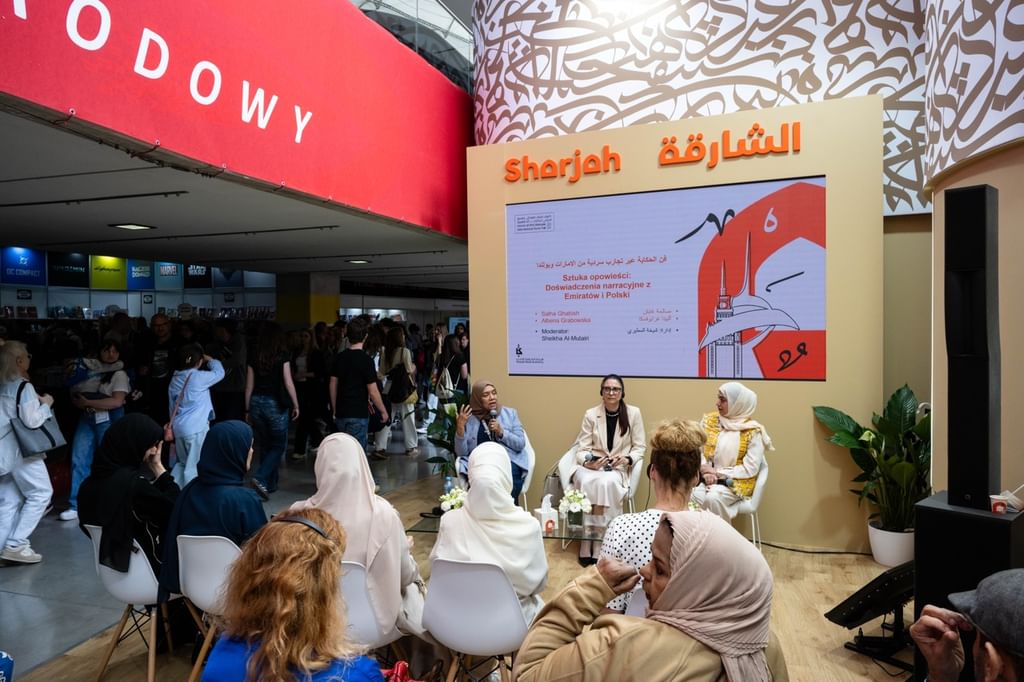
Warsaw, The Gulf Observer: Sharjah’s Guest of Honour programme at the Warsaw International Book Fair 2026 highlighted the deep cultural and creative connections between the United Arab Emirates and Poland through a series of literary discussions focusing on storytelling, memory, history, identity, and children’s literature.
The Sharjah pavilion hosted a panel titled “The Art of Storytelling through Narrative Experiences from the UAE and Poland,” featuring Emirati writer Saleha Ghabesh and Polish novelist Albena Grabowska. The discussion examined how memory, history, and translation enable stories rooted in local experiences to resonate with audiences across different cultures and regions.
The two authors reflected on the relationship between storytelling, memory, history, and place, emphasizing literature’s ability to transcend geographical and cultural boundaries while remaining closely tied to its origins.
Ghabesh noted that although memory plays a central role in fiction, it is ultimately shaped by the writer through language, culture, and artistic expression. She stressed that stories grounded in local realities often possess the greatest potential for global appeal when they explore universal human emotions and experiences.
Grabowska described storytelling as an extension of the collective memory of women, families, and local communities. She highlighted the importance of “small homelands” in Polish literature, referring to the places where people grow up and the memories passed down through generations. She also underscored the complexities of literary translation, noting that it requires preserving cultural nuances and deeper meanings while making works accessible to new audiences.
Another discussion, titled “The Diversity of Human Experiences in Emirati and Polish Fiction,” brought together Emirati poet and novelist Dhaen Shahin and Polish novelist Wit Szostak. The session explored how fiction contributes to understanding memory, history, and identity, while serving as a space for preserving both individual and collective experiences.
The speakers emphasized that literature remains one of the most effective bridges between cultures, with novels, short stories, and historical studies forming a shared intellectual and human heritage that promotes dialogue across geographical and cultural boundaries.
Sharjah’s programme also focused on the evolving landscape of children’s literature. In a session titled “Children’s Literature in the United Arab Emirates and Poland: Between Innovation and Renewal,” Emirati author Nadia Al Najjar and Polish author Barbara Kosmowska discussed changing reading habits, technological influences, and the relationship between young readers and books.
Al Najjar emphasized that successful children’s writing requires a deep understanding of the interests, language, and concerns of different age groups. She identified the growing competition from digital devices and online content as one of the major challenges facing authors seeking to inspire children to read.
Kosmowska observed that many of the challenges confronting children’s literature in Poland mirror those in the UAE. She noted that technology has reduced the central role books once played in children’s lives and stressed the importance of engaging parents, who continue to play a decisive role in shaping reading habits and introducing children to the world of literature.
The discussions formed part of Sharjah’s Guest of Honour programme at the Warsaw International Book Fair 2026, reinforcing the emirate’s commitment to fostering cultural exchange and strengthening literary dialogue between nations.