United Arab Emirates Leaves OPEC
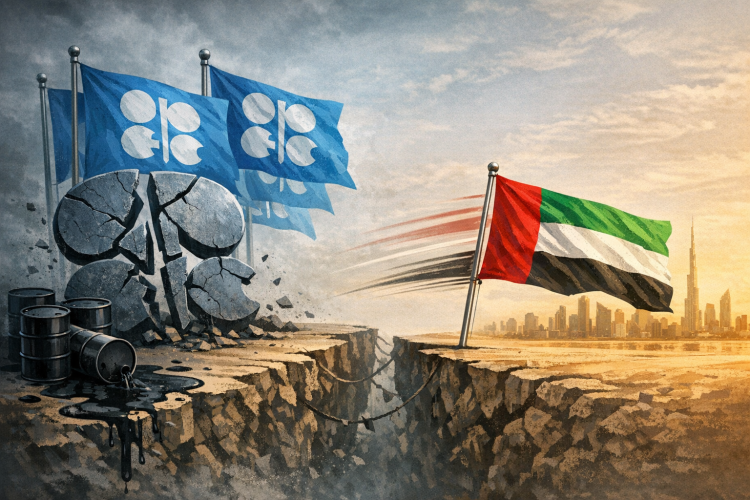
Recently, the Organization of the Petroleum Exporting Countries (OPEC) has been in the news following reports of the United Arab Emirates’ (UAE) withdrawal. On Tuesday, April 28, the UAE, which joined OPEC in 1967 through Abu Dhabi’s mediation, announced it would withdraw from OPEC and OPEC+ on May 1 in order to focus on its national interests and chart its own course. Before the United States (US)-Iran War, although the UAE’s production capacity had reached 4.8 million barrels per day, OPEC had only allowed it to produce 3.2 million barrels per day. The UAE has long been known to clash with Saudi Arabia, the most powerful member of OPEC, over production capacity. Behind this historic decision lies the UAE’s long-standing dissatisfaction with OPEC’s policy of limiting member countries’ production in order to control oil prices and stabilize the market.
This decision, a major blow to the group of oil producers, has once again brought to the surface the extent of the energy crisis caused by the US-Iran war and the disagreements among the Gulf countries. However, experts have stated that this move will not spell the end of OPEC. Kingsmill Bond, an energy strategist at the think tank Ember Future, said that the UAE’s decision to leave was a smart move, as the UAE wanted to free itself from OPEC restrictions by preparing for the post-war period. In an interview with Al Jazeera, Muhammad al-Sabban, a former senior oil advisor to Saudi Arabia, stated that the UAE’s withdrawal was not a major blow to the 23-member OPEC+ group, noting that the departure of a single country from the organization meant nothing. He characterized the decision to withdraw as a political move influenced by the West, which he claimed was fueling divisions within the oil cartel. US President Donald Trump, known for his hostility towards OPEC, has previously accused OPEC of inflating oil prices and robbing the rest of the world. In a statement he made a few days ago, Trump described the UAE’s decision as “I think it’s great” expressing his strong support for the UAE’s decision and stating his belief that the split would lower energy prices. UAE Energy Minister Suhail Mohamed al-Mazrouei, in his speeches following the announcement, stated, “This is a policy decision, taken after carefully considering current and future policies regarding production levels,” emphasizing that his country had not consulted with any other country regarding the decision to separate production, and adding that the UAE could meet the energy needs of the world, which will increasingly require more energy. Experts analyzing this issue predict that if energy flows return to pre-war levels, the UAE could meet the demand with an additional 1.6 million barrels of production per day (approximately 1.5% of global oil supply). This move by the UAE to withdraw has undoubtedly affected international oil prices; following the announcement of the withdrawal decision, international oil prices have retreated. Following this development, Energy Minister al-Mazrouei stated that he did not expect the news to have such a significant impact on the markets in such a short time, given the restrictions in the Strait of Hormuz. On the other hand, some experts argue that because the UAE’s oil exports, like those of other neighboring countries, are restricted due to the crisis in the Strait of Hormuz, the UAE’s decision to leave OPEC will not have an immediate impact on the market.
Along with supply disruptions in the Gulf countries, OPEC+’s share of global oil production fell from 48% in February to 44% in March, according to data from the International Energy Agency. With production restrictions deepening, the decline is expected to continue in April, and further decrease in May as the fourth-largest producer leaves the group.
Bibliography
- Kevin Breuninger, Trump says it’s ‘great’ that UAE pulled out of OPEC, CNBC,https://www.cnbc.com/2026/04/29/trump-says-its-great-that-uae-pulled-out-of-opec.html, 30.04.2026.
- Maha El Dahan, UAE Leaves OPEC In Blow To Global Oil Producers’ Group, Reuters,https://www.reuters.com/markets/commodities/uae-says-it-quits-opec-opec-statement-2026-04-28/, 30.04.2026.
- Nik Martin, Why UAE’s OPEC Exit Is a Blow to Saudi Arabia, DW,https://www.dw.com/en/why-uaes-opec-exit-is-a-blow-to-saudi-arabia/a-76975354, 30.04.2026.
- Virginia Pietromarchi, UAE Quits OPEC: What That Means For The Gulf, Energy Markets And Beyond, Aljazeera,https://www.aljazeera.com/news/2026/4/29/uae-quits-opec-what-that-means-for-the-gulf-energy-markets-and-beyond, 30.04.2026.