Namangan Set for Accelerated Growth as President Mirziyoyev Outlines Ambitious Reform Agenda
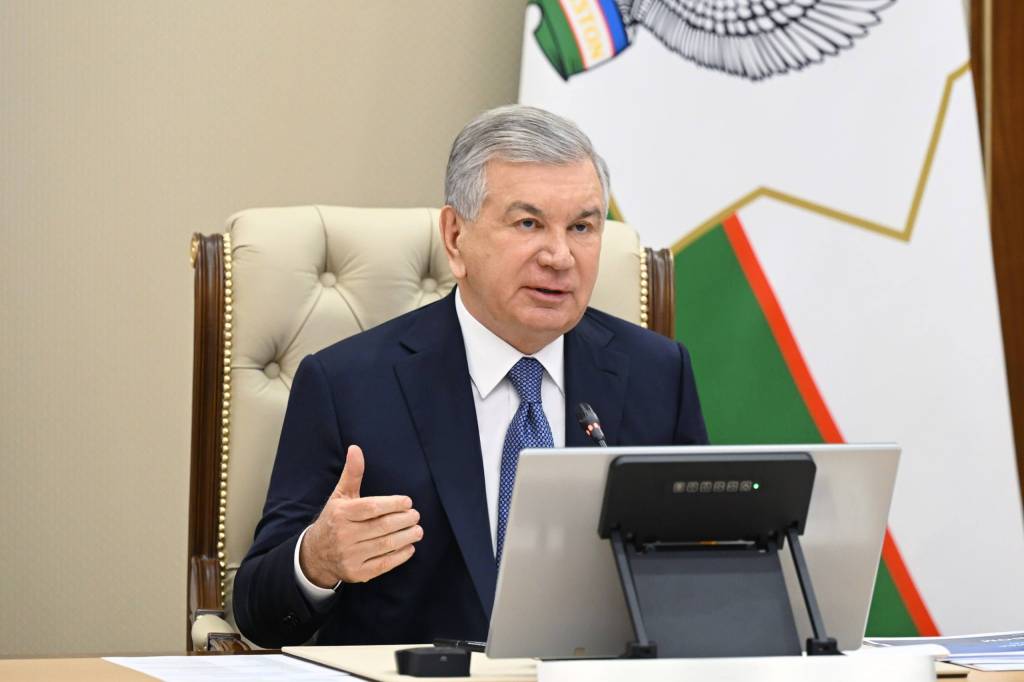
Tashkent, The Gulf Observer: President Shavkat Mirziyoyev chaired a high-level meeting on Tuesday to review the effectiveness of ongoing reforms in the Namangan region and outline a comprehensive roadmap for future development, emphasizing economic resilience, innovation, and social progress.
The President noted that Namangan has emerged as one of Uzbekistan’s fastest-growing regions in recent years, driven by robust expansion in industry, services, and entrepreneurship. Over the past eight years, more than 40,000 new enterprises have been established, while production volumes have surged sixfold to reach 40 trillion UZS.
According to official data, the region’s gross regional product reached 85.4 trillion UZS in 2025, marking an 8.2 percent increase. Industrial output stood at 40.1 trillion UZS, while the services sector recorded 56.3 trillion UZS. Foreign investment totaled $3.3 billion, and exports reached $916 million.
Amid global market uncertainties, Mirziyoyev stressed the importance of sustaining economic momentum and identifying new growth drivers. Authorities were tasked with achieving ambitious 2026 targets, including 9.2 percent overall economic growth, 9 percent industrial growth, 16.3 percent expansion in services, and 6.8 percent growth in agriculture. Plans also aim to boost tourism exports by 1.7 times, increase foreign investment to $5 billion, and raise exports to $1.2 billion.
The meeting also set social development benchmarks, including reducing unemployment to 3.5 percent and poverty to 2.5 percent by year-end. Several districts, including Davlatabad, Yangi Namangan, Kasansay, Norin, and Uychi, are targeted to become free from unemployment and poverty.
A key focus of the discussions was the integration of artificial intelligence into regional planning. Pilot analysis in Norin district revealed significant untapped potential, including the capacity to double investment inflows, increase industrial output by 10.4 percent, and expand exports by 35 percent. The President directed that AI-based planning tools be extended across all districts.
In agriculture, measures were introduced to strengthen food security amid disruptions in global supply chains. Plans include establishing intensive orchards on 2,500 hectares of underperforming land and developing an additional 8,000 hectares, alongside broader initiatives to improve efficiency and create jobs.
The meeting highlighted major investment projects, including the development of infrastructure within the Namangan Free Economic Zone. Authorities underscored the need for a new electrical substation to support 15 projects worth $547 million in the “Sabzazor” area, where seven projects valued at $215 million have already commenced.
Digital transformation also featured prominently, with a proposal to construct a $20 million IT Park aimed at attracting global technology firms and accelerating growth in artificial intelligence, e-commerce, and startups. Additional plans include establishing an AI research laboratory and transforming Davlatabad district into a smart city through the “Smart City Namangan” digital platform.
Energy and industrial initiatives were also discussed, including a 60-megawatt green energy project in Chust district and new manufacturing ventures in Chartak. A $50 million poultry project is expected to significantly boost production capacity, meet regional demand, and generate export revenues of up to $42 million.
Tourism development was identified as a strategic priority, with plans to establish large-scale tourism complexes across the region. Proposed projects include developments around Lake Arashan, the Qamchiq Pass mountain resort, and multiple tourism centers in Chodak, Kasansay, and Yangikurgan districts. Authorities also plan to revitalize Namangan’s historic areas by integrating traditional architecture with modern infrastructure.
Infrastructure modernization efforts include upgrading sewerage systems, expanding wastewater networks, and improving roads, utilities, and green spaces. The New Namangan project alone is expected to create 30,000 jobs while enhancing urban living standards.
In the social sector, plans were announced to expand access to education and healthcare. New kindergarten facilities with a capacity of 15,000 seats will be established, while major healthcare upgrades include a regional traumatology and orthopedics center, advanced oncology services, and the introduction of modern surgical technologies.
Concluding the meeting, President Mirziyoyev instructed officials to ensure the effective implementation of all initiatives, emphasizing the need to translate plans into tangible economic outcomes, enhance employment, increase household incomes, and expand the production of high-value, export-oriented goods.