Hanoi Targets Over 11% Economic Growth as People’s Council Opens Mid-Year Session
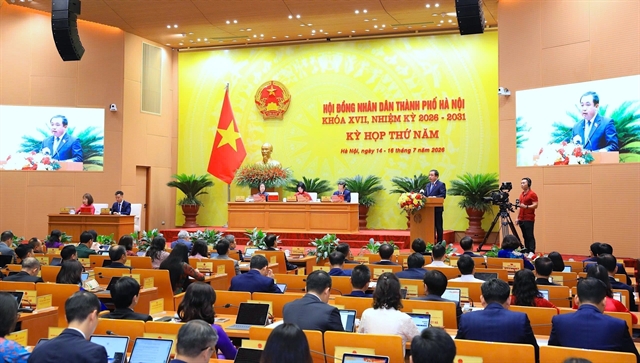
Hanoi, The Gulf Observer: The Hànội People’s Council on Tuesday opened its mid-year session with city leaders emphasizing the need for stronger implementation and accelerated reforms to achieve the capital’s ambitious 2026 economic growth target of 11 per cent or higher.
Addressing the opening session, Council Chairwoman Phùng Thị Hồng Hà said Hà Nội recorded a gross regional domestic product (GRDP) growth of 8.22 per cent during the first six months of 2026, marking the strongest first-half economic performance in recent years.
She said state budget revenue reached nearly VNĐ411 trillion (approximately US$15.7 billion), representing 63.2 per cent of the annual target. Foreign direct investment (FDI) totaled US$3.23 billion, while tourism revenue increased by more than 20 per cent compared with the same period last year.
The chairwoman also highlighted accelerated progress on major infrastructure projects, alongside continued stability in public security and social welfare programmes.
Despite the encouraging performance, Hà stressed that meeting the full-year growth target would require greater determination, faster policy implementation, and more effective mobilisation of resources during the second half of the year.
Addressing the session, Đỗ Văn Chiến, Politburo member and Permanent Vice Chairman of Vietnam’s National Assembly, praised Hà Nội for maintaining its position as one of the country’s leading economic engines while urging city authorities to intensify efforts to remove development bottlenecks and align growth strategies with evolving economic conditions.
He called for stronger accountability across government institutions, stating that economic growth, budget collection, project implementation, and public investment disbursement should serve as key indicators for evaluating the performance of agencies and their leadership.
Chiến also encouraged local authorities to modernize governance by shifting from traditional inspection-based oversight to data-driven monitoring systems capable of identifying implementation challenges in real time.
He commended the People’s Council for adopting innovative governance measures, including a digital council platform, paperless sessions, and the use of artificial intelligence for document digitisation and centralised operations. He noted that following the National Assembly’s adoption of the 2026 Capital Law, the council had promptly issued implementing resolutions to address planning challenges, facilitate resettlement, and unlock resources for strategic development projects.
The session, scheduled to conclude on July 16, is reviewing 51 agenda items, including 16 reports and 35 draft resolutions covering economic development, urban planning, education, healthcare, science and technology, environmental protection, and social welfare.
Among the key proposals under consideration are subsidies for primary school lunches beginning in the 2026–2027 academic year, expanded elderly care services, incentives for older workers to remain in the workforce, funding for community digital transformation initiatives through 2030, adjustments to the Yên Xá Wastewater Treatment Project, and enhanced flood control and pollution mitigation measures along the Nhuệ River.
Chairwoman Hà underscored that citizens expect tangible outcomes rather than policy discussions alone.
“The value of any resolution isn’t measured at the moment it’s passed, but by how it’s carried out – by changes people can actually feel, and benefits businesses can actually see,” she said.
The session is being held following Hà Nội’s recent restructuring of local government into a two-tier administrative system. City officials noted that the latest National Assembly and People’s Council elections recorded a 99.57 per cent voter turnout, after which the council swiftly reorganised its leadership and administrative structure to ensure the uninterrupted functioning of the new governance system.