Oman Showcases Two Millennia of Civilisational Ties with Italy at Landmark Milan Exhibition
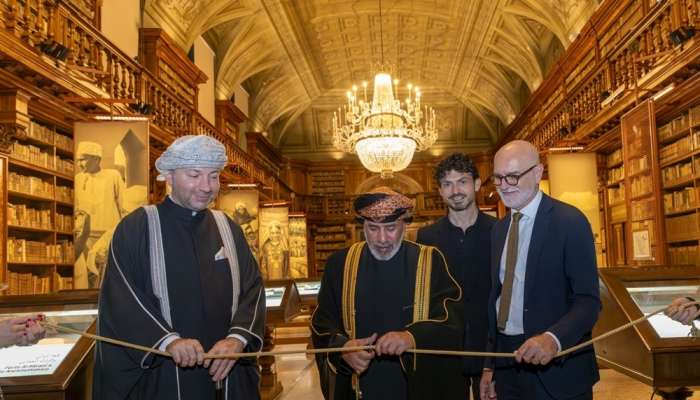
Milan, The Gulf Observer: The Sultanate of Oman’s National Museum on Thursday inaugurated its exhibition and Oman Day programme, “Oman and Italy: Two Millennia of Cross-Civilisational Dialogue,” at the prestigious Pinacoteca di Brera in Milan, highlighting nearly 2,000 years of cultural, intellectual, and commercial exchanges between Oman and Italy.
The exhibition explores the deep-rooted historical connections linking the two nations through maritime trade, scholarship, cartography, archaeology, and the arts. Organized under the National Museum’s Oman Day initiative, the event aims to promote Oman’s civilisational, historical, cultural, and scientific heritage at leading international museums and cultural institutions worldwide.
The opening ceremony was attended by Sayyid Nizar bin Al Julanda Al Said, Ambassador of the Sultanate of Oman to Italy, and Jamal bin Hassan Al Moosawi, alongside Italian officials and cultural and museum professionals.
Addressing the gathering, Al Moosawi described the exhibition as the first museum initiative by Oman in Italy and highlighted the historic role played by Italian scholars and explorers in documenting Oman’s archaeology, architecture, geography, customs, and governance.
“The exhibition focuses on archaeological heritage, travel literature, cartography, and the arts while showcasing common cultural threads that connect Oman and Italy,” he said. He pointed to shared traditions such as Oman’s Aflaj irrigation system, known in Sicily as Qanat, the ritual significance of frankincense in both Islamic and Christian religious practices, and the historical links between the two nations through Africa.
Ambassador Sayyid Nizar said the exhibition presents a carefully curated collection from Oman’s National Museum that reflects two millennia of civilisational dialogue and cultural exchange between Oman and Italy.
“The exhibition demonstrates the cultural richness of both civilizations through archaeology, travel literature, maps, and artistic works,” he said, adding that Oman’s maritime networks across the Arabian Sea, Indian Ocean, and Mediterranean, as well as the historic Frankincense Route, served as channels for intellectual and cultural interaction.
Representing the Italian side, Angelo Crespi said a strong scientific and cultural partnership has developed between the National Museum of Oman and Pinacoteca di Brera over the past two years, paving the way for the exhibition.
He noted that the initiative reflects the growing cultural cooperation between Oman and Italy and offers visitors a deeper understanding of Oman’s history, heritage, and identity as a crossroads of civilizations linking the Arabian Peninsula and the Mediterranean world.
The exhibition features a wide range of rare artefacts and manuscripts illustrating centuries of interaction between the two regions. Among the highlights are Iron Age artefacts from Oman displayed alongside Roman-era objects discovered on Omani territory, including snake-shaped vessel handles found on Masirah Island and a bronze snake figure unearthed at Saih al-Qa’a in Al Hamra.
A significant exhibit is a plaque bearing an ancient South Arabian inscription from the port city of Sumhuram, emphasizing the importance of frankincense in regional and international trade networks.
The exhibition also showcases rare manuscripts, including “A Poem on the Anatomy of the Eye” by Rashid bin Umayra ar-Rustaqi, travel accounts by Italian physician Angelo Legrenzi, and “An Nuniyah Al Kubrah” by renowned Omani navigator Ahmad bin Majid Al Saadi, which was inscribed on UNESCO’s Memory of the World Register in 2025.
Visitors can also explore Oman’s Islamic scholarly tradition through rare manuscripts, illuminated Qur’ans, and early printed editions of Islamic texts, presented alongside European translations of the Holy Qur’an, including the influential eighteenth-century edition by Ludovico Marracci.
The exhibition further highlights shared architectural and maritime heritage, including historical links between Muscat and Venice. Accounts by famed Venetian traveler Marco Polo, historic Venetian gold coins discovered in Oman, and rare sixteenth-century maps from the collection of the late Sultan Qaboos bin Said are among the notable displays.
Italian Orientalist art is represented through works by Giuseppe Signorini and Gustavo Simoni, while the exhibition concludes with a section examining historical interactions in Somalia, where Omani influence and Italian architectural development intersected.
The exhibition underscores the enduring cultural and historical bonds between Oman and Italy and reflects both countries’ commitment to strengthening cultural diplomacy and international cooperation through heritage and the arts.