Hormuz Crisis and Infrastructure Damage
Introduction
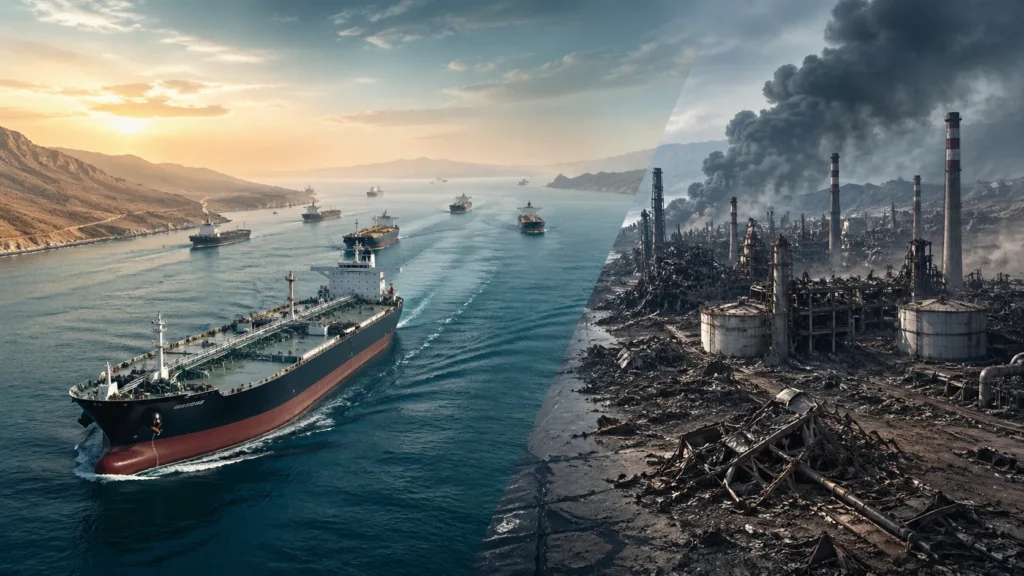
Although the Strait of Hormuz may be reopened to navigation, regional energy trade is unlikely to return rapidly to pre-conflict levels. As one of the world’s most strategic maritime chokepoints, the strait represents not merely a sea passage but a core pillar of global energy security. Recent hostilities have demonstrated that reopening the waterway alone is insufficient. The principal challenge lies in restoring damaged oil fields, refineries, LNG terminals, storage facilities, and logistical networks. Therefore, the proposition that “reopening Hormuz is easy, repairing destroyed facilities is difficult” provides a meaningful framework for understanding the current crisis.
1. Reopening the Strait Does Not Mean Immediate Market Normalization
The reduction of military tensions or the announcement of a temporary ceasefire does not imply that tanker traffic will instantly return to normal levels. During the conflict, numerous tankers were stranded inside the Gulf, while empty vessels remained outside the region awaiting safer conditions. This disrupted global tanker routes and scheduling systems.
Under normal circumstances, crude oil shipments from the Gulf to markets such as India, China, Japan, and South Korea require several weeks. Consequently, even if the strait is reopened, restoring logistical equilibrium will take time. Moreover, elevated insurance premiums, security risks, and crew concerns may delay the return of shipping companies.
Thus, the technical reopening of Hormuz should not be interpreted as an immediate restoration of global energy flows. Maritime access can be resumed faster than commercial rhythm can be rebuilt.
2. The Core Crisis: Destroyed Energy Infrastructure and Lost Production Capacity
The most severe consequences of the conflict are visible not at sea, but on land-based energy infrastructure. Damage to oil fields, refineries, power lines, pumping stations, and LNG plants directly constrains production capacity.
In particular, strategic hubs such as Ras Laffan Industrial City may generate consequences far beyond the region. LNG infrastructure depends on advanced technology, specialized equipment, and highly skilled labor. As a result, repair timelines are measured not in weeks, but often in years.
Some mature oil wells and low-pressure reservoirs may never fully recover previous output levels after prolonged shutdowns. This increases the likelihood that the war could generate not only temporary disruption but also permanent supply losses. Accordingly, reopening the strait cannot resolve the deeper structural problem of damaged production assets.
3. Reconstruction Depends on Geopolitical Stability
Repairing facilities is not solely an engineering issue; it is equally a political and security matter. As long as the threat of renewed attacks remains, international firms may hesitate to redeploy capital, engineers, and technical personnel.
Post-war recovery may also be slowed by shortages of spare parts, equipment delivery constraints, insurance complications, and rising financing costs. In countries exposed to sanctions or elevated political risk, reconstruction tends to proceed even more slowly.
Therefore, without a durable ceasefire, diplomatic accommodation, and credible security guarantees, recovery of regional energy infrastructure will remain difficult. Hormuz may reopen in a day, but investor confidence cannot be restored so quickly.
Conclusion
Recent developments demonstrate that global energy markets depend not only on maritime chokepoints but also on production infrastructure. Reduced military pressure on the Strait of Hormuz may generate short-term psychological relief. However, meaningful normalization will remain impossible unless damaged oil fields, refineries, and LNG terminals are repaired.
The key issue in the coming period is not whether the strait is open, but how quickly the Gulf energy system can be rebuilt. In short, reopening Hormuz is relatively easy; restoring destroyed facilities is far more difficult and time-consuming.