President Ilham Aliyev Delivers Keynote Speech at Baku Energy Week Launch
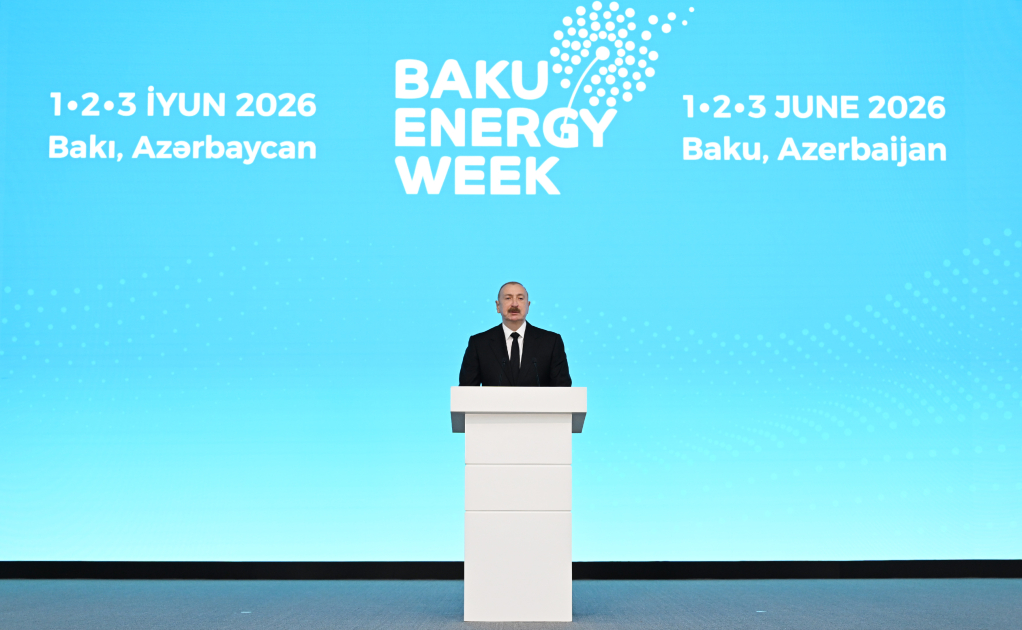
Good morning, ladies and gentlemen.
I welcome all the participants of Baku Energy Week and wish this great event success.
As was already mentioned, the Caspian Oil and Gas Exhibition laid the foundation for the energy development of modern Azerbaijan. As time passed, it transformed and became bigger, and now it is called Baku Energy Week, with numerous events and many very good ceremonies. As was correctly mentioned, the Shah Deniz contract, one of the biggest gas field contracts in the world, was signed almost exactly 30 years ago, in June 1996. And that actually opened a new chapter in Azerbaijan’s modern gas development, providing energy security for a growing number of countries. The importance of this event is also reflected in the kind letter from U.S. President Donald Trump.
This once again demonstrates that Baku Energy Week really is one of the leading events in the global energy arena. I’m very grateful to President Trump for his kind message and also very grateful to President Erdoğan of Türkiye and UK Prime Minister Starmer for their messages to the event.
President Trump deserves additional gratitude for bringing the energy trend back to normality. As we all know, for many years countries and companies involved in oil and gas production have been demonized and sometimes blackmailed, accused of ruining the planet, and without any grounds, cornered in public opinion.
President Trump changed that trend, and that was a really remarkable event because we all know that some of the big oil companies even changed their names to be in line with so-called modern trends. But the reality is absolutely different. The world cannot live without fossil fuels. We all want to have a better climate and save the planet. We all want to live in a better environment. But today we must be very pragmatic and, based on realism, plan our future with respect to energy security while also investing in renewables. I think this is the way to move forward.
So I think that what is happening now in the global energy arena was really generated by the very wise and pragmatic policy of the U.S. President. And once again, we are all very grateful to him. Countries should not be blamed for having oil and gas because oil and gas are commodities like any other. And every country uses what it has under its soil or on the seabed in order to develop. And that was the case for Azerbaijan in the beginning of our independence. Oil and gas were the only way for us to survive as an independent country. So countries should be judged not by whether they have oil or not, but by how they use the revenues, how they invest the funds they accumulate from energy development to develop their countries, provide better living conditions for their people, and invest in green agenda issues. And I think the example of Azerbaijan can be very illustrative. It can demonstrate that when you open your country to international investment and conduct a wise policy based on national interests, you achieve success.
It was mentioned by our distinguished participant and the organizer, by the way—many thanks to the organizers—that Azerbaijan’s energy development started in 1994. If we look back at 1994, we will see that Azerbaijan was in very bad shape. The country was economically totally disorganized and politically unstable. Approximately 20% of its territories were under Armenian occupation. We had 1 million refugees, and at that time this was probably one of the highest per capita rates of refugees in the world. We didn’t have any funds, and we were importing electricity. We were even importing natural gas. The poverty level was more than 50%. Unemployment was widespread. And the only way for us to survive as an independent country and move forward was to use what we had—our natural resources. Azerbaijan was the first country to open the Caspian reserves to international oil companies. Since that time, a lot has happened.
If we look at Azerbaijan today and see this transformation, how we used this wealth, how we reinvested in social infrastructure, education, healthcare, and energy development, we will see that this is how countries should develop. And this is the way forward for many other countries that today suffer from more or less the same problems that we suffered from at the beginning of the 1990s.
Today, Azerbaijan’s economic performance is very positive. Our ratings are improving year after year by the leading international rating agencies. And so far, we have already achieved an investment-grade rating. The poverty level has been reduced to 5%. Unemployment is around the same figure. We managed to significantly reduce foreign debt. We had to borrow in the beginning, but then our strategy was to stop borrowing and repay our debts so as not to be dependent on any international financial institution. Today, we have one of the lowest levels of foreign debt in the world, amounting to just over 6% of our GDP.
We have accumulated reserves in our State Oil Fund and Central Bank. So our reserves exceed our foreign debt by more than 18 times. All this happened, first, because we properly used our natural resources. We created a win-win situation for investors and for the host country. And we conducted a very pragmatic policy based on national interests, not listening to those who wanted to interfere or give us bad advice. We did everything based on our strategy. And all our tactical steps were based on that strategy. We built a strong army, which liberated territories that had been under occupation for almost 30 years. In just 44 days, we defeated Armenia completely and forced it to sign a capitulation act. And, of course, military victory is not about money, and it is not even about weapons. It’s about spirit. But let’s be honest: if we had not had the funds to build the army, we would probably still be under occupation today. So the development of Azerbaijan—whether social, economic, military, or in foreign policy—demonstrates that natural resources, when properly used, can generate many advantages.
Energy security. We all talk about that, especially now, when the crisis in the Middle East has largely damaged the energy security of many countries, producers, and consumers. We worked on that for many years. We invested heavily and initiated large-scale infrastructure projects such as the Baku-Tbilisi-Ceyhan oil pipeline, connecting the Caspian and the Mediterranean for the first time; the Baku-Supsa oil pipeline, connecting the Caspian and the Black Sea; and TANAP and TAP—the Trans-Anatolian and Trans-Adriatic gas pipelines—which, together with the South Caucasus Gas Pipeline, are part of the Southern Gas Corridor, one of the most ambitious energy infrastructure projects of our time: a 3,500-kilometer integrated pipeline system. Part of it goes across high mountains; part of it runs along the seabed. Today, it provides energy security for a growing number of countries. We initiated it, and we are grateful to our partner countries and companies that stood with us.
Today, it is difficult to imagine what the European energy market would look like without the Southern Gas Corridor. As I said, we provide gas supplies to a growing number of countries. Last year, here at Baku Energy Week, I reported to the audience that we had 12 recipient countries of Azerbaijani gas. Today, that number is 16, and 10 of them are members of the European Union. And the number will definitely grow. In terms of supplying pipeline gas to different countries and the geographical reach of those supplies, if you look at that parameter, we are number one in the world. And we will increase our gas supplies. And today, by the way, we will have a very good ceremony and the signing of several documents. In particular, I would like to highlight the Azeri-Chirag-Gunashli deep gas project, which will generate additional gas production, along with Absheron and many other projects. So our contribution to global energy security will definitely grow. The right energy policy has now allowed us to invest outside Azerbaijan. There was a time, 30 years ago, when we were attracting investors. Now we are taking our investments abroad. Today, our State Oil Company, SOCAR, is investing in the Middle East, Africa, and Central Asia. And this geography will continue to expand.
We are providing crucial transit opportunities for our friends and partners who live on the eastern shores of the Caspian. Oil from Central Asia is moving through Azerbaijan’s territory to international markets. I hope the time will come when the same will be true for natural gas.
We have created a very diversified downstream capacity. Today, SOCAR’s refining capacity exceeds 30 million tons. And through the recent acquisition of Italiana Petroli, our refining capacity in the Mediterranean increased from 13 million to 23 million tons. So we not only provide oil and gas, but also oil products. We also export electricity, petrochemicals, and renewable energy. This is one of the important areas of our focus. And as I said earlier, countries should not be judged by having oil, but by how they use the revenues and how they invest in renewables.
With our gas reserves, which will be sufficient for at least 100 years—not only for us but also for our clients—we actually do not need any other source of electricity generation. But our responsibility dictates that we invest in renewables. And we are doing that, together with our partners, creating very good conditions for investors, more or less the same as those that existed in the beginning of the 1990s for oil companies. Now, the same level of cooperation and investment-friendly approach is being applied to companies in the renewable energy sector.
We already have several projects in operation. By the end of next year, we will have 2 gigawatts of solar and wind capacity. By the end of 2032, we will have 8 gigawatts of solar and wind capacity. And if we add hydropower, which we are actively developing, especially in the liberated areas of Garabagh and East Zangezur, where more than 300 megawatts have already been commissioned, this represents additional potential. And this will be a supplement to oil and gas exports.
Today, we are working closely with our partners on energy cables. The Black Sea Energy Cable, which is now very close to completing its feasibility study, will stretch from Azerbaijan to Georgia, under the Black Sea, to Romania, Hungary, and many other countries. Another project, the onshore electric cable connecting Azerbaijan, Georgia, Türkiye, and Bulgaria, is also in the implementation phase. Recently, there was a very productive meeting of government officials from these countries.
We are also working on a green energy cable from the eastern shores of the Caspian to Azerbaijan, together with our partners in Central Asia.
So this is a vast geography, and connectivity is not only about transportation. Though in this area, we can also be proud of our achievements. By investing in railway and highway infrastructure, we are opening new transportation corridors and connecting the continents.
The East-West Corridor is functioning successfully. The Zangezur Corridor, which will be another branch of the East-West Corridor, will definitely be constructed based on the document signed at the White House on August 8 by the President of the United States, the Prime Minister of Armenia, and myself. So all this is a great asset for all of us.
And another issue I would like to underline is that we achieved all this through a high level of diplomatic activity. Because we are landlocked. We do not have access to oceans. So, for us to export our resources, we need to transit through other countries. And in order to do that, you have to have good relations with your neighbors and the neighbors of your neighbors. And we managed to do it.
Today, as I said, 16 countries receive gas from Azerbaijan through the Southern Gas Corridor and its extensions. So with all of these countries, we have had negotiations, agreements, disagreements, and signing ceremonies. This has created a very broad regional cooperation format—in the broadest sense of the word. And Azerbaijan, once again, was the driving force. It was our resources. It was our initiatives. It was mainly our investments that created this very broad cooperation format.
I am sure that, as always, Baku Energy Week will produce good results. We will see some of them in just a few minutes. But the discussions, interaction, new ideas, and, of course, result-oriented plans will also be beneficial for all of us. I thank you once again for being with us and wish Baku Energy Week every success.
Thank you.